
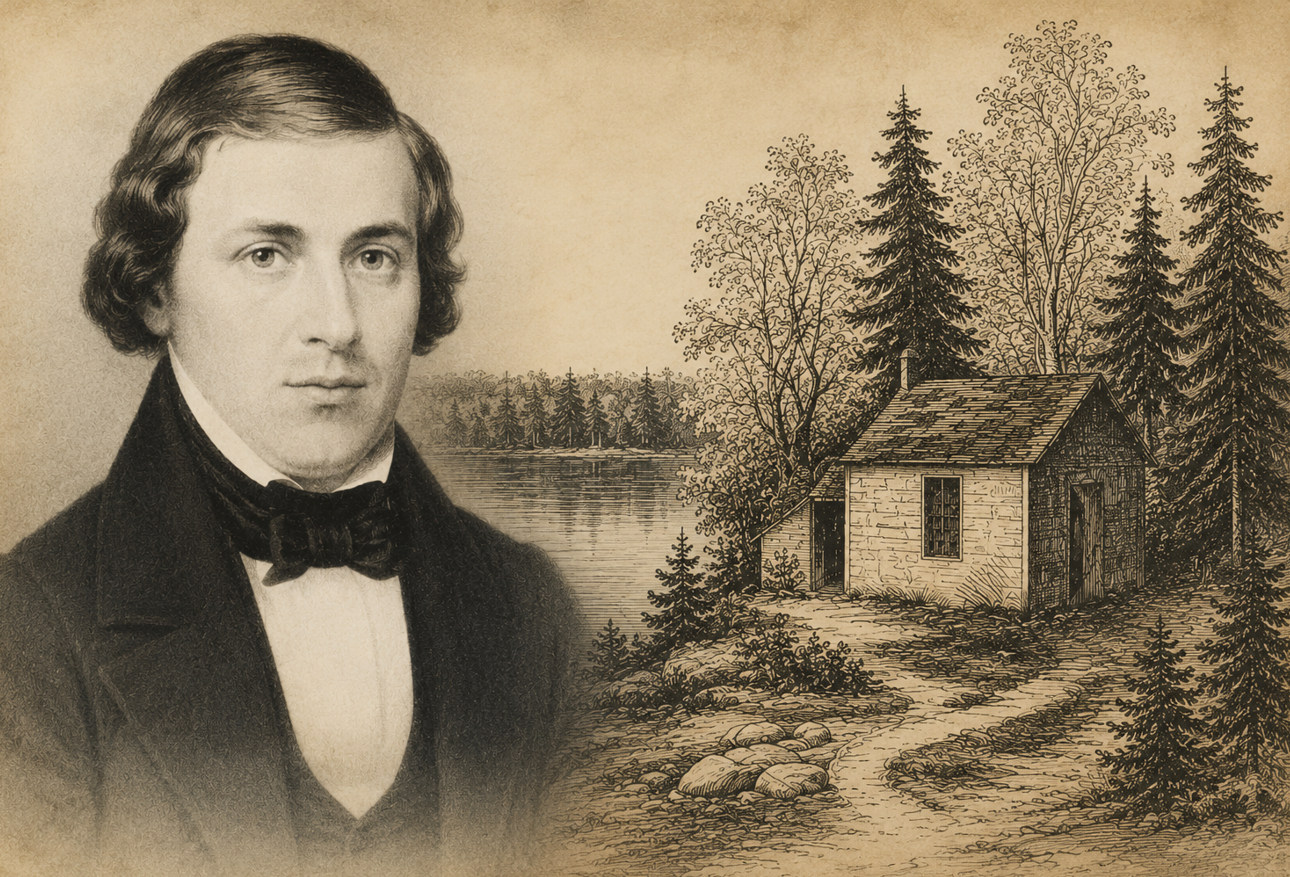
 Ralph Waldo Emerson supplied the ideas. Charles Stearns Wheeler helped put them into practice.
From 1836 to 1842, Wheeler edited Emerson’s manuscripts, prepared publications and contributed his classical scholarship to the young Transcendentalist movement. Together they helped shape Transcendentalism during its earliest years, though Wheeler’s role is often overlooked.
Transcendentalism was one of America’s first homegrown philosophical movements. Emerging in New England during the 1830s, it held that people could find truth through their own intuition rather than through established churches or social convention.
Transcendentalists believed that nature revealed the divine, that every individual possessed inherent goodness and that simple living encouraged spiritual and intellectual growth. Ralph Waldo Emerson became its leading voice, while writers such as Henry David Thoreau, Margaret Fuller and Bronson Alcott carried its ideas into American literature and culture.
Charles Stearns Wheeler
Wheeler helped Emerson with several publishing projects that influenced the Transcendentalists. His careful editing and knowledge of Greek literature made him one of Emerson’s most trusted collaborators. Emerson affectionately called him “the good Grecian,” reflecting both Wheeler’s scholarly brilliance and the trust he placed in him.

Wheeler and Emerson review a manuscript for publication
Biographer John Olin Eidson wrote that Wheeler’s commitment to Transcendentalism grew from his admiration for Emerson. That loyalty made Wheeler one of Emerson’s strongest supporters as the movement took shape.
The Transcendental Club
Wheeler attended the Transcendental Club’s first official meeting in September 1836. He took part in conversations with Emerson, George Ripley, Frederick Hedge, Alcott, Fuller and Thoreau. Those discussions shaped the movement and eventually led to the publication of The Dial, the Transcendentalists’ magazine.
Instead of formal lectures, the club favored conversation. Members challenged one another’s ideas, tested new philosophies and refined their thinking through discussion.
Living Emerson’s Ideas
In 1836, Wheeler built a shanty beside Flint’s Pond, inspired in part by Emerson’s belief that nature revealed spiritual truth. The shanty appeared the same year Emerson published Nature, making it one of the earliest attempts to live according to Transcendentalist principles.
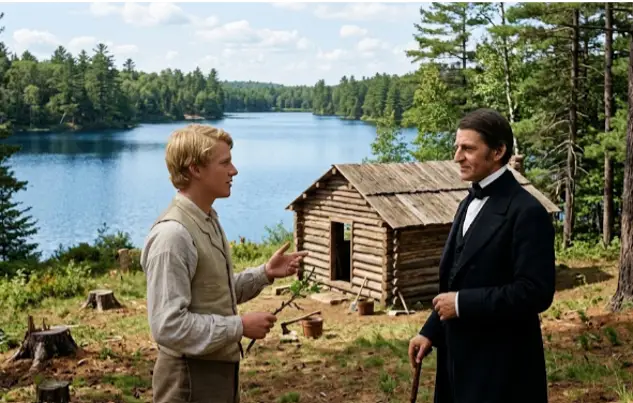
Emerson pays a visit to Wheeler at his shanty at Flint’s Pond
During his Harvard vacations from 1836 to 1842,(as a student and later as a Harvard instructor and tutor), Wheeler retreated there to live simply and study. Henry David Thoreau spent six weeks with him there in 1837. That experience helped inspire Thoreau’s decision to build his own cabin at Walden Pond years later.
Bringing Europe to New England
Wheeler also helped connect American Transcendentalists with European thought.
He wrote articles for The Dial about German philosophy and culture. After traveling to Germany, he sent Emerson letters describing new intellectual movements. That enabled Emerson to introduce those ideas to American readers.
Wheeler also promoted writers such as Thomas Carlyle and Alfred Tennyson, whose work complemented Transcendentalist ideals. He helped Emerson publish Carlyle’s Sartor Resartus, a book that deeply influenced Transcendentalism.
Scholar and Teacher
As Harvard’s Greek tutor, Wheeler gave the movement academic credibility. He had annotated the works of the ancient Greek historian Herodotus. That demonstrated that Transcendentalism rested on serious scholarship as well as bold ideas.
His knowledge of classical literature also reinforced Emerson’s belief that Transcendentalism revived timeless truths rather than inventing a new philosophy.

Wheeler discusses his plans with Thoreau during their shanty stay in 1837
Wheeler practiced the simplicity Emerson admired. He built his Flint’s Pond shanty partly to save money for expensive Greek books and, eventually, for graduate study in Germany. His life embodied the Transcendentalist ideal of plain living and high thinking.
Wheeler’s Early Death
In 1842, Wheeler traveled to Germany for advanced study while serving as an informal correspondent for the Transcendentalists. He died of gastric fever in Leipzig on June 13, 1843, at just 26 years old.
His death deprived the movement of one of its most gifted young scholars. Wheeler had supplied Emerson with books, translations and reports from German universities while serving as an editor and contributor to The Dial. Emerson mourned not only a close friend but also an indispensable collaborator.
Why Their Partnership Mattered
Emerson provided the vision. Wheeler supplied scholarship, editing and example.
He helped publish influential books, contributed to the Transcendental Club and The Dial, demonstrated the movement’s ideals through his life at Flint’s Pond and inspired Thoreau’s experiment at Walden. Together, Emerson and Wheeler helped transform Transcendentalism from a set of ideas into a way of living.

Wheeler and Thoreau likely used a canoe at Flint’s Pond during their 6-week stay
As discussed in previous New England Historical Society articles, the exact location of the Wheeler shanty site was discovered by Jeff Craig in 2018, after a five year search effort. Read about it here.
Featured image by ChatGPT. All other illustrations by Google Gemini.