
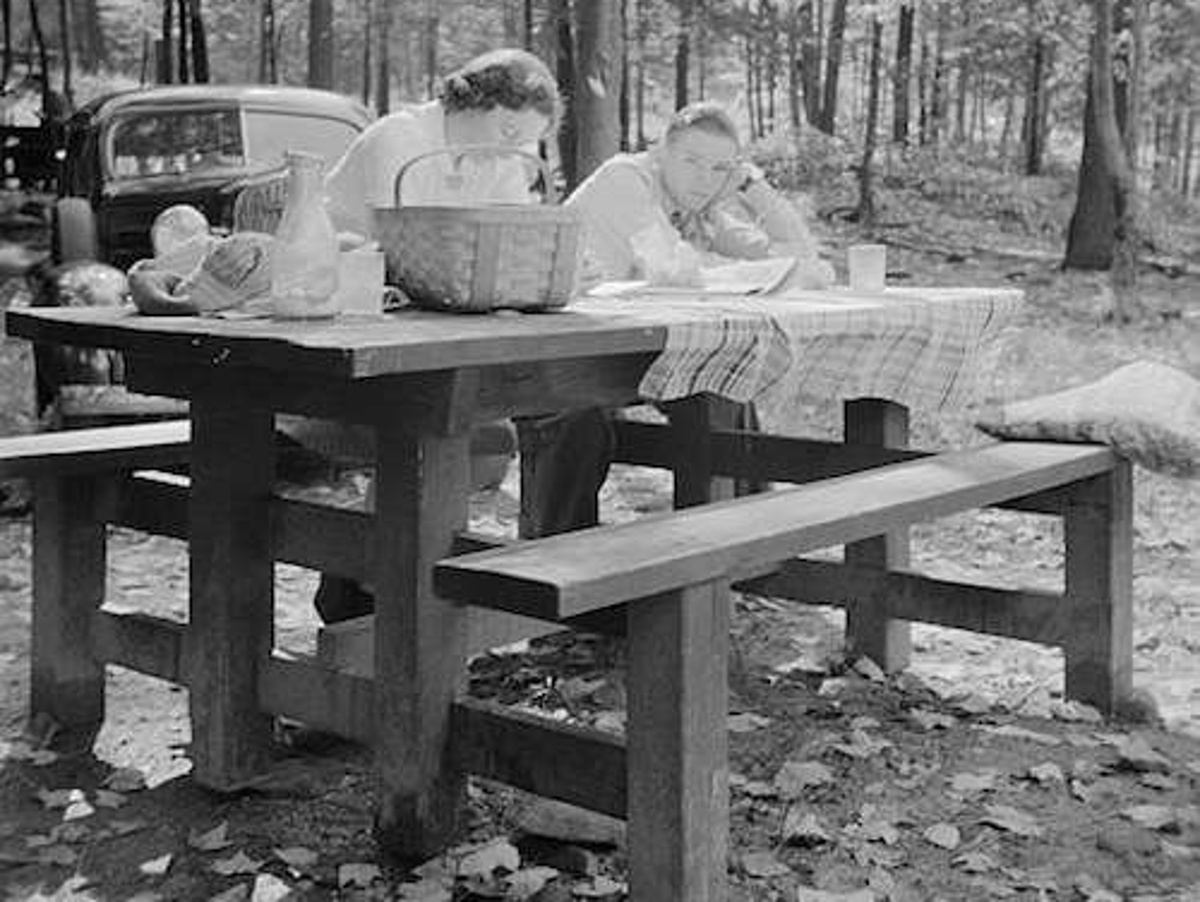
 In 1941, government photographer Jack Collier took photos of picnickers along the Mohawk Trail, once a trade route from what is now northwest Massachusetts to upstate New York.

A picnic party. Photo courtesy Library of Congress.
Early European settlers traveled the trail between Deerfield, Boston and the Dutch settlements in New York. Metacomet traveled the Mohawk Trail during King Philip’s War, and Benedict Arnold took it 100 years later to Fort Ticonderoga, where he captured the cannons. As the region industrialized, the trail was widened into a road. in October 1914, the Massachusetts Legislature designated the Mohawk Trail a scenic tourist route.
The state had improved (but not paved) the dirt road. It graded and engineered the most mountainous routes and added gravel. It was considered one of the first scenic highways designed for the automobile.
The state wanted to lure tourists to the cash-strapped farm belt in western Massachusetts. It worked. By 1915, 700 cars traveled the road in one day. By 1924, the state had paved it and 1,050 automobiles from 28 states and Canada drove the trail. So many tourists visited the area the state created the Mohawk Trail State Forest in 1921.
Collier Captures the Mohawk Trail on Film
Collier was working for the Farm Security Information/Office of War Information. The Farm Security Administration was a New Deal program that evolved into a propaganda office that produced positive images of American life and values.

Cooking. Photo courtesy Library of Congress.
Collier’s caption for this photo was “All cooking in state-owned picnic site on the Mohawk Trail was done on gas stoves.”

Refrigeration. Photo courtesy Library of Congress.
“Cooling beer in stream at state-owned picnic and camping site along the Mohawk Trail,” wrote Collier.

Schoolteachers. Photo courtesy Library of Congress.
“New England school teachers on a picnic in Savoy Mountain State Park,” reads the caption for the above photo.

Motorcyclists. Photo courtesy Library of Congress.
“Members of a motorcycle troup out to enjoy the fall coloring along the Mohawk Trail through the Berkshires.”

Another photographer. Photo courtesy Library of Congress.
“Making snapshots along the Mohawk Trail.”

Sunday picnickers. Photo courtesy Library of Congress.
“Folks from the cities camp up on Mohawk Trail on Sunday to view the fall foliage and read the Sunday paper. Mohawk Trail picnic park,” wrote Collier.
***
 New from the New England Historical Society! A Kindle Short Read, Weird New England: Hidden History, Lost Places and Unexplained Events.
This story updated in 2026.