 In 1775, George Washington’s Continental Army encircled the British army occupying Boston. The patriot siege–and thus the Revolution–neared collapse as the army desperately needed arms, gunpowder and military supplies. But the British navy controlled the waters off New England. Washington needed a solution to his dilemma. One of the men he turned to was Capt. John Manley, a Massachusetts mariner who would soon deliver one of the most valuable prizes of the Revolutionary War.
Manley, according to John Adams, suggested to Washington the idea of arming private ships to attack British vessels. Some historians credit others with the idea, but later that year Washington chose Manley to command the schooner Lee. As commander of Lee, Manley captured Nancy, a British munitions ship stuffed to the beams with supplies Washington’s army badly needed.
The haul was so important that Washington called it an “instance of divine favor.” Newspapers celebrated Manley’s achievement, a broadside proclaimed his victories and a song praised him as a hero of the sea. Washington rewarded him with command of a larger vessel and eventually made him commodore of his small fleet, arguably the first American Navy.
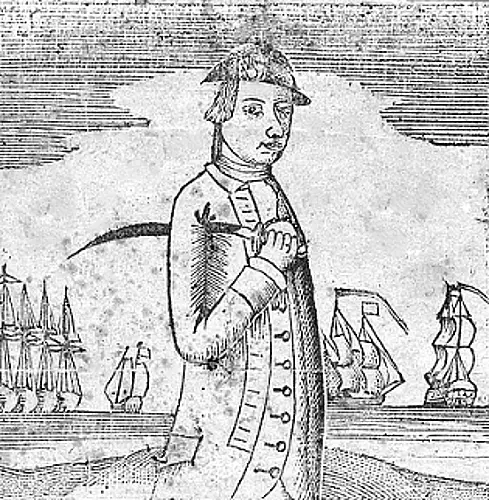
Close-up of the broadside, the only known image of Captain John Manley
Yet the man who helped supply Washington’s army and rose to lead America’s fledgling navy would eventually disappear from public memory. Manley died nearly penniless, and today, even his grave remains unmarked.
Who was John Manley, and how did a celebrated Revolutionary naval hero become one of America’s forgotten patriots?
John Manley Before the Revolution
John Manley’s naval exploits made him famous, but questions about his life before and after the Revolution have perplexed historians. Where was he born? Did he jump ship from the British Royal Navy? What brought about his downfall?
Ironically, the only hard evidence about John Manley’s birth comes from British sources. In June of 1777, Manley captured a fishing brig, Patty, and burned it. The master of the ship, Capt. Thomas Hardy, was called to account for the loss of his ship. He gave this testimony about the identity of his captor:
Q. How do you know it was Captain Manley that commanded the American privateer?
A. He told me he was born at Merrychurch near Dartmouth. I then recollected that I knew many of his family…
A search of the church records of St. Marychurch—a fishing village on the coast of Devonshire, England—confirms that John Manley was born to Robert and Elizabeth Manley in 1732, the third of four children.
But when and how did he come to America?
Did John Manley Serve in the Royal Navy?
Some historians argue that John Manley jumped ship from the Royal Navy, where he gained the skills and experience that made him a successful sea captain. But no records have surfaced to support that theory. In fact, the only suggestion of Manley’s service in the Royal Navy comes from John Paul Jones, who resented Manley and competed for position against him. In 1777, Jones wrote to a friend that Manley “had lately the honor of being a stick officer vulgarly called boatswain’s mate in an English man-of-war and was duly qualified for that high station…”
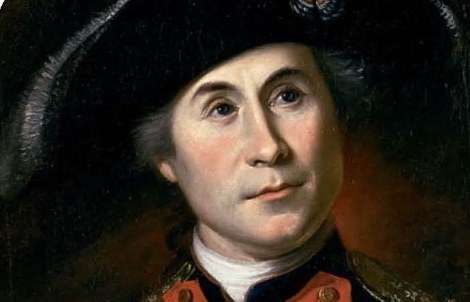
John Paul Jones
Jones may have mistakenly referred to Manley’s time aboard the British privateer Hertford during the French and Indian War. On Hertford’s first cruise in 1757, Manley somehow fell afoul of its owner, who attacked him and shackled him to the ship’s deck for a week. Allowed only bread and water, “he suffered great pain, shame and disgrace, hunger and thirst before many spectators during the whole seven days and nights,” according to the suit Manley filed later.
Despite this abuse, Manley received his share of prize money for Hertford’s captures. He may have continued the lucrative occupation of privateering through the end of the French and Indian War.
A Merchant with a Secret
The French and Indian War ended on Feb. 10, 1763. Within two weeks, Manley married Hannah Cheevers in Boston. The following year, he married again, this time in Marblehead, Mass., under the name John Russell. The second marriage has long puzzled historians, particularly because Manley continued using his own name elsewhere. The records suggest he had two wives, though the circumstances of his unusual double identity remain a subject of historical interest.
After the French and Indian War ended, Manley returned to merchant shipping. In 1766, he was hired by Fortesque Vernon, a wealthy Boston merchant and member of the Sons of Liberty. Vernon’s name appears on the Sons of Liberty Bowl made by Paul Revere, now considered one of the most important artifacts from the Revolutionary period.

Paul Revere’s Sons of Liberty Bowl at the Museum of Fine Arts, Boston
Vernon eventually sued Manley for money he believed he owed him. Manley hired John Adams, then a Boston attorney, to defend him. Adams, already with a reputation as an able trial lawyer, won the case. Manley didn’t have to pay.
Newspaper accounts and vital records confirm that Manley continued serving as a merchant captain and siring children by both of his wives through 1774. But the political crisis engulfing the colonies began to press upon him.
John Manley, Patriot Privateer
By May 1775, revolution spread throughout the colonies. John Manley enlisted in the Marblehead regiment of John Glover. The regiment consisted of fishermen and mariners comfortable on land and sea. The regiment would later play a key role in two of George Washington’s most storied military operations: the escape from Long Island across the East River and the midnight crossing of the Delaware River.
After the June 17, 1775 Battle of Bunker Hill, Glover’s regiment moved to Cambridge, where Manley met Washington, newly arrived to take command of the Continental Army. Manley suggested that Washington arm private vessels to attack British shipping. The idea offered a way to disrupt shipments of supplies to the British army while capturing desperately needed provisions for the Americans.
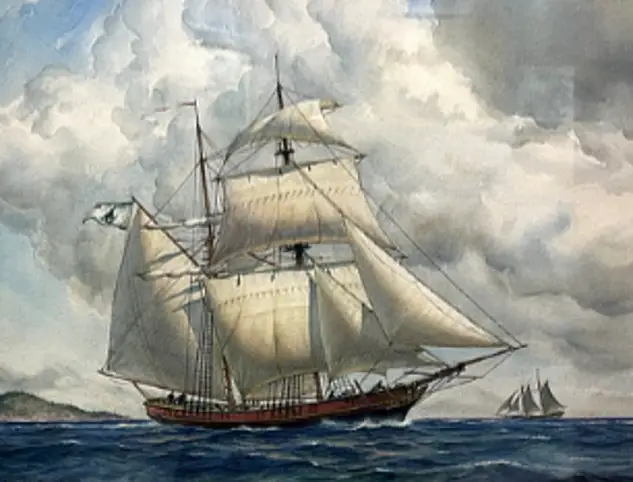
Manley’s first command, the schooner Lee.
Washington chose Manley to command the schooner Lee, part of a small fleet of armed vessels. Manley sailed from Marblehead in October 1775. His early captures included several small vessels, but his most important prize was the British brigantine Nancy.
Nancy carried an extraordinary cargo of military supplies, including arms, ammunition, artillery and a large mortar. The capture was a windfall for Washington’s poorly equipped army. Stephen Moylan, later one of Washington’s aides, wrote, “Manly is truly our hero of the sea.”
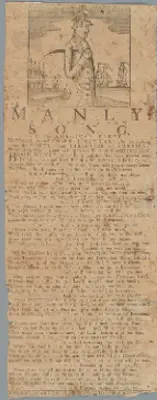
Broadside extolling the virtues of John Manley
Manley had distinguished himself where other captains in the small fleet had disappointed Washington. Washington rewarded Manley with command of a larger vessel, the schooner Hancock, and appointed him commodore of a reorganized fleet. Manley continued to capture British vessels and disrupt enemy shipping.
The Continental Congress did not formally establish the Continental Navy until Oct. 13, 1775. In December, it authorized the construction of 13 frigates, one of which was intended for Manley. Naval ranks remained unsettled until the following year, when Manley was ranked second in command. He eventually received command of the new frigate Hancock, which was not ready for sea until May 1777.
On Hancock, Manley’s luck held for a time, and he made more victories at sea. Then his fortunes turned.
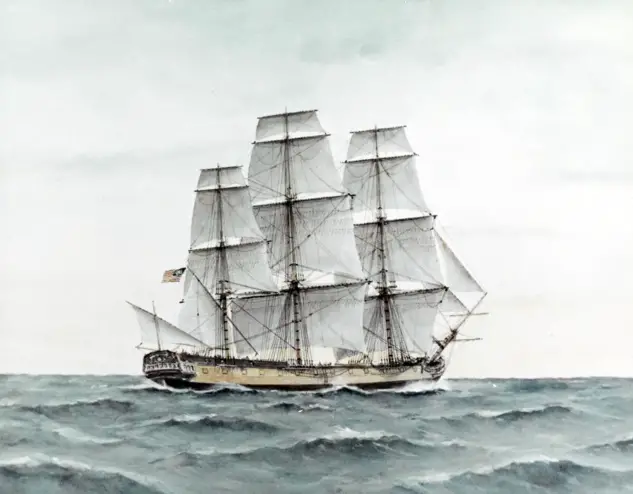
John Manley commanded the frigate Hancock.
Captured, Imprisoned and Still Fighting
In July 1777, Manley was cruising off the Grand Banks with the frigate Boston and the captured British frigate Fox. He encountered a superior British squadron. Capt. Hector McNeill of Boston, who had long been at odds with Manley, abandoned him. The British captured Hancock and took Manley prisoner.
He was sent to New York Harbor, where the notorious British prison ships took thousands of American lives. Manley was eventually exchanged and faced a court-martial over the loss of his ship. He survived the proceedings, but the Continental Navy had no ship for him. Rather than wait ashore, he returned to sea as a privateer.

Belowdecks on the Jersey prison ship in New York Harbor
Manley sailed to Barbadoes, where he took several prizes. But then the British captured him again and put him in Bridgetown prison. This time, however, he and his officers made an audacious escape. They made their way to town, commandeered a sloop and sailed to safety past British men-of-war whose crews didn’t recognize them.
Back in command of a new privateer, Jason, Manley initially enjoyed more success. But his luck ran out once again when the British captured his vessel and sent him to Mill Prison in Plymouth, England. He spent two years there, repeatedly attempting to escape. Each time, the prison authorities caught him and threw him into the black hole.
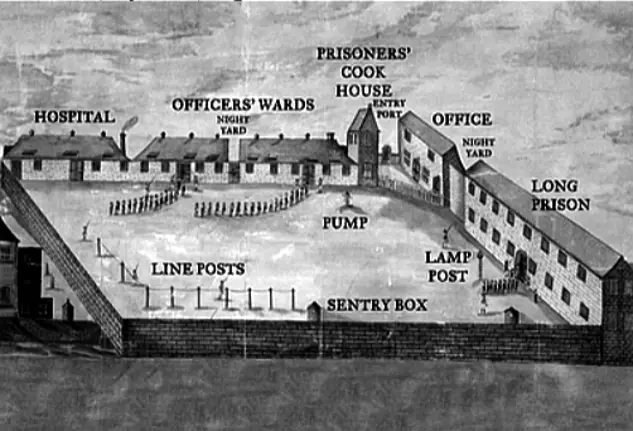
Mill Prison
Manley was finally exchanged in December 1781. The war neared its end, but he still had one more naval command ahead of him.
One Last Victory
In September 1782, Manley received one final naval command: the frigate Hague. After years of captivity and privateering, he was back in the Continental Navy, commanding one of the few frigates still in service.
In January 1783, Manley captured the British ship Baillie, which carried 1,600 barrels of provisions. It was the Continental Navy’s last major prize during the Revolution, a fitting bookend to his capture of Nancy at the beginning of the war.
But his triumph didn’t last. After returning to Boston, Manley faced another court-martial, this time on charges brought by his first lieutenant. The charges remain obscure. What may have happened was that the navy had many captains it didn’t need at the end of the war. It couldn’t afford to pay pensions, and so it looked for excuses to get rid of them.
The court found Manley guilty and stripped him of his commission. He would never again serve in the Continental Navy.
The Decline and Fall of John Manley
Manley’s naval career had ended, but he returned to merchant shipping and continued working as a captain. Newspaper shipping reports show him commanding several vessels through 1790. His finances, however, began a final downhill slide. The Continental government still owed him money for prizes captured during the Revolution, and he had received no pension for his service.
Not until 1792 did Congress award him a half-pension as an “invalid pensioner” for injuries he sustained early in the war. He would not enjoy that pension for long.
On Feb. 12, 1793, John Manley died in Boston during a nor’easter blizzard, after what his obituaries called “a brief illness.” He was essentially bankrupt. Newspapers across the country carried the news of his death, recounting his exploits and extolling his virtues. “Resolute, active and daring in the extreme, he exerted himself to the utmost extent of great naval abilities,” the Massachusetts Mercury eulogized.
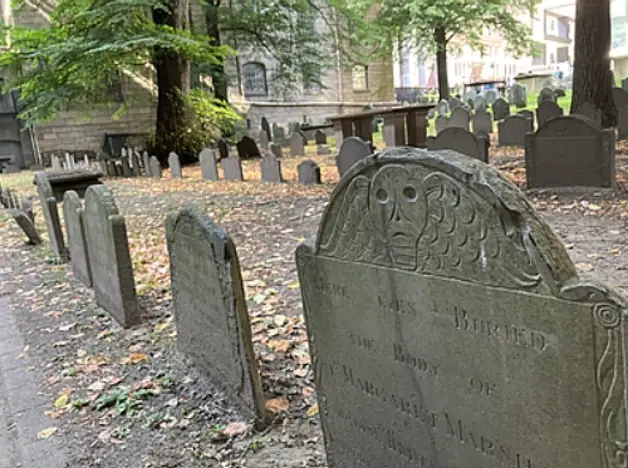
King’s Chapel Burying Ground, Boston
Manley was buried six days later with military and Masonic honors, in a week with “floods of rain,” as Abigail Adams wrote to her husband John. Despite the dismal weather, “a very numerous and respectable procession of fellow citizens attended his corpse to the grave,” the Independent Chronicle reported. Among the attendees was the supreme executive, or governor of Massachusetts, John Hancock.
The funeral procession marched from Manley’s last residence in Boston’s North End, past the Green Dragon Tavern—where Manley’s neighbors and fellow Masons had planned the Boston Tea Party. It ended at the King’s Chapel Burying Ground on Tremont Street, the oldest cemetery in Boston.
An Unmarked Grave
Today no record exists of John Manley’s precise burial location, and there is no marker for him at the Burying Ground. At the time, gravestones did not necessarily mark individual graves. Of the over 1,000 people interred there, only 618 have legible tombstones. John Manley is not among them.
Not far away from the Burying Ground is the Revere Mall, a shaded courtyard at the center of which stands a statue of Paul Revere astride his horse. To one side, a brick wall bears a plaque honoring John Manley, on the approximate site where his home once stood. This is the only memorial to the daring, courageous hero of America’s first navy, now largely lost to history.
***
Kenneth M. Sheldon is the author of Captain John Manley: Patriot, Privateer, and America’s
Forgotten First Hero, available at bookstores, online retailers and his website, kensheldon.com.
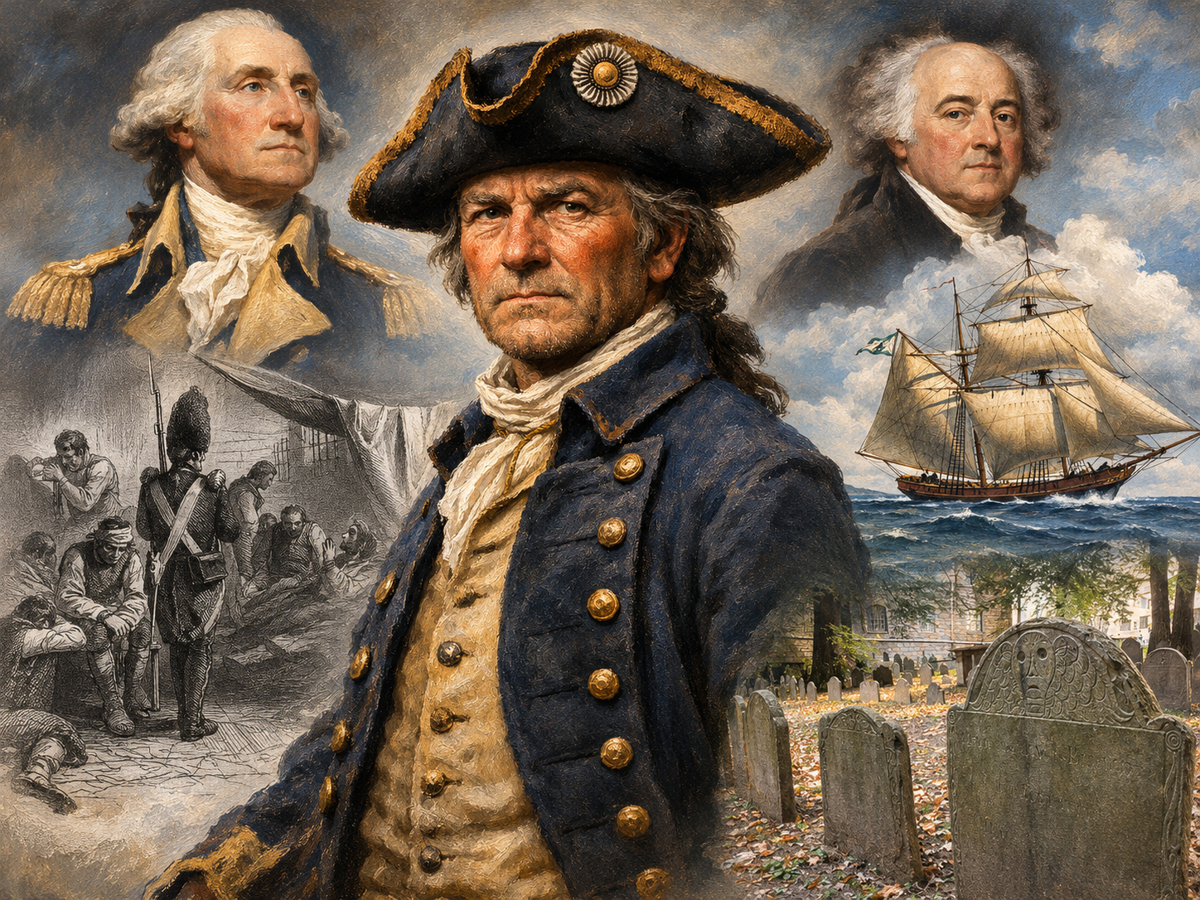
Images: Sons of Liberty Bowl By BostonHistoryGuy – Visiting the Museum of Fine Arts in BostonPreviously published: www.stevestravelguide.com and published in my own print and ebook – “Freedom Trail Boston – Ultimate Tour & History Guide” and associated mobile applications and Google Maps, CC BY-SA 3.0, https://commons.wikimedia.org/w/index.php?curid=25767890. Featured image by ChatGPT.


 Ever since a mob



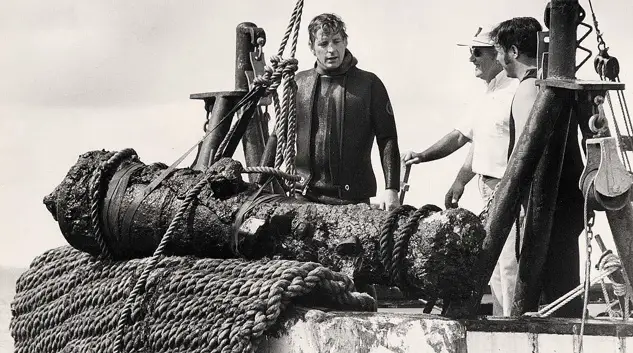
 British warships, including the frigate Orpheus, at the bottom of Narragansett Bay. For nearly 200 years, the vessels sat in the mud, completely forgotten. Then a curious University of Rhode Island student found two of the vessels. Today, you can visit artifacts from the frigate Orpheus at the Naval War College in Newport, R.I.