On the Feast of St. Sebastian, in foul weather or fair, an outdoor spectacle takes place in the streets of two places: Middletown, Conn., and Melilli, Sicily.
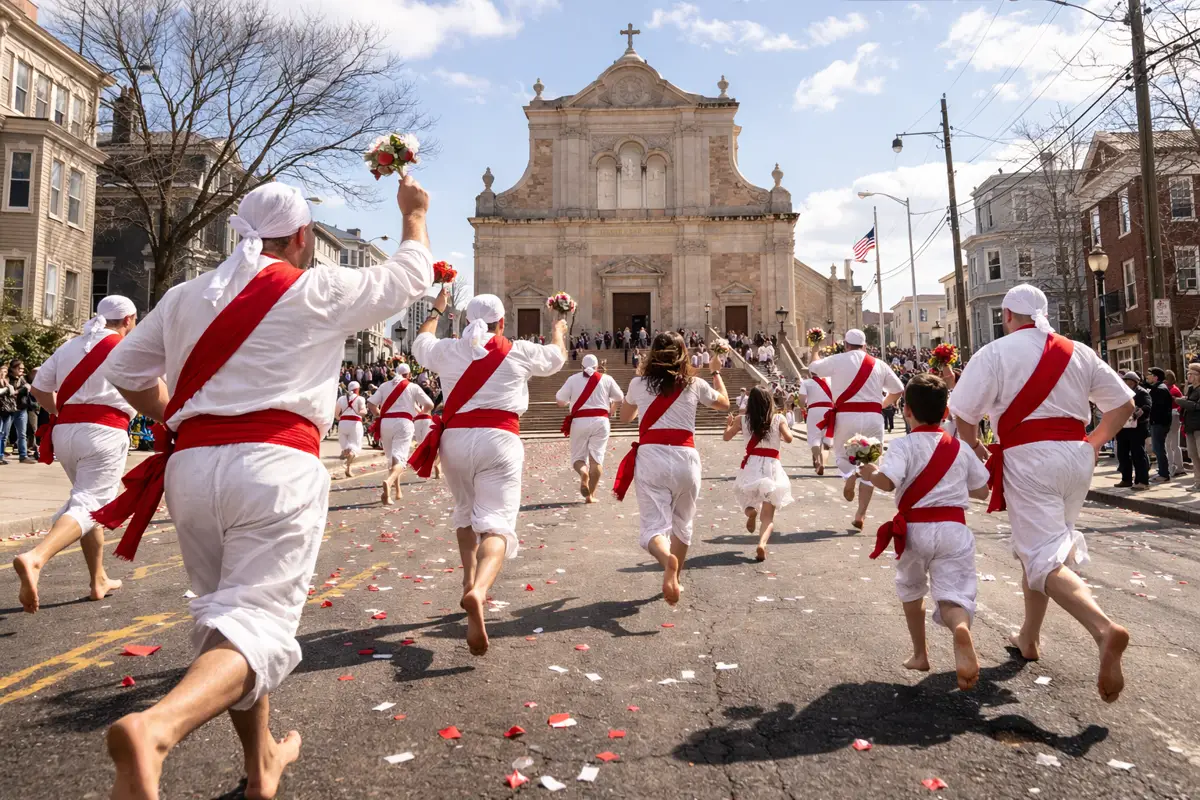
Hundreds of the I Nuri—the vowed ones— run barefoot through the streets brandishing bouquets of flowers and shouting, “E Chiamamulu Paisanu! Primu Diu E Sammastianu!” Call him, neighbors! First God and Saint Sebastian!
Men, women and children join the I Nuri throng, all wearing loose white garments and red sashes across their shoulders and around their waists. Many of the men cover their heads with white handkerchiefs. Onlookers watch as they run from St. Sebastian Cemetery toward St. Sebastian Roman Catholic Church. They time their arrival to the end of the solemn Pontifical Mass celebrated in honor of St. Sebastian, patron saint of Melilli.
The run is a sacrifice, a pilgrimage to express faith to God and St. Sebastian. But celebration follows the sacrifice. In the streets of Middletown, the Sam Vinci band plays Sicilian favorites, kids take carnival rides and vendors sell Italian sausage, struffoli, cantuccini and Vechitto’s Italian ice.
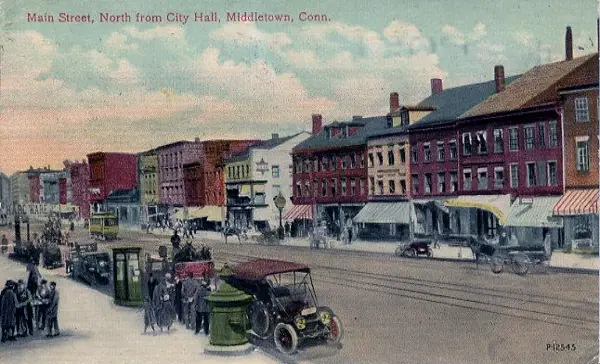
Main Street in Middletown in 1910
On the 100th anniversary of Middletown’s San Sebastian Festival, U.S. Rep. Rosa DeLauro, described what it meant. DeLauro, a first-generation Italian American from New Haven, praised the festa in the Congressional Record, calling it, “a celebration of ethnic pride and culture that has grown to become a treasured community tradition.”
It wasn’t always so. The Melillisi did not come together as a community until a failed labor strike in 1912 turned the city against them.
Melilli to Middletown
In the late 19th century, tens of thousands of Italians from the impoverished Mezzogiorno—southern Italy—came to Providence, Hartford and New Haven to work in the factories and on the railroads. Starting around 1895, another Italian colony began to form in the Connecticut River city of Middletown.
Middletown offered them work in quarries, on the railroad, paving city streets, at the Newfield brickyards, the Middletown-Portland bridge project and the Russell Manufacturing Co. None of those jobs paid much, but they paid more than what they’d get in the Mezzogiorno. High taxes, the threat of military conscription and overpopulation created desperate poverty similar to hat which drove the Irish from Ireland half a century earlier.
Middletown held another attraction: by the 1890s, about a dozen Sicilian immigrants owned stores or followed a trade—confectioners, grocers, barbers, tailors, a shoemaker, a fruit dealer and a milk dealer. They did business with the Italian laborers drifting in and out of town. They spoke English and the Sicilian dialect, and they could help new arrivals find a job and a place to live, even lend them money.
In 1895, a barber named Angelo Magnano came to Middletown from Melilli, a hill town in southeastern Sicily,
In 1897, Magnano went back to Melilli and told his friends and family about his good luck in Middletown. At first a few Melillisi followed him.
Then between 1897 and the closing of immigration in 1922 some 2,500 Melillsi came to Middletown, and four out of five stayed. Between 1900 and 1910 alone, Middletown’s Italian population rose from under 500 to over 2,000.
Strangers in a Strange Land
A newcomer from Melilli, arriving alone or with family, would typically settle first into one of the crowded tenements in the north end of town, near the railroad tracks and the Connecticut River. Often, four or five others lived in the same room, sharing a single bed. The building would have four or five such rooms, all using the same small stove and the same broken toilet. When the river overflowed, the Italian neighborhood was the first to flood.
Many took jobs as day laborers and returned to Italy during the winter. But not all. Melilli had a caste system, and it traveled with the immigrants to Middletown. Some of the Melilli bourgeoisie had run shops, owned land, followed a trade. They lived in a neighborhood next to the tenement district, and they didn’t associate socially with the laboring classes.
Until 1912, wrote scholar Peter Cunningham Baldwin, “the Italian community remained weak and divided.”
Bread and Roses
In early 1912, thousands of textile workers, mostly immigrants and many Italian, won a pay raise after a long and violent strike in Lawrence, Mass. They demanded “bread” (a living wage) and “roses,” (respect), and people still call it the “Bread and Roses Strike.” To intimidate workers during the strike, authorities charged three Italian union organizers with murder. The three men had been miles away at the time, and the frame-up enraged Italians throughout New England.

The Bread and Roses strike
Middletown had several textile companies that employed immigrant workers, including the Russell Manufacturing Co. Women and children typically worked in the mills, while the men sought more lucrative day laborer jobs.
New England’s textile mills were especially punishing workplaces. Owners pushed production relentlessly, packing workers together in rooms that shook with the clamor of power looms. They sweltered in summer, froze in winter and worked nearly 12 hours a day with no lunch break—for $3 a week.
In the aftermath of the 1912 Bread and Roses strike, immigrant workers walked out of mills and factories throughout New England. In Middletown, Italian textile workers led a large strike against the Russell company. It backfired badly, but in the end it brought the Italian community together.
The Melillisi Strike the Russell Company
The strike started quietly and ended in violence and recrimination.
First, a group of women walked off the job in one Russell company mill building because of low wages and “discourteous treatment.” The mill owners locked out the rest of the workers in that building.
A few days later, Italians at the Russell company led several large meetings of their fellow workers, including many Italians and Poles, some Germans and Yankees. They invited organizers from the International Workers of the World (“IWW” or “Wobblies”) to speak. Though the Wobblies had been branded as dangerous anarchists, the workers voted to form an IWW local and to strike.
Talk of a strike alarmed the Italian shopkeepers and tradesmen of Middletown. So, they asked the priest, the Rev. Dr. Donovan, from their church, St. John’s, to convince the workers to keep working.
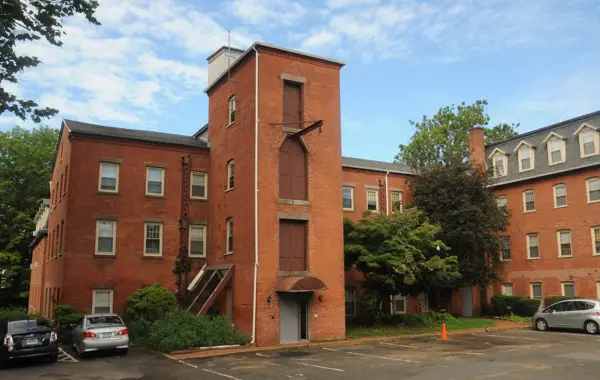
Upper Mill at the Russell Company, once the largest employer in Middletown. Now the building is condos.
The workers paid no attention. After all, the Irish parishioners had forced the Italians to sit at the back of the church. A large part of the workforce, mostly Italians, Poles and Germans, walked out.
At first, the workers marched from their headquarters to the company gates to dissuade the scabs. But then the scabs arrived in a trolley car protected by police officers and students from Middleetown’s Wesleyan University. Someone rushed the trolley, and a Wesleyan student pushed or hit a woman striker. A melee broke out.
Police started clubbing strikers. The students swung iron pipes and baseball bats at them. Some of the strikers hit back with rocks and pickets from nearby fences. The rioters stopped when spray from firehoses dampened their enthusiasm. Both sides received injuries and police arrested three Italian workers.
Non-Italian strikers gave up, went back to work and the strike collapsed within a week.
The Melillisi Come Together
In Middletown, hostility against Italians followed the failed strike. The Russell company fired all the striking workers and announced it wouldn’t hire any more Italians. Then, when it relented, the other Russell company workers threatened to strike if they had to work with Italians. Workers at other mills began to complain about working with Italians. Italians couldn’t get work, and some gave up and went home to Melilli. Others moved to nearby milltowns, forming small Melillisi communities in Lawrence and in the Connecticut towns of Ansonia and Derby.
But in the crucible of hatred toward Italians, a sense of community began to form. No longer did the town’s Italian shopkeepers and tradesmen hold themselves aloof from their countrymen who worked as day laborers and mill hands. Italian businessmen who belonged to the Columbus Club formed a committee to look into the problem.
They wrote one, then another letter to the local newspaper defending the workers. And they took on the responsibility of Americanizing their fellow Italians. Previously, the Wesleyan community had run Americanization classes, but the strike had created such enmity that had become impossible. So, in 1913, Sebastian LaBella, a barber, began teaching Americanization classes to Italians at the YMCA.
“The Italian middle class had never before taken such a protective interest in the problems of the workers,” wrote Peter Cunningham Baldwin in his thesis about Middletown’s Italian community. “As the split widened between the Italian colony and the rest of Middletown, merchants and tradesmen would begin to assume the roles of community leaders.”
Upward Mobility
World War I helped break down the class barriers that divided the Melillisi as wartime prosperity came to them. Melillisi who for generations had been peasants now found themselves in the middle class.
They began to buy real estate, and by mid-century the vast majority had bought their own homes. Before the war, workers had joined the Garibaldi Society and the middle-class joined the Sons of Italy. After the war, Italians could join either and some belonged to both.
Middletown Italians began to run for office, and then they began to win with the help of new, Americanized Italian voters. Gerardo Roccapriore, a Melilli native, won election to Middletown’s common council in 1917.
Max Corvo left Milelli at the age of 9 and arrived in Middletown in 1929. In 1941 he joined the Army, and rose quickly through the Office of Strategic Service. Corve helped plan the invasion of Sicily in World War II.
Many years later, Baldwin asked Corvo about anti-Italian discrimination. “You could say Middletown has been good to the Italians, but that’s not the real question,” he said. “The real question is — did it give them opportunities? And it did.”
A New Church, Like the One in Melilli
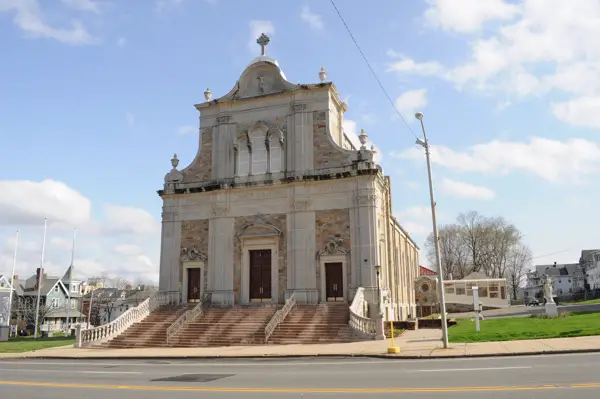
St. Sebastian Church
St. Sebastian Roman Catholic Church rises from the sidewalk above Washington Street, a jewel box of a building that evokes the Italian Renaissance. A broad curved stairway leads to the three entrances and a stone cross on a rounded gable tops it off. It looks very much like the Basilica of St. Sebastian in Melilli.
The Italian community had long wanted its own church, and on Dec. 6, 1931, Father Alvario A. Santolini celebrated the first Mass, with Father Rocco J. Guerriero appointed as the first pastor.
St. Sebastian Church has always been entwined with the Feast of St. Sebastian, which began as small neighborhood parties among the new arrivals. The feast grew as more Melillisi arrived, and in 1921 they formed a committee to run the festa. They turned the feast into a major attraction among the area’s Italians, with fireworks, music, food and an auction of gifts. At first the money raised went from the festa to the church in Melilli, but soon it went into a fund for an Italian national church they hoped to build in Middletown.
In 1927, the festa committee went to Bishop John J. Nilan to ask permission for an Italian church. He said no, as long as the Irish church had a priest who spoke Italian they didn’t need their own.
They went back to Middletown and held a mass meeting that raised $23,000 in pledges. In 1930 they returned to the bishop and told him some Italians would convert to Protestantism if they didn’t get their own church. The bishop relented.
Another Tradition Arrives From Melilli
An Italian contractor built St. Sebastian for a reduced price. Italian carpenters, stonemasons, bricklayers, laborers, mechanical and electrical workers gave two weeks of their time to work on the church for free.
The feast of St. Sebastian continued, of course. Every year, after the Mass, men would shoulder a simulacrum holding the statue of the Roman saint. His head is bowed, his hands are tied to a column behind him. Under his ribcage an arrow protrudes. Sebastian was shot with arrows for his Christian belief, and Melilli adopted him a millenium later as its patron saint
According to a Sicilian legend, In May 1414, a ship’s crew escaped a shipwreck miraculously unharmed. They believed the miracle was linked to a statue of San Sebastiano on a crate carried on the ship. The local people placed the statue on a simulacrum and began to discuss where they should take the statue. Suddenly, it grew too heavy for everyone who tried to lift it except the inhabitants of Melilli.
For years the Melillisi showed their devotion to St. Sebastian with the I Nuri Run. It begins at 3 a.m. on the Feast of St. Sebastian in the mountains called the “Sacred Cross.
In 1980, Santo Salafia, president of the Italian Society, decided to organize an I Nuri run in Middletown. A handful of people participated. Today, hundreds of white-clad I Nuri run to the church on the Feast of St. Sebastian.
As the church today points out on its website, Sebastian’s legacy as a Roman martyr resonated powerfully with the immigrant community seeking strength and protection in a new land.
* **
 New from the New England Historical Society. A collection of stories about the Irish in New England. Click here to order your copy today!
End Notes
With thanks to “Italians in Middletown, 1893-1932: The Formation of a Community,” by Peter Cunningham Baldwin.
Images:St. Sebastian Catholic Church, By Joe Mabel, CC BY-SA 3.0, https://commons.wikimedia.org/w/index.php?curid=19335412. Russell Company Factory By JERRYE & ROY KLOTZ. M.D. – Own work, CC BY-SA 4.0, https://commons.wikimedia.org/w/index.php?curid=50773940. Featured image created by ChtGPT.