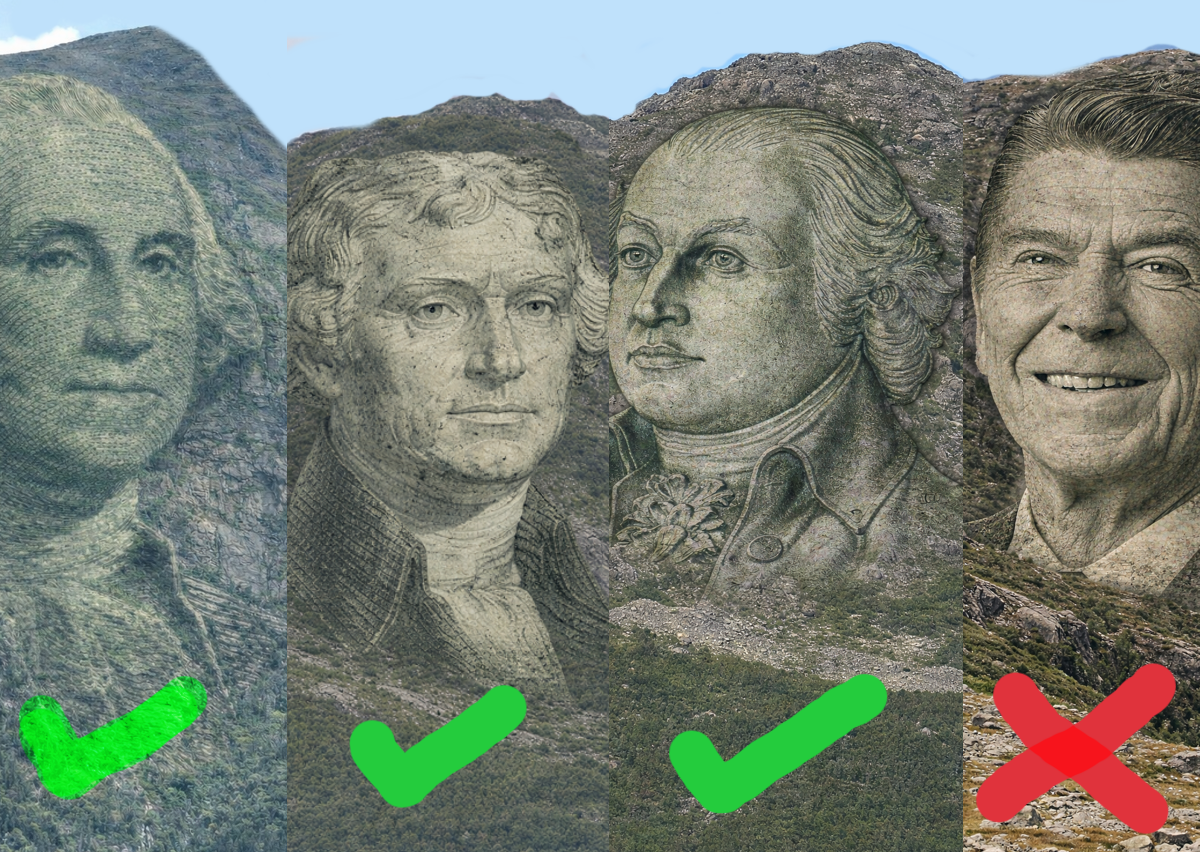
 In the 19th century, New Hampshire went into a frenzy of naming the White Mountains, from Attitash (the Indian name for blueberries) to Zealand (no one knows why). That changed in 1890, when the federal government began tightening control over the haphazard naming of geographic features—much to the displeasure of those with their own ideas about naming the Presidential Range.
Controversies over the names of New Hampshire’s tallest mountains began in the 19th century, continued into the 21st century. They may well go on into the 22nd.
The White Mountains
Though Maine and Vermont have their share of mountain peaks, the Whites are the most intensely mapped and hiked in New England. They have the highest concentration of named summits, including 48 4,000-foot peaks. Maine only has 14 4,000-footers, Vermont five.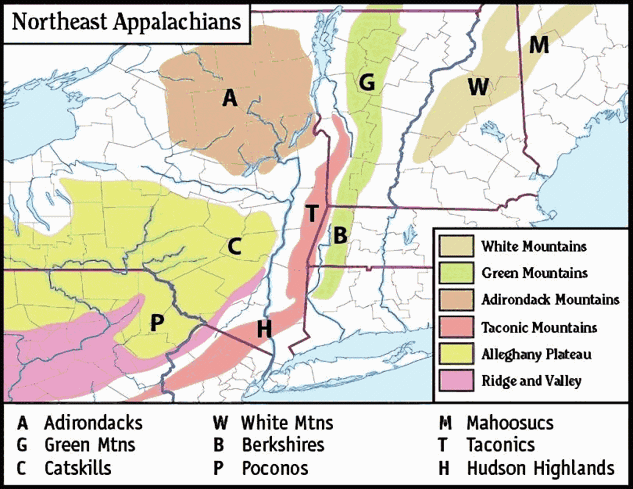
Massachusetts and Connecticut don’t have any 4,000-footers, and you can forget about Rhode Island. Its highest peak is the 812-footer, Jerimoth Hill, in Foster. (Though some joke its highest peak is the 550-foot landfill in Johnston.)
The New Hampshire Presidential Range, located mostly in northernmost Coos County, has the tallest of the tall peaks. The 13 Presidentials include eight 14,000-footers. They also boast the highest mountain in the Northeast, Mount Washington. The 6,288.2-footer got its name during the earliest days of white White Mountain exploration. In 1784, two prominent intellectuals, Jeremy Belknap and Manasseh Cutler, climbed Mount Washington. Cutler was the first to publish the name Mount Washington, in his report on the expedition. Belknap used it in 1792 in the third volume of his “History of New Hampshire.”

Mount Washington from Intervale, N.H.
Even then the naming of the mountain stirred up controversy. Thirty-two years later, Dr. Jacob Bigelow led another expedition to the mountaintop. The party left behind a note in a bottle inscribed with the Abenaki name for the mountain. “Mount Agiochook Conquered, We leave this behind,” the note said.
The name “Washington,” however, pretty much inoculates a geographic feature against a challenge. And so Mount Washington kept its name.
O-be-joyful
By 1820, the civic leaders of Lancaster, N.H., decided to have a party naming the rest of the mountains in the Presidential Range.
Tourists had begun to travel to the White Mountains by then. The Crawford family, after whom the notch is named, began it all in 1790 when they moved to the Whites and started building inns.
On July 31, 1820, the Lancaster men began their journey. They hired Ethan Allen Crawford, the son of the Crawford family patriarch, as their guide. Then they loaded their baggage on Crawford like a pack mule and added their coats as they started to climb the mountains.
When they reached the summit of Mount Washington, they began to name the surrounding mountains. They named the second highest mountain after the second president, John Adams, the third highest after Thomas Jefferson. Then they named the fifth highest peak after James Madison and the fourth highest—by 5 feet–after James Monroe, the current president.
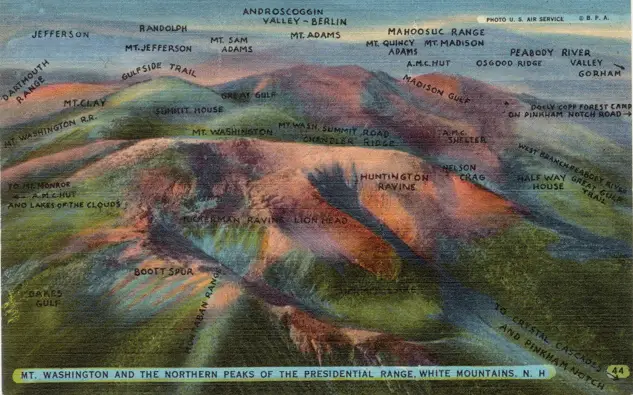
But they’d run out of presidents. So they named the sixth highest peak after someone of presidential stature–Mount Franklin, after Ben.
They still had another mountain to name, so they called it Mount Pleasant.
The Lancaster men included among their provisions an adult beverage called “o-be-joyful.” They eponymously toasted the mountains and the statesmen they’d named them after.
The Mountains in Words and Pictures
By the mid-19th century, painters and writers took to the mountains to ply their trades. In the process, they promoted tourism to the Whites.
Nathaniel Hawthorne visited, wrote a short story, “The Great Stone Face,” and got a brook and a waterfall named after himself.
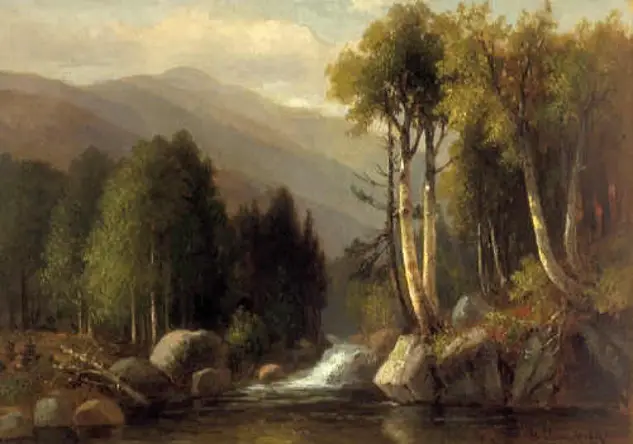
Mount Washington by Benjamin Champney
Benjamin Champney often painted the White Mountains and founded an artist colony in North Conway, N.H. He got a brook and a trail named after him on Mount Chocorua. Artists Brook and Artists Falls took their names from artists who painted their splendor. However, the falls became a favorite subject not because of their splendor but because they were easy to get to.
Throughout the mid-19th century, the Whites hosted geologists like Charles Hitchcock, cartographers like Philip Carrigain and botanists like Edward Tuckerman. They gave their own names and others to the mountains’ geographic features. One almost-president who actually climbed the White Mountains got one named after him: Daniel Webster.
More Names for the Presidential Range
Thomas Starr King in 1859 wrote a White Mountain guidebook packed with bombast. “The White Hills: Their Legends, Landscapes and Poetry,” served up such grandiloquence as “the richest feasts of loveliness and grandeur … are spread by the Summer around the valleys.”
King paid a visit to the Presidential Range, and he noticed Mount Adams had three peaks. In his book, he named the second peak after the seventh president, John Quincy Adams. The name stuck.
In 1876, MIT professor Edward Charles Pickering and entomologist Samuel Hubbard Scudder sent invitations to their academic friends to join their new organization, the Appalachian Mountain Club. The goal: to map the White Mountains, create trails and build campsites and shelters. They also established a Committee on Nomenclature to study mountain names.
AMC members got started right away by jokingly referring to the third peak on Mount Adams as “Sam Adams.” That name stuck, too.
It seemed anyone could name any of the White Mountains. If a name spread by word of mouth in nearby towns, it would stick. The U.S. government had no formal organization or protocol for naming peaks.
Naming Gets Formal, Finally
Finally, the willy-nilly naming of geographical features ended. In 1890, President Benjamin Harrison issued an executive order creating the Board on Geographic Names (USBGN) as the standard authority on all unsettled questions about geographic names.
Harrison did not get a peak named after him for his troubles. Others who did, but not in the Presidential Range, include Abraham Lincoln, James A. Garfield, Calvin Coolidge and Grover Cleveland. The Presidential Range does have a Mount Jackson—but named in 1848 after New Hampshire state geologist Charles T. Jackson, not President Andrew Jackson.
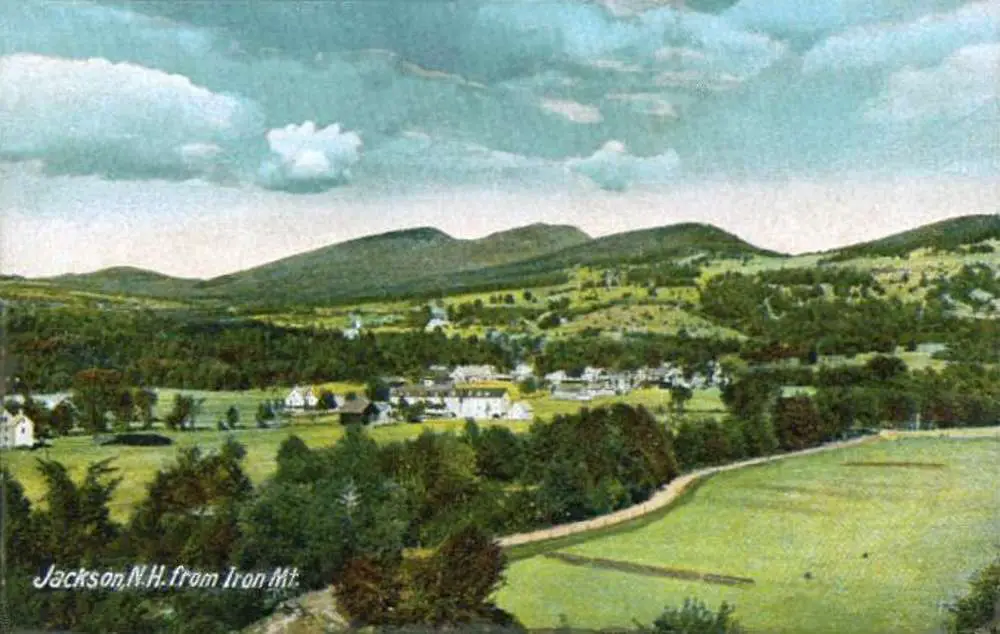
The town formerly known as Adams
But a town that lies in the shadow of the Presidential Range does bear the seventh president’s name. Adams was originally named after John Adams in 1800. But his son, John Quincy, fought two bitter battles for the presidency with Andrew Jackson. John Quincy won the first election but lost the second in 1828. The town of Adams, presumably a hotbed of Jacksonian democracy, voted in 1829 to change its name to Jackson.
More Presidents
The USBGN may have thought it had the last word on geographic names, but it has had to think again. In 1913, the New Hampshire state Legislature renamed one of the Presidential mountains. It named Mount Clinton (after New York Gov. DeWitt Clinton) after Franklin Pierce, the only U.S. president born in New Hampshire.
The USBGN went along with Mount Pierce, but the AMC did not. Perhaps because of its contempt for Pierce’s dismal presidency, the AMC continued to publish maps calling the mountain “Mount Clinton.”
In 1969, former President Dwight D. Eisenhower died. His assistant and former New Hampshire governor, Sherman Adams, lobbied for a Mount Eisenhower in the Presidential Range. The Legislature tossed out Mount Pleasant and brought in Mount Eisenhower. In 1970, the USBGN put its stamp of approval on the change.
The USBGN Giveth and Taketh Away
The Legislature then in 2003 passed a law that said Mount Clay, named after presidential candidate Henry Clay, “shall hereafter be called and known as Mount Reagan.” The USBGN refused to make the change. New Hampshire state documents continue to refer to the mountain formerly known as “Clay” as Mount Reagan.
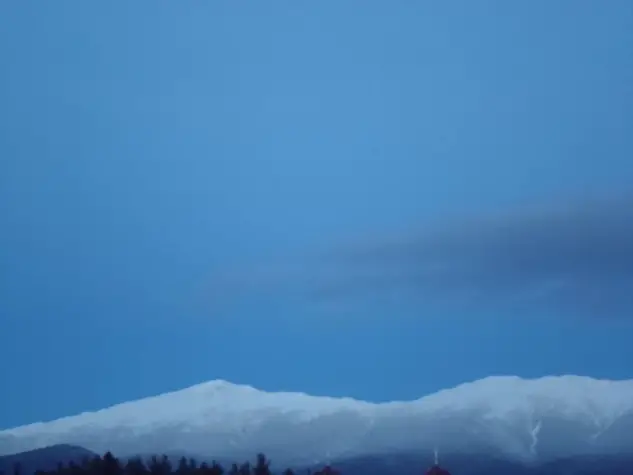
Mount Jefferson and Mount Clay
As late as 2000, two minor subpeaks of Mount Adams still didn’t have names. With one subpeak named Quincy and the other Sam, the USBGN in 2010 agreed to name one Mount Abigail Adams. The other remains Adams 5. Perhaps fans of Clover, Henry, Brooks, Mitch or the two Charles Francis Adams would like to lobby the USBGN for one of their names just to keep it in the family.
The USBGN eventually moved to the Department of the Interior, and in the ’60s and ’70s it began to eliminate the use of derogatory terms for Japanese, Black and Indigenous people.
President Donald Trump gave it a new task in his 2025 executive order, Restoring Names That Honor American Greatness.
Images: Mount Washington By Kyle Corry – Own work, CC BY-SA 4.0, https://commons.wikimedia.org/w/index.php?curid=50406610. Mount Adams By Fredlyfish4 – Own workhttps://web.archive.org/web/20161015012058/http://www.panoramio.com/photo/39614533, CC BY-SA 4.0, https://commons.wikimedia.org/w/index.php?curid=54220238.Mount Jefferson By AlexiusHoratius – Own work, CC BY-SA 3.0, https://commons.wikimedia.org/w/index.php?curid=26757996.Northeast Appalachians graphic By File:NortheastAppalachiansMap.jpg: PflyAI upscaling, conversion to gif: Hike395 – This file was derived from: NortheastAppalachiansMap.jpg:, CC BY-SA 2.5, https://commons.wikimedia.org/w/index.php?curid=139285383. Mount Clay By Fredlyfish4 – Own work, CC BY-SA 4.0, https://commons.wikimedia.org/w/index.php?curid=35487536. Featured image illustration created by ChatGPT. Mount Washington from Intervale By Harvey Barrison – originally posted to Flickr as White Mountains_12 30 09_81, CC BY-SA 2.0, https://commons.wikimedia.org/w/index.php?curid=10396490. Mount Jefferson and Mount Clay By EgorovaSvetlana – Own work, CC BY-SA 4.0, https://commons.wikimedia.org/w/index.php?curid=148392603.












 Lakota name was Ohíye S’a, but since 1873 he had been called Charles Alexander Eastman.