
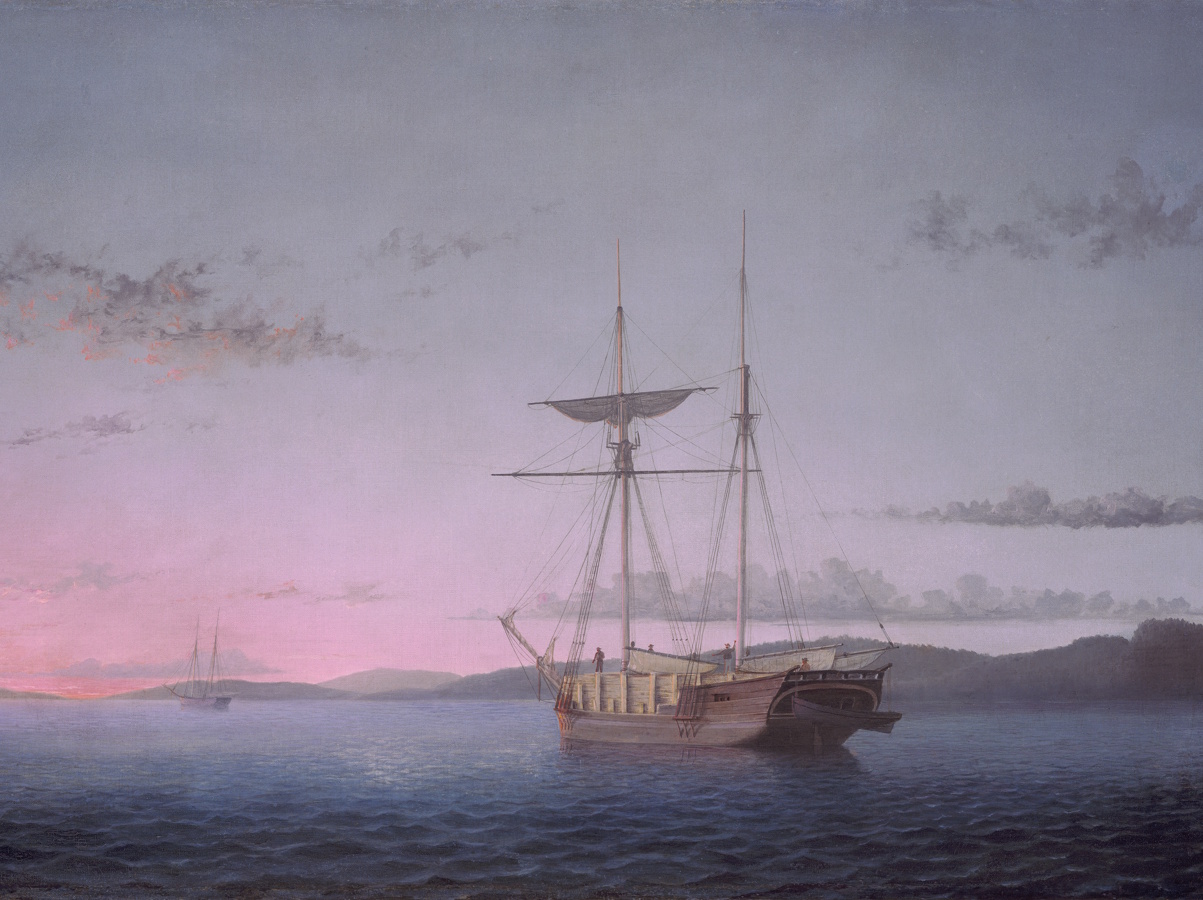
When Andrew Robinson in 1713 sailed his new boat around Gloucester, Mass., someone watching exclaimed, “There she scoons!” It’s a Scottish word meaning to skip lightly across the water, as a pebble, and it gave the name to the iconic New England sailing vessel, the schooner.
Though Robinson’s schooner may not have been the first-ever schooner, it was the first of Gloucester’s famous fishing fleet. The light, sturdy vessels that moved like scalded cats originated in New England in the early part of the 1700s. They evolved from the large ketches used by the Dutch a century or two earlier. Shipbuilders started adding topsails and making the aft mast taller — hence, the schooner.
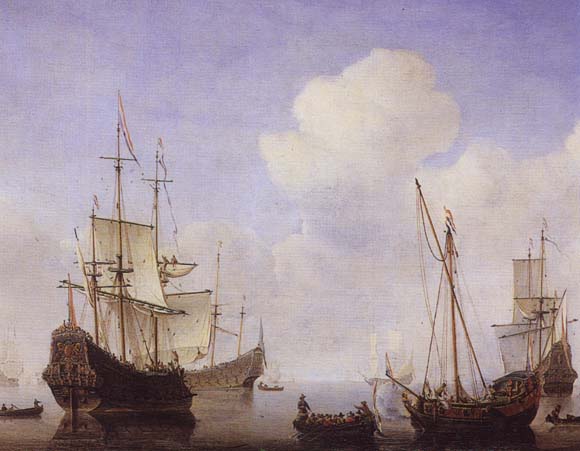
Ships, Riding Low at Anchor, byt the Dutch painter Willem van de Velde the Younger, ca. 1670s
The schooner was that rare commodity that met the criteria “fast, cheap and good.” Schooners were seaworthy, durable and relatively cheap to build. They required only a dozen or so crew and could be adapted to many uses. Offshore fishermen depended on schooners, as did West Indies traders, Civil War blockade runners, pirates of the Caribbean, lumber and coal merchants, slavers evading the law and the Continental Navy.
The Schooner as Workhorse
With their iconic silhouette — sweeping masts, graceful lines and billowing sails — schooners were masterpieces of shipbuilding. Sailors of the Age of Sail often called them ‘the most beautiful thing ever made by man,’ a testament to their marriage of form and function.
But above all, they worked. Schooners were the 18-wheelers of their age—the salt-freight carriers of global commerce. They hauled the raw materials of an industrializing world: coal from Pennsylvania, spruce and pine from Maine, guano from Peru.
Schooners carried granite for East Coast roads and bridges, coffee from Brazil, African mahogany for fine furniture. They brought molasses north for rum, ice south for tropical cocktails and even entire pre-cut houses to the West Indies.
Specialized schooners emerged like tradesmen — white-painted ‘fruit schooners’ racing bananas from the Caribbean, clipper ships moving prospectors and gold rush supplies to California, fishing schooners without bowsprits for the fishermen’s safety.
Most were made in New England. Their stories could fill volumes, but here is a taste — seven fun facts about the New England schooner.
1. The schooner Wyoming was the largest wooden ship ever built.
The Wyoming put paid to the notion that bigger is always better. She was a giant, a football field-and-a-quarter long with six masts.
Built in 1909, its massive size and wooden hull proved troublesome. But she was too long for her bones. The sea twisted her planks apart and sailors had to pump out the seawater that constantly leaked in.
The Wyoming met her tragic end in March, 1924, when she anchored off Chatham, Mass., to weather a nor’easter. The ship, loaded with coal, sank east of the Pollock Rip Lightship, and all 13 crew members lost their lives.
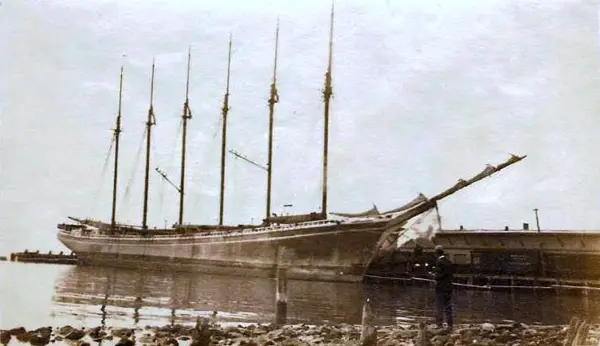
Schooner Wyoming, 1917
The wreck remained undiscovered until 2003, when the American Underwater Search and Survey Company of Cataumet, Mass., found her. The Wyoming had shattered amidship, leading investigators to believe she struck the seabed and broke apart. Out of respect for the sailors lost, the exact location of the wreck has not been publicly disclosed.
Today there is a sculpture representing the Wyoming at the Maine Maritime Museum in Bath, Maine, site of the Percy & Small shipyard where the ship was built.
2. There were a lot of them.
No one seems to have come up with a count of how many schooners plied the seas in their heyday. But some random numbers provide a sense of their ubiquity:
- Before the American Revolution, 500 schooners sailed from Connecticut to the West Indies. Most would have been built in Essex and the lower Connecticut River Valley — in Deep River, Chester, Old Saybrook, Lyme and Old Lyme. Stately old homes in those towns testifies to the wealth created by shipbuilding and trade.
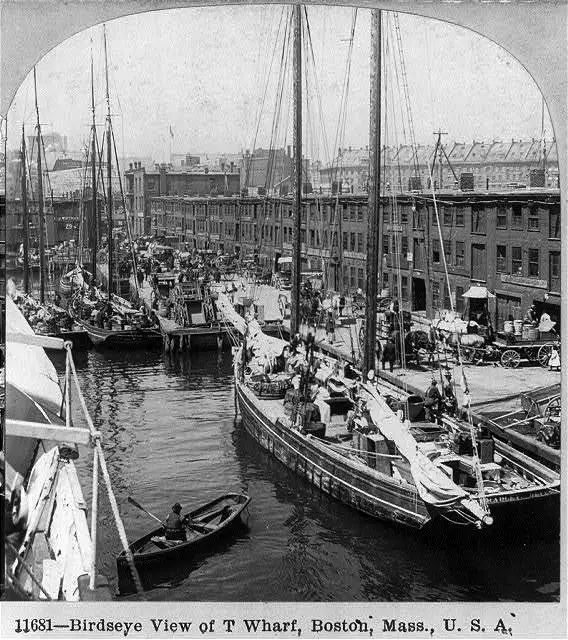
Schooners crowded on a wharf in Boston Harbor
- Between 1789 and 1936, over 4,000 schooners were registered in Connecticut Customs Districts.
- Gloucester’s fishing fleet alone had more than 400 schooners by the 1880s. As many as 500 schooners showed up in the harbor during that time. From 1830 to 1900, the golden age of the Gloucester schooner, 3,800 Gloucester fishermen and 670 schooners were lost at sea.
3. Essex, Mass., and Maine dominated New England’s schooner business.
Though shipyards produced wooden boats throughout New England, two places made most of them: Essex, Mass., and Maine.
Essex built more schooners than any other city or town – 4,000 of them. Located just west of Gloucester, its shipyards filled the fishing fleet’s insatiable need for schooners.
Up north in Maine, shipyards built more than 4,000 schooners. Of all the vessels built on the East Coast between 1870 and 1899, half of the three-masted schooners came from Maine. Maine shipyards made another 71 percent of the four-masted schooners, 95 percent of the five-masted schooners and 90 percent of the six-mast schooners.
Today, shipbuilding in Maine happens at the Bath Iron Works.
4. The most famous American schooner was the America.
America defeated 15 British yachts in a race around the Isle of Wight on Aug. 22, 1851. That started the oldest international sailing competition, named after the winner.
She was very much an upstart. Rich New York yachtsmen built her to win races. Her revolutionary design influenced yacht racing for decades.
According to Sailing World, she was low to the water and widest far forward of other racing yachts. She had at most four sails, which let a small crew execute maneuvers quickly. Her masts were raked dramatically, her sails were made of tightly woven duck and her lead ballast was molded to the shape of the hull. For racing, her crew could fit her out with a tiller, more responsive than a wheel.
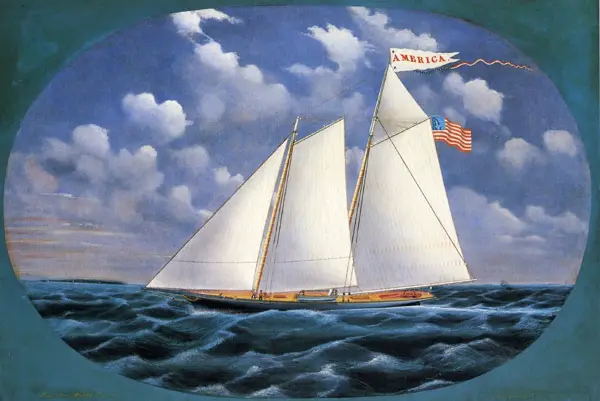
America
Her owners sold her immediately after winning the race. She changed hands several times until her owner abandoned her in a mudflat at Cowes, a seaport on the Isle of Wight. A shipwright restored her and sold her to a mystery buyer, who apparently gave it to the Confederate Navy during the Civil War. The Union captured her and used her in blockades. A controversial Massachusetts politicians named Benjamin Bulter then bought her in 1873 and restored her again. When Butler died in 1893, a group of Boston yachtsmen bought her and moved her to the U.S. Naval Academy at Annapolis.
Neglected, the once-proud America’s Cup winner ended up in the Annapolis city dump.
5. When steam eclipsed sail, schooners became windjammers.
In the 1930s, a man named Frank Swift of Bucksport, Maine, came up with an idea: Why not turn aging cargo schooners into dude schooners for tourists?
He began chartering schooners for summer sailing trips with campers. Then he chartered a small schooner called Mabel and took out ads for “Vacations under sail” in urban newspapers. By 1938 he had a fleet of three dude schooners, renamed windjammers. He sailed out of Camden, Maine, giving the town bragging rights as “the Windjammer Capital of the World.”
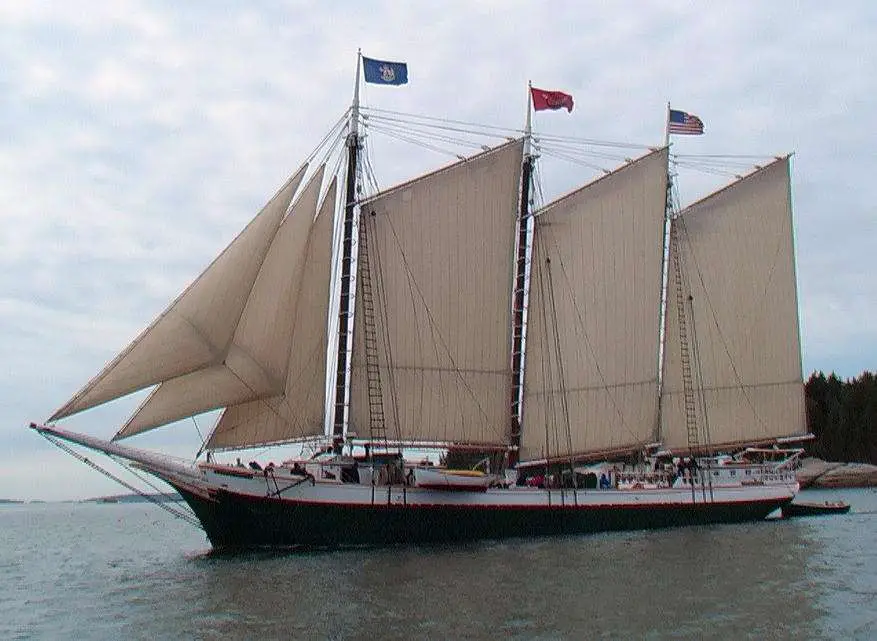
Victory Chimes
In 1954, Maine investors bought the Edwin and Maude, a schooner that had hauled cargo in the Chesapeake Bay. They renamed her Victory Chimes and repurposed her as a windjammer.
In 1984, Thomas Monaghan of Domino’s Pizza bought her and called her Domino Effect. In 1988, he refitted – and saved – her, using original techniques. She returned to Maine in 1989 and got her old name back.
Today, Victory Chimes appears as the windjammer on the back of the Maine state quarter.
6. The best schooner sailors come from Deer Isle, Maine.
Fishermen on Deer Isle today learn boathandling skills at an early age, and it isn’t unusual for a 10-year-old to have a boat. Back in the day, it was said, anyone who showed up at the New York Yacht Club and said he was from Deer Isle had a job crewing on a yacht.
Deer Isle seamen didn’t fish, though. The “Deer Isle Boys” went under sail to all parts of the world as professional mariners. Their reputation led to the New York Yacht Club recruiting crews from Deer Isle for America’s Cup races.
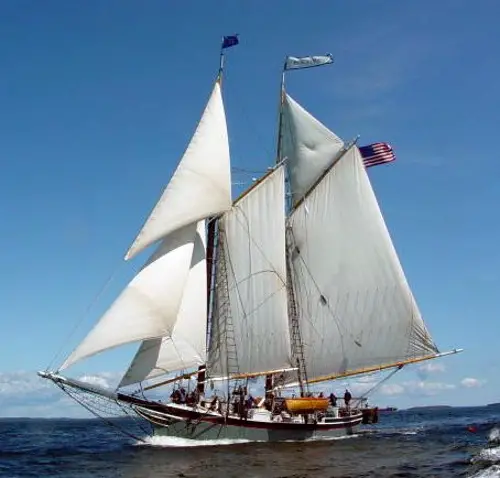
Lewis R. French
7. Many continued well into the 20th century.
Schooners hauled commodities like wood, coal, fertilizer and grain until World War II.
During the war, the U.S. Navy bought the schooner Metha Nelson from Metro-Goldwyn-Mayer, which used it for filming. The Navy had her converted and placed her into service in September 1943. Her job: to identify all ships trafficking in and out of Los Angeles.
In Gloucester, some fishermen still worked under sail power until 1960.
The Lewis R. French, launched in 1871 in Bristol Cove, Maine, hauled coal and lumber to her homeport of Vinalhaven, Maine. Then she hauled canning supplies to the sardine factories along coastal Maine – until 1972, still with no engine.
* **
 Read more about how New England's wild weather affected the course of history in New England Weather by the New England Historical Society. Click here to order your copy today.
Image of Lewis R. French: By Raphodon – Own work, CC BY-SA 3.0, https://commons.wikimedia.org/w/index.php?curid=7424995

2 comments
The America was reportedly designed after the fast pilot boats serving vessels in new york city. In that era competing pilots raced to meet incoming ships. The first pilot to arrive and scramble up the awaiting Jacobs ladder won the job to guide the vessel.
Cindy Elder’s two books are truly a captivating read for anyone who loves a nautical story of the triumphs and tragedies of brave mariners who sailed the seas and their families.
Comments are closed.