
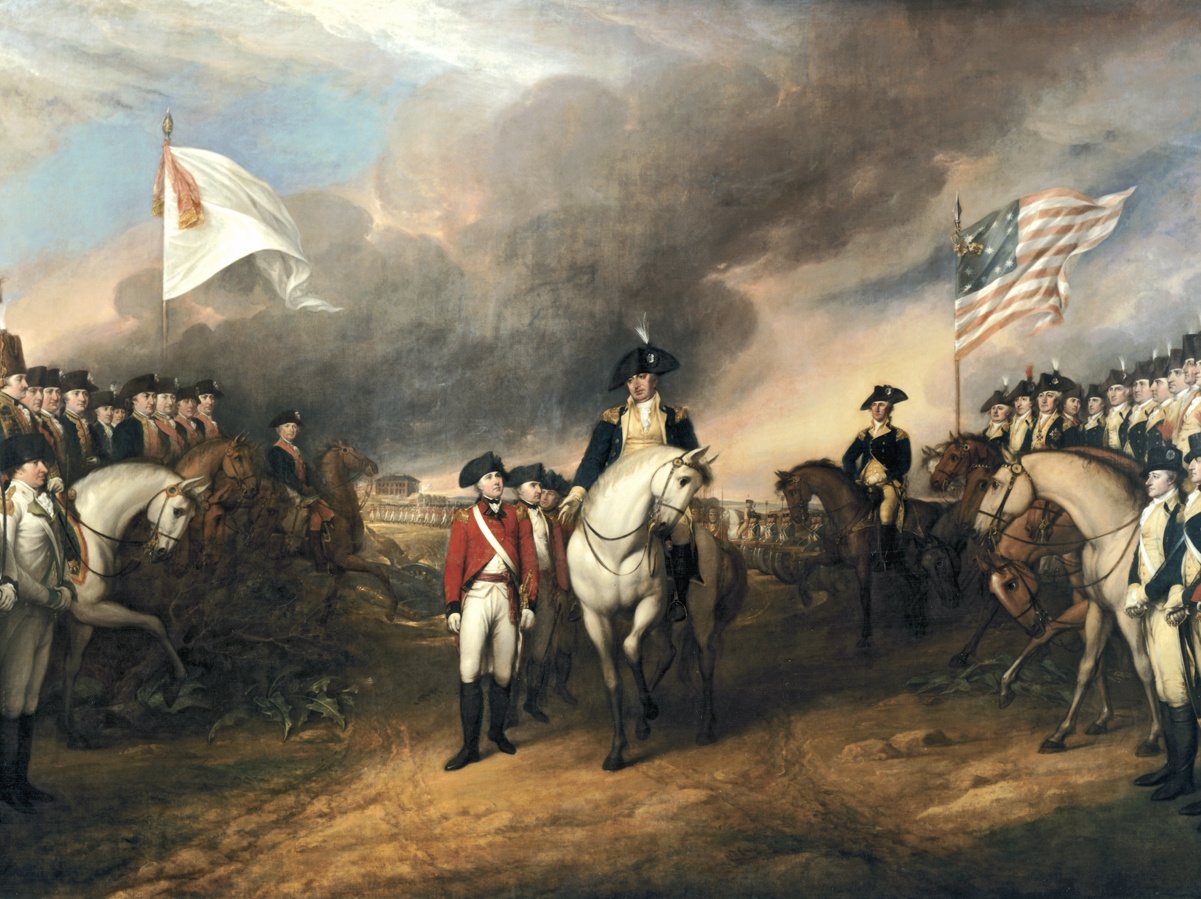
You’ve seen the American Revolution unfold on screen in Ken Burns’s The American Revolution—through paintings, documents, narration, reenactments and footage of the landscapes where history happened. What Burns did on PBS, you can do for yourself on foot.
Across New England, the places where ordinary people and famous leaders pushed the colonies toward rebellion still stand—often right beside modern life.
Ken Burns’ The American Revolution Episode I
The series opens before war, in a world of mounting tension.
Benjamin Franklin’s 1754 “Join, or Die” cartoon foreshadowed the need for unity. Though Franklin left Boston at 17, a bust still marks his birthplace on Milk Street.
John and Abigail Adams, whose words frame Ken Burns’s narrative, lived with the fear that Revolution could unleash chaos as easily as liberty. Adams National Historical Park in Quincy preserves their story in three buildings where the Adams family lived and worked for generations.
The trouble started with the British victory in the French and Indian War, which brought crushing debt—and new taxes. Then Parliament passed the Stamp Act of 1765, which taxed printed paper. It enraged printers and readers alike because they didn’t want to be taxed without representation. On Boston’s Freedom Trail, you can now visit the Printing Office of Edes and Gill, publishers of revolutionary newspapers. You can also see their presses at the Museum of Printing in Haverhill Mass.

Peacefield, a house Abigail Adams bought while John was away in Europe. Ken Burns quotes extensively from both Adams in his documentary.
Samuel Adams, a brilliant propagandist, rallied resistance. His likeness hangs today at the Museum of Fine Arts, Boston.
Stamp Act riots followed across the colonies, including Newport, R.I., where protests at The Old Colony House forced stamp distributors to resign. The Newport Historical Society now runs the little-changed Old Colony House as a museum.
The Townshend Duties
Parliament repealed the Stamp Act, but tensions escalated when it passed the Townshend Duties. In order to police unruly Boston, British troops arrived in the town in 1768, landing at Long Wharf, which still exists. Nearby stands the Gardiner Building, once John Hancock’s counting house and now the Chart House restaurant serving seafood and steak. (Hancock’s beanpot hangs from the ceiling.)
On March 5, 1770, a confrontation outside the Old State House ended with British soldiers firing into a crowd—the Boston Massacre. A pavement marker shows where it happened; the victims lie buried in the Granary Burying Ground. Paul Revere’s famous engraving ensured the event would never be forgotten. You can visit his house, in Boston’s North End, year-round.
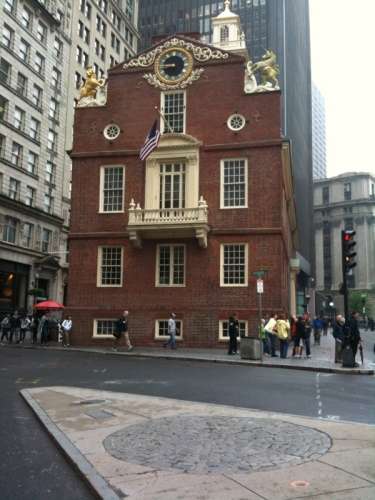
The Old Statehouse, another spot on Boston’s Freedom Trail mentioned in Ken Burns’ documentary..
Resistance then spread outward. In New Hampshire, the Pine Tree Riot erupted in 1772; a marker in Weare commemorates it. In Rhode Island, colonists burned the grounded customs ship Gaspee, an act still celebrated each summer during Gaspee Days.
The Tea Party
The crisis peaked in Boston. At the Old South Meeting House, citizens debated what to do with taxed tea. On Dec, 16, 1773, they dumped it into the harbor. Today, you can visit Old South, Griffin’s Wharf and the Boston Tea Party Ships & Museum to see where it all happened.
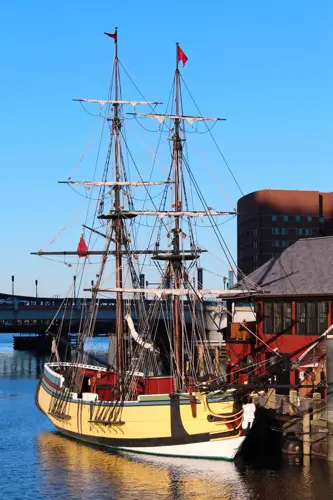
Boston Tea Party Ship & Museum, Boston, Massachusetts, United States
Parliament’s response—the Intolerable Acts—closed Boston’s port, revoked Massachusetts’ charter and replaced elected officials with those appointed by the Crown. Protesters forced all the King’s men to resign. Local historical societies reenact the protests that shut down local government at the original courthouses in Barnstable, Mass., and Westminster, Vt.
Sympathy poured in from other colonies; church bells rang in Lebanon, Conn., whose Green remains rich with Revolutionary history.
By 1774, armed resistance had become organized. Militia companies created special units that drilled as minutemen. When Gen. Thomas Gage sent troops to seize gunpowder in Charlestown, Mass., alarm bells rang across the countryside. The powder house still stands in the middle of a rotary in what is now Powder House Square in Somerville.
The violence escalated. A boy rammed his sled by mistake into a minor customs official, John Malcolm. George Hewes, a veteran of the Boston tea party remonstrated with Malcolm, who beat him senseless. Malcolm was tarred and feathered. Hewes’ portrait hangs in the Old Statehouse, now a museum.

George Robert Twelves Hewes
Patriots formed committees of safety and prepared for war. In 1774, 12 colonies sent delegates to the Continental Congress in Philadelphia. John Adams commented that every delegate was a “great man” who must on every question show his oratory, his criticism, and his political abilities. Gage told King George they were a motley crew. You can see John Singleton Copley’s painting of Thomas Gage at the Yale Center for British Art.
A Crackdown Backfires
Gage received orders to crack down on the colonists. John Hancock and Sam Adams left Boston for their safety, staying at a friend’s house in Lexington, on the way to Concord. The Lexington Historical Society operates the Hancock Clarke House as a museum.
Early one morning in April 1775, British troops stealthily marched out of Boston toward Concord. Patriot Joseph Warren got wind of their plan and told Paul Revere. Portraits of both Revere and Warren hang at the Museum of Fine Arts Boston.
Two lanterns were ordered hung from Old North to warn people the British would row across the Charles River. You can visit Old North, and you can also visit the grave of the sexton who hung the lanterns. Robert Newman, in Boston.
Paul Revere and William Dawes rode to Lexington to alert Hancock and Adams and the local militia. Markers along the route commemorate their historic rides. Dawes and Revere are both buried in Boston.
A Shot Heard ‘Round the World
Lexington’s militia assembled on the Green to face the British. A shot rang out, and the firing began, mostly by the British. Lexington has preserved its historic Green, which has monuments, markers and a visitors center. Every Patriots Day in Massachusetts, living history units reenact the battle.
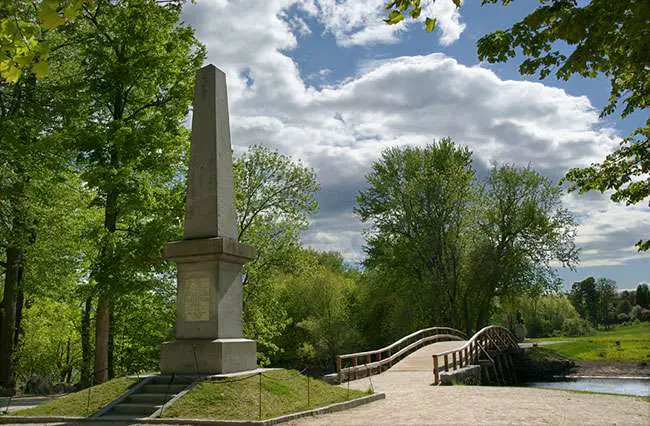
Old North Bridge
The British marched on to Concord and began ransacking the town. The American militia skirmished with them at the Old North Bridge. A replica of the Old North Bridge is part of the 1,038-acre Minute Man National Historic Park.
The British then retreated along the Battle Road as colonial militiamen fired at them from behind trees and fences. The British suffered heavy casualties as they marched through Menotomy (now Arlington). Now on Patriots Day, reenactors perform tactical demonstrations of the shooting, accompanied with lectures, workshops and living history events.
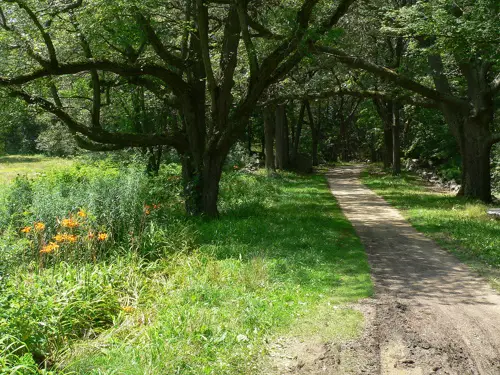
The Battle Road looks much as it did in 1775.
Part II of the Ken Burns Documentary Series
After Lexington and Concord, New England became the war’s engine.
By nightfall on April 19, 1775,, thousands of militiamen had surrounded Boston, beginning the Siege of Boston.
Over the next 11 months, British troops trashed the town, turning Faneuil Hall into a theater and Old South into a riding ring.
A month after Lexington and Concord, Ethan Allen and Benedict Arnold captured Fort Ticonderoga. A few days later, Seth Warner subsequently took Fort Crown Point, also in northern New York. By seizing the lightly defended forst, they secured the artillery that Henry Knox would later haul to Boston. The Knox Cannon Trail marks his legendary winter journey, and Fort Ticonderoga, now a museum, offers a robust program of living history events.

Fort Ticonderoga today.
On June 17, 1775, the bloody fight at Bunker Hill proved the colonists could stand against British regulars. A 221-foot-tall granite monument and a museum commemorate the battle on Breeds Hill, where the fight took place.
As the Siege of Boston dragged on, George Washington arrived in Cambridge in July 1775 to take command of the Continental Army. His headquarters, later home to Henry Wadsworth Longfellow, is now a National Park Service site.

Washington’s Headquarters during the Siege of Boston
The war widened quickly. Benedict Arnold led a brutal expedition through Maine toward Quebec, hoping to capture the British fortress there. You can retrace his route today by driving along the Arnold Expedition Route. (Look for markers.)
Meanwhile the British vowed to lay waste to the ports that provided safe harbor for American privateers wreaking havoc on British shipping. Lt. Henry Mowatt began by bombarding Falmouth (now Portland) in Maine. He burned the entire town in October. A plaque marks Fort Allen, earthworks at the time of British bombardment of Falmouth.
1776
On New Year’s Day, 1776, George Washington ordered a new “Continental Union” flag raised atop Prospect Hill overlooking Boston. A tower marks the spot today in what is now Somerville, Mass. Every New Year’s Day, the City of Somerville reenacts the raising of the first flag of the United States.
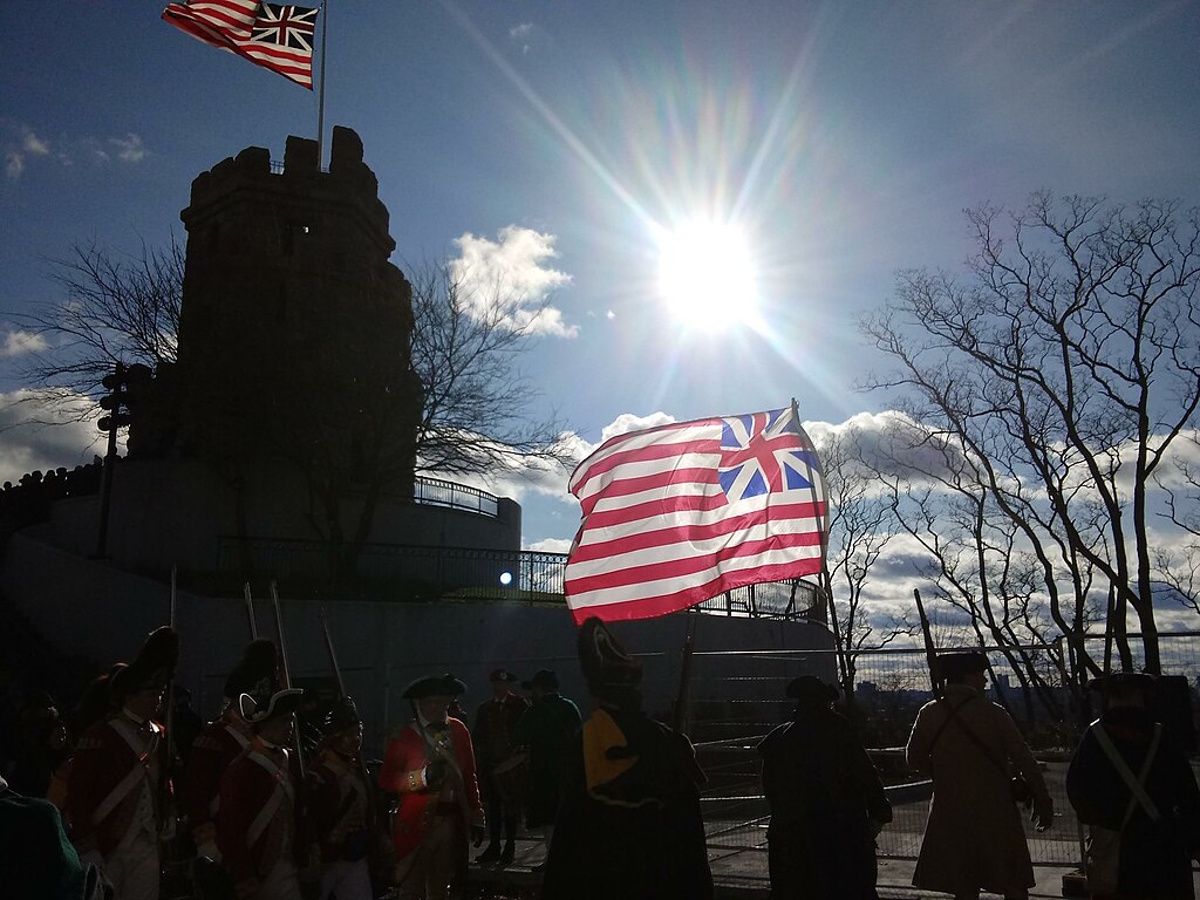
The first American flag flying over Prospect Hill in Somerville, Mass.
On March 17, 1776, British commander William Howe evacuated Boston for Halifax, taking 10,000 soldiers and more than 1,100 Loyalist civilians. Washington had driven them out by mounting the artillery from Ticonderoga on Dorchester Heights. Dorchester Heights is now a National Historic Site and public park.
Expecting the British to strike New York next, Washington moved his army south.
Far to the north, Benedict Arnold’s assault on Quebec collapsed as smallpox ravaged his troops, forcing a retreat to Crown Point. Britain escalated by hiring thousands of German mercenaries. New Hampshire delegate Josiah Bartlett, commemorated on the Kingston town green, warned the war would grow harder.
To secure French aid, the colonies declared independence. Thomas Jefferson drafted the Declaration; Rhode Island’s Stephen Hopkins, signing despite palsy, declared, “My hand trembles, but my heart does not.” You can visit Stephen Hopkins’ home in Providence, R.I., now a historic house museum.
In Boston, the Declaration was read aloud and the king’s arms torn down at the Old State House. It’s now a museum on the Freedom Trail.
Episode III of Ken Burns’ The American Revolution
By June 29, 1776, the British landed 10,000 troops in New York. The war had become both a fight for independence and a civil war. Patriots imprisoned Loyalists in places like Newgate Prison in Simsbury, Conn. You can visit the prison, an old copper mine, now run by the State of Connecticut as an archaeological preserve.
Washington spread his forces thin; Nathanael Greene fortified Brooklyn but fell ill. Israel Putnam, a brave but not very bright general, replaced him and left a key road unguarded. Connecticut Landmarks owns and operates the Putnam Farm in Brooklyn, Conn.
The British routed the Americans at the Battle of Long Island, capturing Gen. John Sullivan. A plaque and memorial in Sullivan’s hometown of Durham, N.H., honor his service.

Fort Sewall today
Trapped on Brooklyn Heights, Washington narrowly saved his army when John Glover’s Marblehead mariners miraculously ferried 9,000 men across the East River under cover of darkness. Glover’s Regiment still exists as a living history unit. Every Fourth of July, they fire off cannon at Fort Sewall, where they garrisoned for a time, in Marblehead, Mass.
Manhattan soon fell, Loyalists flooded the city, and on Sept. 21, 1776, New York burned. The British hanged captured spy Nathan Hale. Hale’s homestead, now a house museum. stands in Coventry, Conn.
The Northern Theater
Meanwhile, the Americans feared a British invasion from Canada, while disease weakened their forces at Ticonderoga and Crown Point.
You can visit the site of Fort Crown Point, which features the ruins of the stone barracks and stunning views of Lake Champlain.
The soldiers from different colonies fought among themselves, so the New Englanders were sent to the opposite shore to build Mount Independence. Mount Independence State Historic Site, opposite Ticonderoga, stands as one of America’s largest and most preserved Revolutionary sites. A museum showcases exhibits and artifacts.
On Lake Champlain, Arnold hastily built a small fleet and fought the British at Valcour Island in October 1776. Though defeated, the battle convinced the British it would be harder to capture Fort Ticonderoga than they had thought, and it started to snow. They decided to invade in the spring.
The Lake Champlain Maritime Museum in Vergennes, Vt., has artifacts and a replica gunboat from the Battle of Valcour Island.
Episode IV of The American Revolution
The fourth episode begins with a quote from Mercy Otis Warren: “No suffering which Britain can inflict will reduce America to submission.”
Mercy Otis Warren lived in Barnstable, Mass., on Cape Cod. Drive by the Barnstable County Courthouse and you’ll see a bronze statue of her.
The Continental Army abandoned Manhattan. As Washington retreated across New Jersey, British and Hessian troops occupied Newport, R.I. You can visit several sites in Newport to learn about the British occupation of the town.

Mercy Otis Warren is quoted often in Ken Burns documentary on the American Revolution. A bronze statue of her stands in front of Barnstable County Courthouse.
Washington struck back at Trenton on Christmas night, crossing the Delaware with Glover’s regiment and artillery under Henry Knox. The Hessians surrendered, reviving American morale.
Learn more about Henry Knox at Montpelier, a museum/replica of his home in Thomaston, Maine, and John Glover at his house in Marblehead, now a museum that offers guided tours.
Cornwallis chased Washington across New Jersey, only to lose the Battle of Princeton on Jan. 3, 1777.
John Trumbull, an aide-de-camp to Washington, later painted a scene from the Battle of Princeton. You can see it at the Yale University Art Gallery.
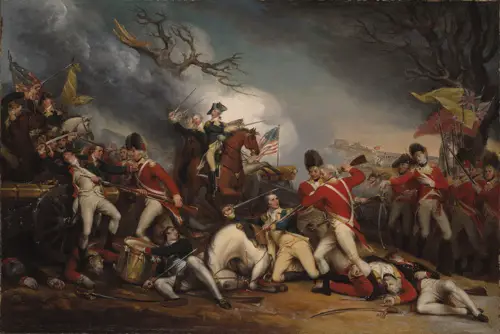
The Death of General Mercer at the Battle of Princeton
The Turning Point: Saratoga
In 1777, Gen. John Burgoyne invaded from Canada, forcing the Continentals to abandon Forts Ticonderoga and Crown Point. Burgoyne then beat the retreating Americans at the Battle of Hubbardton. But then he lost 15 percent of his army at the Battle of Bennington because John Stark defeated and captured hundreds of Hessians on a foraging expedition.
Vermont celebrates Bennington Battle Day as a state holiday, and the Battle of Bennington Monument commemorates the victory. Owned by Vermont since 1937, Hubbardton Battlefield hosts annual Revolutionary War reenactments and features a visitor center with a permanent exhibit on the battle. John Stark, New Hampshire’s great hero, returned to his farm in Derryfield, N.H. (now Manchester). It’s now on the National Register of Historic Places. You can also see his words on New Hampshire license plates: Live Free or Die.
Burgoyne pushed on but was stopped at Saratoga, where fierce fighting at Freeman’s Farm and Bemis Heights ended in surrender. The victory would bring France openly into the war.
Take a driving tour of the battlefield at Saratoga National Historic Park, which includes the Surrender Field in Schuylerville. The visitor center in Stillwater explains the whole battle.
Episode V
In the Mid-Atlantic, the British captured Philadelphia. Washington camped nearby in the winter of 1777-78 at Valley Forge, while Benjamin Franklin secured French alliance in Paris. Pvt. Joseph Plumb Martin described the suffering at Valley Force in his memoirs, from which Ken Burns quotes liberally. You can buy a copy of Martin’s memoirs on Amazon and visit his grave in stockton Springs, Maine..
In 1778, John Paul Jones raided Britain’s coast from the ship Ranger, built in Portsmouth, N.H. You can visit the John Paul Jones House in Portsmouth, N.H., where Jones lived while the local shipyard built and outfitted Ranger in 1777 and built and outfit another vessel, America, from 1781-82.
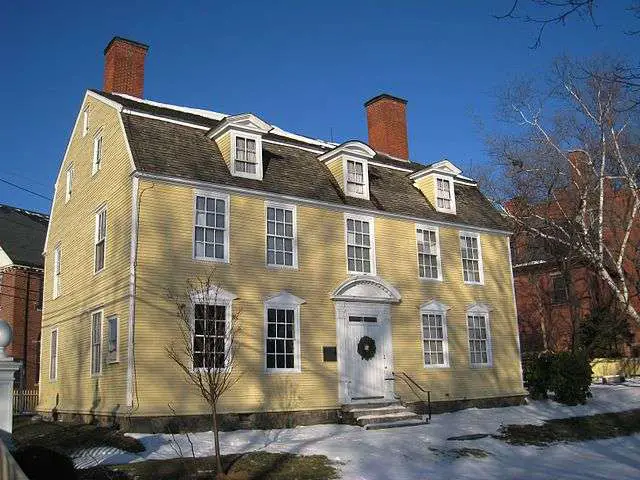
John Paul Jones House in Portsmouth, N.H.
The French Arrive
Finally, the French fleet under Admiral d’Estaing arrived to help dislodge the British from Newport, R.I. The plan called for a joint assault—French by sea, Americans under Gen. John Sullivan by land. But Sullivan advanced early, and then a storm drove the French fleet to Boston for repairs. Left alone, the Americans were then attacked; the battle was inconclusive, and the British retained Newport.
Today the Battle of Rhode Island Association is restoring the fort on the battlefield, which has been partially preserved. The battlefield also includes memorials, including to the 1st Rhode Island Regiment, a Black regiment that fought gallantly.
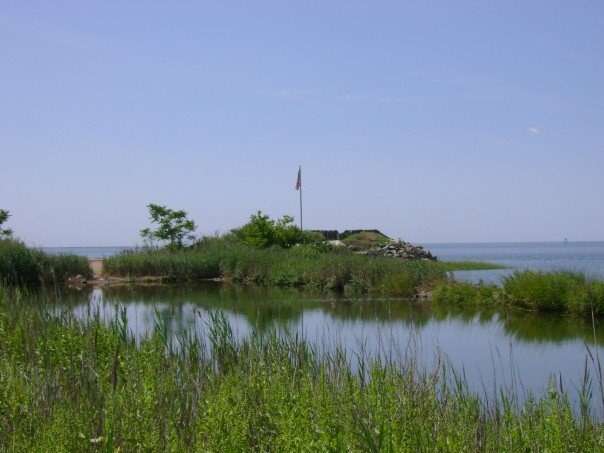
The British landed near here in New Haven.
Then in July, British commander Gen. Henry Clinton ordered an expedition in order to destroy Connecticut port towns that harbored privateers: Norwalk, Fairfield and New Haven.
Several sites commemorate the militia men who fought the raiding British: In Norwalk, Mill Hill Historic Park; in Fairfield, the Fairfield Museum and History Center and Experience Fairfield; and in New Haven, Black Rock Park.
The war then shifted south. British forces captured Savannah and Charleston, defeating Gen. Benjamin Lincoln. Lincoln was born in Hingham, Mass., and his grave can be found in the Old Ship Churchyard in Hingham.
The Final Episode of Ken Burns’ The American Revolution
Nathanael Greene then took command of the southern army, wearing down Cornwallis. He usually lost; however, his forces remained intact and he inflicted costly losses on the British, including Guilford Courthouse. Today, the General Nathanael Greene Homestead Association now operates Greene’s home in Coventry, R.I., as a house museum.

The home of Nathanael Greene, called the most underrated revoltuionary general in the Ken Burns’ documentary.
The tide finally turned when French troops landed in Newport in 1780 under le comte de Rochambeau. King Park, the site where the French landed, has a monument honoring Rochambeau and the French.
Rochambeau and Washington then met to discuss strategy in Hartford. In May 1781, Washington and Rochambeau subsequently met again in Wethersfield, Conn., and agreed to join forces north of New York City. They spent several days at what is now the Webb-Deane-Stevens Museum.
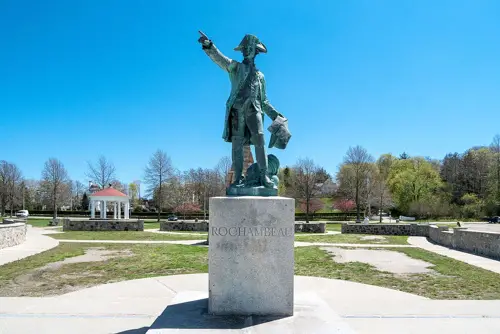
Rochambeau monument in King Park, Newport
They then marched south along what is now the Washington–Rochambeau National Historic Route. Washington from New York and Rochambeau from Newport. Once they met up, they agreed to head south to Yorktown, where d’Estaing and his fleet were also headed. The Washington Rochambeau National Historic Route commemorates the 680-mile march to Yorktown. The spectacular French march through Connecticut has many markers along the way.
Cornwallis had made a mistake by choosing Yorktown to entrench his forces because it was a strategically vulnerably position. French ships then sealed the Chesapeake, and American and French artillery closed in. Then, after a three-week siege, Cornwallis surrendered in October 1781. For all practical purposes, the war had ended.
End Notes
Images: Nathanael Greene Homestead By Camanda at en.wikipedia, CC BY-SA 3.0, https://commons.wikimedia.org/w/index.php?curid=18112163. Longfellow Washington House By Daderot at en.wikipedia – Originally from en.wikipedia; description page is/was here. Original uploader was Daderot at en.wikipedia, CC BY-SA 3.0, https://commons.wikimedia.org/w/index.php?curid=2929917. Peacefield By Daderot, CC BY-SA 3.0, https://commons.wikimedia.org/w/index.php?curid=3162095. Battle Road By NewtonCourt – Own work, CC BY-SA 4.0, https://commons.wikimedia.org/w/index.php?curid=106953815. Boston Tea Party Ship By Robert Linsdell from St. Andrews, Canada – Boston Tea Party Ship & Museum, Boston (493624), CC BY 2.0, https://commons.wikimedia.org/w/index.php?curid=46943593. Fort Ticonderoga By Mwanner – Own work, CC BY-SA 3.0, https://commons.wikimedia.org/w/index.php?curid=6967864. Mercy Otis Warren by By Kenneth C. Zirkel – Own work, CC BY-SA 3.0, https://commons.wikimedia.org/w/index.php?curid=32733257. First American flag By Mmangan333 – Own work, CC BY-SA 4.0, https://commons.wikimedia.org/w/index.php?curid=132392902. Fort Sewall By Fletcher6 – Own work, CC BY-SA 3.0, https://commons.wikimedia.org/w/index.php?curid=10266490. Rochambeau Monument By Kenneth C. Zirkel – Own work, CC BY-SA 4.0, https://commons.wikimedia.org/w/index.php?curid=58488582.