
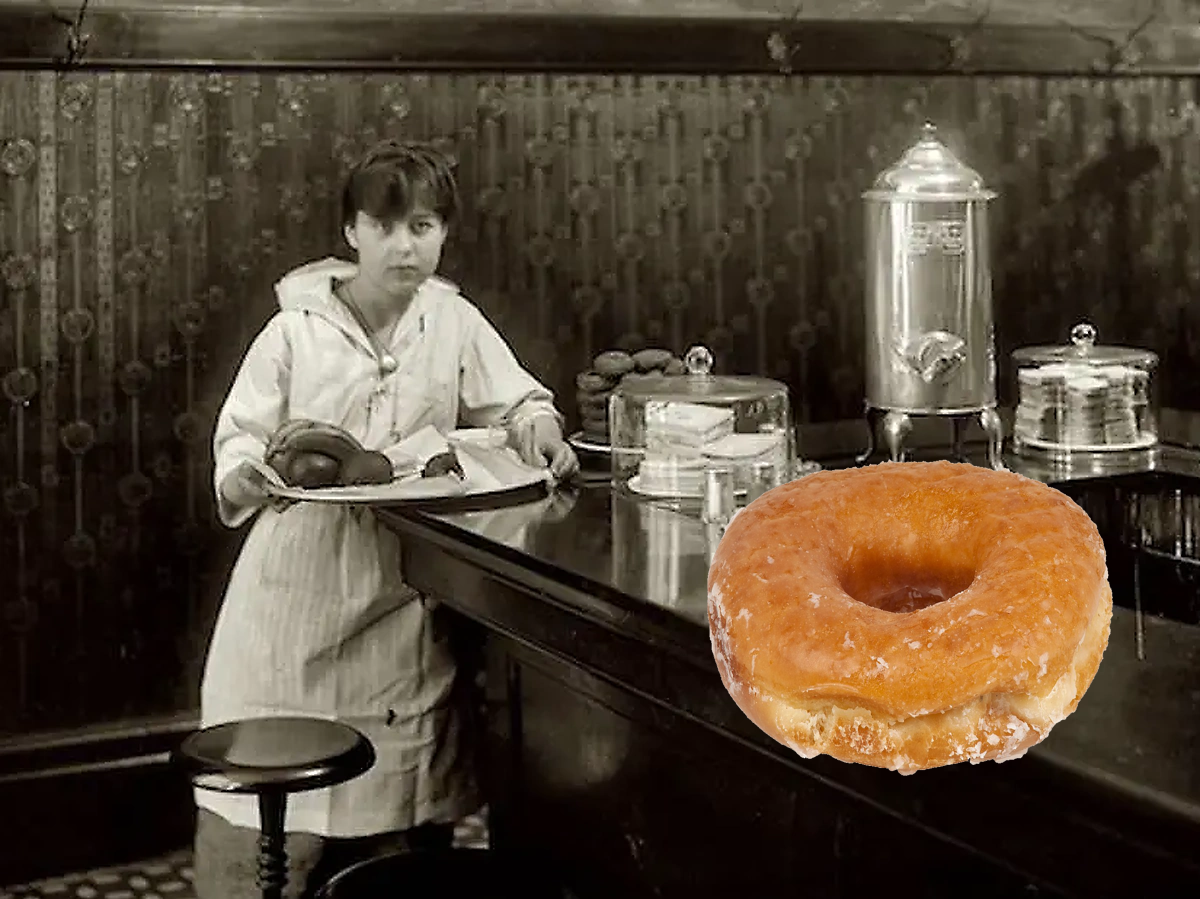
 In 1847, a Maine ship captain invented the donut as we know it today – with a hole.
On the day Lewis Hine took the photo of a waitress next to a plate of donuts (with holes), Capt. Hansen Gregory lived in the next town. He was telling his cronies how he’d gotten the great inspiration to cut a hole in a donut.

14-year-old waitress at the Exchange Luncheon in South Boston. Photo, by Lewis Wickes Hine, courtesy Library of Congress.
Captain Gregory, 85, lived at the Sailor’s Snug Harbor in Quincy, Mass. His fame as the inventor of the modern donut had spread, and the Washington Post interviewed him in a story published March 26, 1916.
He told the reporter he discovered the donut hole when he worked as a 16-year-old crewman on a lime-trading schooner.
“Now in them days we used to cut the doughnuts into diamond shapes, and also into long strips, bent in half, and then twisted,” he said. “I don’t think we called them donuts then–they was just ‘fried cakes’ and ‘twisters.’ Well, sir, they used to fry all right around the edges, but when you had the edges done the insides was all raw dough. And the twisters used to sop up all the grease just where they bent, and they were tough on the digestion.”
First Donut
He asked himself if a space inside the dough would solve the difficulty – and then came the great inspiration.
“I took the cover off the ship’s tin pepper box, and—I cut into the middle of that donut the first hole ever seen by mortal eyes!”
Gregory, born in 1832, would have had his insight around 1858. According to the New York Times, he rose to second mate at 19, mate at 21 and master mariner at 25. He sailed in all kinds of vessels from the lime coaster to a full-rigged ship.

A plaque at Nativity Lutheran Church pays homage to an iconic food. Photo courtesy Google Maps.
But the donut made him famous. He had asked a tinsmith to fabricate a donut cutter for him, and soon, reported the Times, ‘cooks everywhere had adopted it.’
He returned to Camden, Maine, where he taught his mother the trick. She sent several plates to Rockland, Maine, where people gobbled them up. After that, the donut never looked back.
A plaque in the town of Rockport, Maine, marks Captain Gregory’s birthplace, now the parsonage of the Nativity Lutheran Church. The National Baking Association nominated him for the Baking Hall of Fame, but it doesn’t appear he made the cut.

Sailors Snug Harbor
More Donut History
How reliable is the old sea captain’s tale? The Food History Timeline posts donut recipes before 1858, and they all advise cutting the donut into diamonds, squares or twists. Then in 1877 a donut recipe calls for cutting them into rings.
The Food History Timeline also notes that after the Civil War, ‘ inexpensive tin doughnut cutters with holes were manufactured commercially and sold widely.’
Capt. Hanson Gregory died in 1921. You can visit his grave at the National Sailors’ Home Cemetery.
Lewis Wickes Hine, by the way, took many photos of very young workers, which then influenced the passage of child labor laws. His caption read, “Exchange Luncheon. Delia Kane, 14 years old. 99 C Street, South Boston. A young waitress.”
* **
 Check out this entertaining and informative cookbook, Eat Like a President, about the six New England presidents by the New England Historical Society. Click here to order your copy today.
This story about the donut was updated in 2026.
Image of Nativity Lutheran Church courtesy Google Maps.

17 comments
There used to be a donut maker that used this little saying….”Wherever you go through life, Brother, whatever be your goal, keep your eye upon the donut and not on the hole.”
Molly how great to hear that again
Molly how great to hear that again
I like it!
I like it!
Arrrrgh, I stepped on them with my peg leg…
[…] invención del donut moderno se atribuye a un marinero holandés llamado Hanson Gregory. Su madre, Elizabeth, era famosa por hacer unos ricos olykoeks o “pasteles de grasa.” […]
I am related to Hanson Gregory. My great grandfather, Charles E. Gregory, knew him. It’s interesting, because that’s not the hole in the doughnut story that’s been passed down in my family. According to my great grandfather, in Hanson’s later years he liked to joke and embellish the circumstances of inventing doughnut hole. The story I’ve been told is that Hanson was a teenager in his mother’s kitchen, watching her fry doughnuts. He didn’t like how soggy they were in the middle, so he cut that part out. She brought them to to the neighbors and the rest is history! When the original Gregory homestead was torn down, my grandfather Charles L. Gregory rescued the plaque from the wreckage and stored it in his barn in Rockport for many years. He and his cousin Fred Crockett had the plaque reinstalled on the grounds of the Lutheran Church.
How interesting! Thank you for sharing. It does seem Hanson Gregory’s mother deserves some credit as well, don’t you think?
[…] Capt. Hansen Gregory, as a 16-year-old crewman on a lime-trading schooner in 1847, would change the world of donuts forever when he invented the donut hole. Years later he told his story to a reporter from the Washington Post: […]
[…] Twenty years later, British fiction writer Len Deighton published a spy novel, Berlin Game, in which he wrote that Kennedy had mangled the German language during the speech and actually said, ”I am a jelly doughnut.” […]
[…] New Year's Day party in 1903, the legendary Isabella Stewart Gardner served her two favorite foods: donuts and champagne. One of her guests, the novelist Edith Wharton, was not […]
[…] as a bonus sweet treat, here’s the story of the 16 year-old who is credited with inventing the donut hole. Wherever you are today, Hanson […]
[…] (pronounced ZAY-poe-lay) are loosely defined as baked or fried donuts or fritters with fillings such as cream, custard or jelly and topped with sugar or […]
[…] in life, while living at the Sailor’s Snug Harbor in Quincy, Mass., Capt.Gregory told the Washington Post how he’d come about his invention. Back when he was a 16-year-old cook aboard a coasting schooner, he took long strips of dough, bent […]
[…] to the New England Historical Society, donuts with a hole was the idea of Captain Hansen […]
[…] capitán de barco llamado Hanson Gregory inventó una solución en 1847 para resolver el problema de cocción en el centro de las donas, con […]
Comments are closed.