
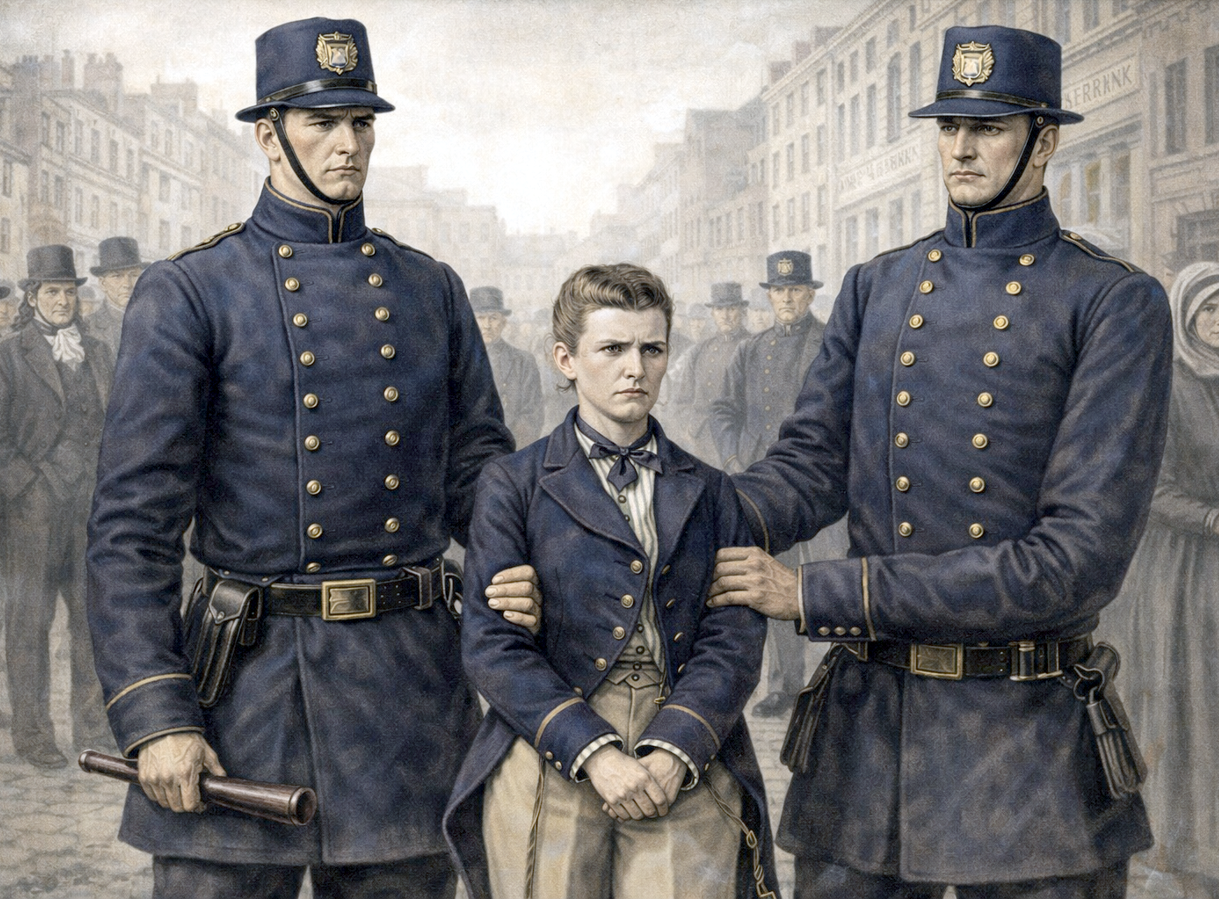
Emma Snodgrass created a sensation in 1852 by showing up in Boston wearing pants.
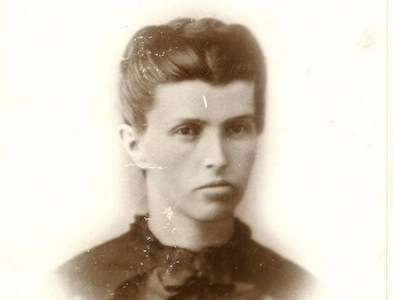
Emma Snodgrass
She was mocked, arrested and sent home to her father in New York City, only to return again and again. Each time the police found her out, arrested her and sent her home. She became national news. Newspapers described her as the “wanderer in man’s apparel,” the “foolish girl who goes around in virile toggery” and “an eccentric female who roams about town.”
Emma Snodgrass was the pretty, petite 17-year-old daughter of a New York City police officer. Exactly when she arrived in Boston is unclear, but by the fall of 1852, someone discovered her wearing pants and a frock coat. Her audacious pranks “turned the heads of the Boston editors,” reported the Daily Dispatch of Richmond, Va.
Talking ‘Horse’
Emma Snodgrass made good copy. In the space of 2-1/2 weeks, the Boston Herald ran five news items about the young woman wearing pants, according to Carol Mattingly in Appropriating Dress. On November 15 the Herald reported Emma Snodgrass had been “visiting places of amusement around Boston.”
“Snodgrass used to circulate in all the drinking houses, made several violent attempts to talk “horse,” and do other things for which “fast” boys are noted,” reported the Daily Alta California in an item called “Letter From Boston.”
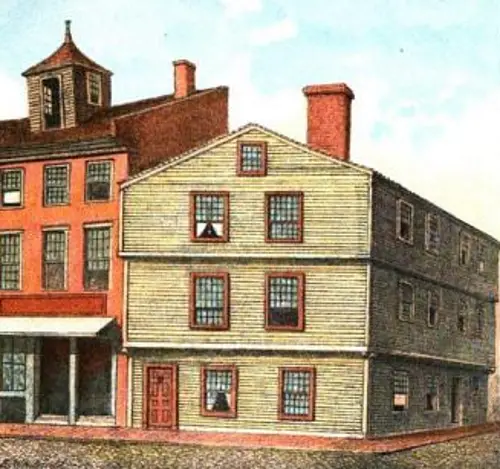
The Sun Tavern in Boston’s Dock Square
Newspapers focused more on the sensational nature of her exploits and less on getting the facts straight. We don’t know, for example, if her father was a police captain or assistant police captain in New York City.
We do know from the New York Daily Times on Nov. 30, 1852, that Emma Snodgrass was caught “donning the breeches.” She’d called herself George Green and gotten a job as a clerk at the clothing establishment of John Simmons & Co. The police took her to the station and sent her back to her father, “a respectable city official in New York.”
She soon returned to Boston and wore women’s clothes at the Washington Coffee House, where she had taken lodgings. According to one report, Emma left the Coffee House in women’s clothes, but returned wearing “a neat frock coat, cloth cap, and black broadcloth pants.” A bartender recognized her and told the police, who took her into custody. A police officer took her home with him and saw to it that she returned to her father. “What her motive may be for thus obstinately rejecting the habiliments of her own sex, is not known,” reported the New York Daily Times.
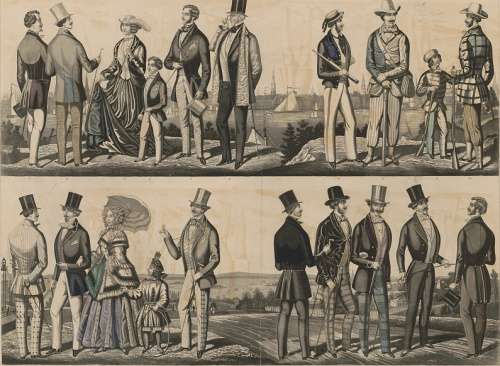
Men’s fashions in 1852
Disturbing Equanimity
By now, Emma Snodgrass was getting plenty of attention. She “disturbed the equanimity of the sleepy magistracy in the eastern cities,” reported the Fort Wayne Times and Peoples Press.
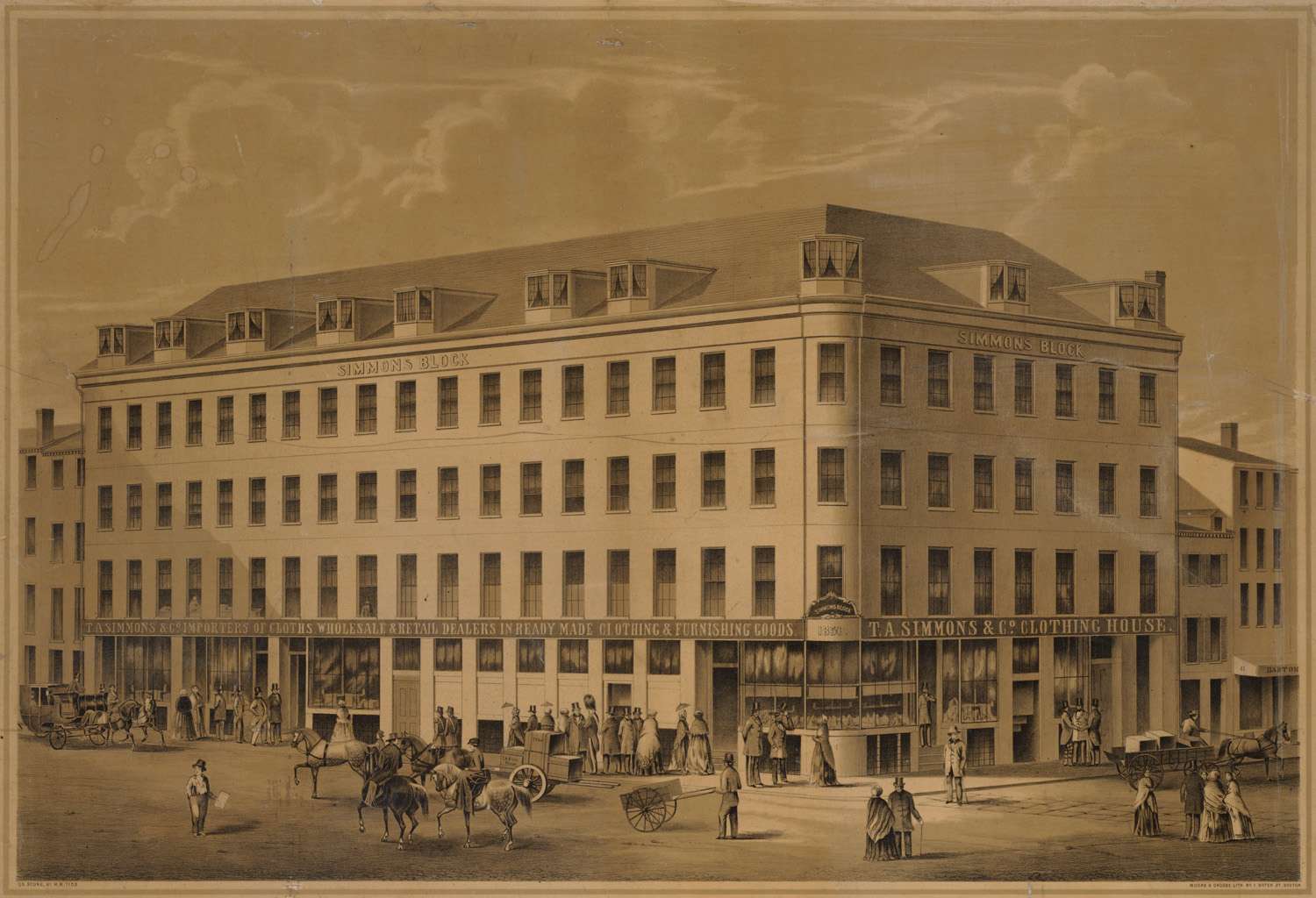
The Simmons Clothing House, Courtesy Boston Public Library.
She boomeranged back to Boston in December, again wearing pants. On December 18, the Boston Herald reported on her attraction to romantic young men. On December 22, she reportedly made a “profound sensation” on a trip to Portsmouth, N.H. And then police arrested her again in Boston.
The Boston Times defended Emma in an item dated Dec. 29, 1853, the day of her detention. The newspaper reported police arrested her, jailed her and scheduled her for arraignment. “[W]e shall see under what form of complaint she is to be victimized. It must be something else than the mere fact of her wearing breeches. What is it? Common loafer–suspicious person–vagrant–or has she been doing some other naughty thing?” queried the Times.
Best To Have Money in Those Trousers
She was charged with vagrancy. The Boston Transcript reported that during her wanderings, “she had been well supplied with money, and all bills were promptly paid, so that the charge of “being without home, lawful employment, or means of support,” could not be legally sustained.” The judge let her go–“much to the apparent satisfaction of a crowded audience.”
This time, however, police had also arrested another pants-wearing female–Harriet French, a friend of Emma’s who did not fare so well.
When they appeared in court, only with great difficulty could the friends could be separated, reported the Daily Alta California. “Snodgrass was finally sent to New York in charge of an officer, and her friend was packed off to the House of Industry for two months,” the newspaper wrote. But then the court relented, and gave Harriet a day to get out of town.
The Tribune editorialized that authorities punished Harriet because she didn’t have money, while Emma got away scot free. That demonstrated “the difference between breeches without money, and breeches with,” noted the editors.

Men’s fashions in the 1850s
Go West, Young Man
For the next few months, newspapers reported Emma Snodgrass arrests and appearances as frequently as Elvis sightings.

Fashionable women in 1853
In March 1853 she stood before a magistrate in Albany, N.Y., wearing pants and calling herself Henry Lewis, the Albany Journal reported. She said she planned to go to California or Australia.
A month later, newspapers reported an Emma sighting in Louisville, Ky. “”Emma Snodgrass, the girl in pantaloons … was last seen at Louisville, on her way to California,” reported the Fort Wayne Times and Peoples Press. “She wears a frock coat, glazed cap, striped pantaloons, &c., and has the appearance of quite a good looking young man. She is a practical Woman’s Rights girl.”
On May 28, 1853, the Washington, D.C., Daily Evening Star, reported, “Emma Snodgrass, the young lady in pants, appeared in Buffalo, on Sunday last, habited in a very becoming and genteel attire. She is about four feet ten inches in height.”
To Her Credit?
Less than two weeks later police arrested her in Cleveland – presumably for wearing pants – according to the Democratic Banner of Davenport, Iowa, on June 10, 1853.
On July 13, 1853, the Grant County Herald of Lancaster, Wisc., reported, “Emma Snodgrass has repented, gone home, taken off her breeches, and sworn eternal attachment to petticoats and propriety. This is to her credit.”
We lost sight of Emma Snodgrass after that news item. So perhaps she did repent.
The Unfeminine Freak
Three years later, the reading public in New York City learned more about what had gone on in Boston. On March 14, 1856. The New York Daily Times published an item about “an unfeminine freak” arrested and charged as a vagrant in New York City. “Charley”–Harriet French–was sentenced to two months imprisonment on Blackwell’s Island.
A reporter interviewed “Charley,” who claimed to have visited Boston with Emma Snodgrass 3-1/2 years earlier.
We have to take Harriet French’s story with a big grain of salt. The reporter did. “Charley is a wag,” he wrote. But her comments may explain why she decided to dress as a man.
First, a description: She was 19, 5-foot-3-inches tall, with neatly combed short black hair. Her coat and pants were new, neat and well fitting. Her tie was fashionable, and “usually worn ajaunt, as becomes a gay young man about town.”
She learned to chew tobacco on the Mississippi River, where she worked for two years on a steamboat. Charley then came to New York City and worked as a bartender.
Why, asked the reporter, would you dress as a boy? She could get along better as a boy, she said. “Can get more wages.”
She told the reporter she planned to go out west to visit her sister in California – where Emma Snodgrass had headed, wearing pants, three years earlier.
***
 Now available in paperback and as an ebook from the New England Historical Society! A collection of stories about the French people who came to America. Click here to order your copy today!
This story was updated in 2025. Featured image illustration by ChatGPT.

29 comments
Many thanks to Emma Snodgrass! I wear slacks all the time.
And look how people dress in public today. I think people in today’s society would probably be hanged if they showed up wearing a bikini into the store or wearing their pajamas.
Amanda Lippold little, I see men and women wearing Pajamas every day on the street and in the Supermarkets, also have visited Florida for decades, Bikinis are worn in every store, and some times even less attire!
There was a woman doctor in Civil War that showed up with pants on – shocking the soldiers and superiors when she walked into camp to take care of the wounded. She was from upstate New York and insisted on wearing pants – I read about her in an account of Mass. regiment 34th but can’t recall her name at the moment !
^Linda, We think you probably mean Mary Edwards Walker. http://en.wikipedia.org/wiki/Mary_Edwards_Walker
Yes ! she was an interesting character
thank you
🙂
OMG was she actually called a cross dresser as described here?
^Not back then. She was called a lot of other things.
In the account that I read, a General said a woman wearing trousers walked into the tent and announced she was the doctor. So, at least in this instance, she was apparently a woman – just wearing pants – which threw men for a loop ! They thought it was very outlandish and bizzare.
But in the article from Wikpedia it says she did pretend to be a man to be able to do her work as a phsyician in the field.
Bravo for fiesty woman!!!
Thanks. This was an awesome read. I read about both women.
Goddess bless her
1852? She should have moved to San Francisco: we had ladies rocking that style!!!
Cpl Klinger wore a dress
she looks like a dude to me
[…] the time it actually spawned multiple news stories. In three weeks, Snodgrass managed to inspire a total of five articles in the in Boston […]
[…] a new style of dress for women. Political activists equated a more liberated style of dress with political rights for women. Meanwhile, fitness advocates argued that it was impractical and unhealthy for women to […]
[…] https://newenglandhistoricalsociety.com/emma-snodgrass-arrested-wearing-pants/ […]
[…] for wearing pants, the earliest example I’ve found (yet) was a young woman by the name of Emma Snodgrass, who was arrested multiple times for publicly wearing pants in 1852 and […]
The “Joan of Arc” of her era — I know my mother was sent home from work wearing slacks in the 1930’s. . . and on it goes!
Lord Cornbury, the Royal Governor of New York, was our first drag queen and crossdresser. He wore women’s dresses.
His behavior was so scandalous that he was removed by the King.
[…] and Popocatepetl. She made headlines: Not only was she an ardent advocate of women’s rights, she wore pants when she climbed […]
[…] it, and before any of these 20th century icons were even twinkles in their parents’ eyes, Emma Snodgrass started her fight for her right to wear pants back in 1852 at just 17 years old—and made national […]
[…] Emma Snodgrass, via New England Historic Society […]
[…] Theodul Pass, the Matterhorn, Pico de Orizaba and Popocatepetl. She made headlines, partly because she wore pants when she climbed […]
[…] ‘the wanderer in man’s apparel,’ the ‘foolish girl who goes around in virile toggery’ and ‘an eccentric female who roams about town.’ (New England Historical Society) […]
Comments are closed.