
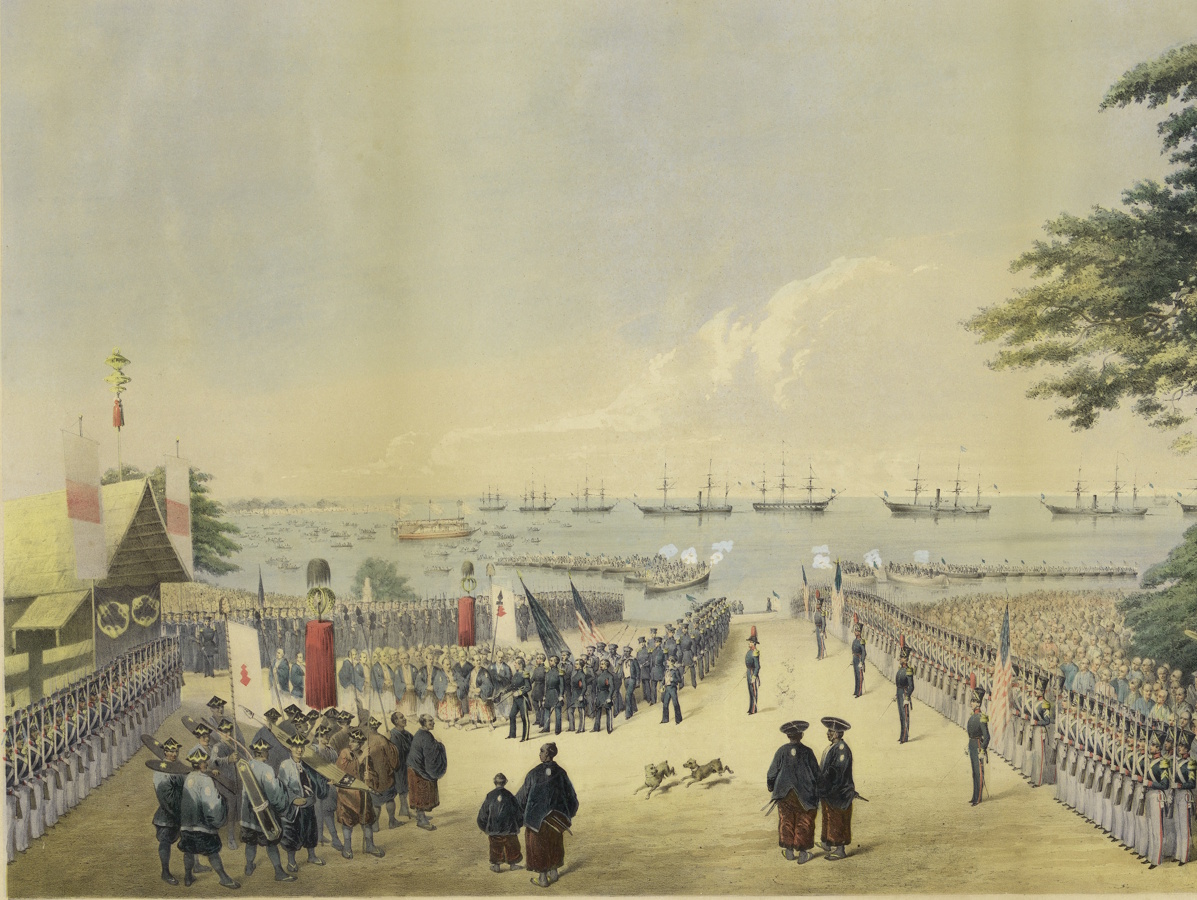
 On July 8, 1853, four American warships steamed into Japan’s Edo Bay, their black hulls and smoking funnels announcing the arrival of a new age. For more than 200 years, Japan had kept the outside world at arm’s length, allowing only limited trade with the Dutch and Chinese. Leading the American squadron was Newport-born Commodore Matthew Calbraith Perry, who carried a letter from President Millard Fillmore requesting friendship, trade and protection for American sailors.
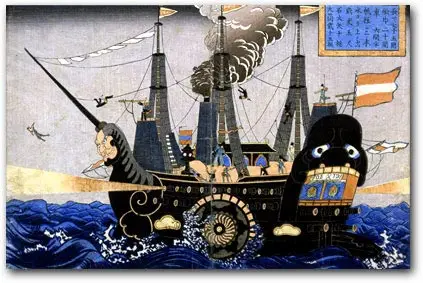
One of Perry’s barbaric black ships.
Perry had no intention of taking no for an answer.
His expedition would end Japan’s long isolation, open the Pacific to American commerce and set in motion events that reshaped world history. Few New Englanders have had a greater impact on the modern world.
Why America Wanted Japan
America’s interest in Japan grew rapidly during the mid-19th century. The United States had signed a commercial treaty with China in 1844, acquired California after the Mexican War in 1848 and watched thousands of settlers stream west during the Gold Rush. American merchants, whalers and naval vessels increasingly crossed the Pacific, creating a need for ports where ships could take on coal, water and supplies.
Japan sat squarely along those routes.
Previous American efforts to establish relations had failed. Between 1790 and 1853, nearly 30 American ships attempted to open trade with Japan, only to be turned away. Perry carefully studied every earlier mission before accepting the assignment from Fillmore in 1852. He consulted leading experts on Japan, assembled artists and scientists to document the expedition and even brought along a French chef and an Italian bandmaster, believing hospitality and ceremony could help achieve diplomatic success.
Still, diplomacy would be backed by overwhelming naval power.
Matthew Calbraith Perry: The Right Man for the Job
Matthew Calbraith Perry was well suited for the assignment. Born in Newport on April 10, 1794, he followed his father and his celebrated older brother, Oliver Hazard Perry, into the Navy. During a career that spanned more than four decades, he fought in the War of 1812, commanded numerous vessels and emerged as one of the nation’s foremost advocates of steam-powered warships.
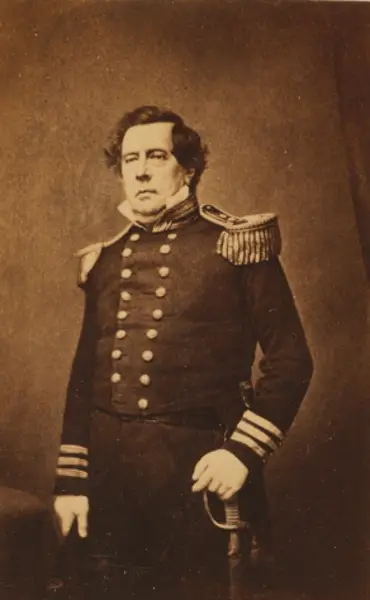
Commodore Perry
Long before steam transformed naval warfare, Perry recognized its potential. He helped establish the Navy’s first engineering corps, promoted professional education for naval officers and organized the nation’s first naval gunnery school. By the early 1850s, he had become America’s leading expert on modern naval technology, making him the logical choice for one of the country’s most sensitive diplomatic missions.
His confidence matched his experience.
Gunboat Diplomacy
Perry arrived in Edo Bay with two steam frigates and two sailing warships. Japanese officials ordered him to proceed to Nagasaki, the only port then open to limited foreign contact. Perry refused. Instead, he anchored near Edo, today’s Tokyo, took soundings of the harbor despite Japanese objections and insisted that he would deliver the president’s letter only to representatives of the emperor.
When swarms of small Japanese boats approached his ships, Perry dispersed them with the threat of force.
On July 14, he landed 400 sailors and Marines in an elaborate ceremony designed to impress Japanese officials. Military bands played while officers marched in full dress uniform. Perry presented Fillmore’s letter, which requested friendship, humane treatment for shipwrecked American sailors and permission for U.S. steamships to obtain coal, food and water in Japanese ports.
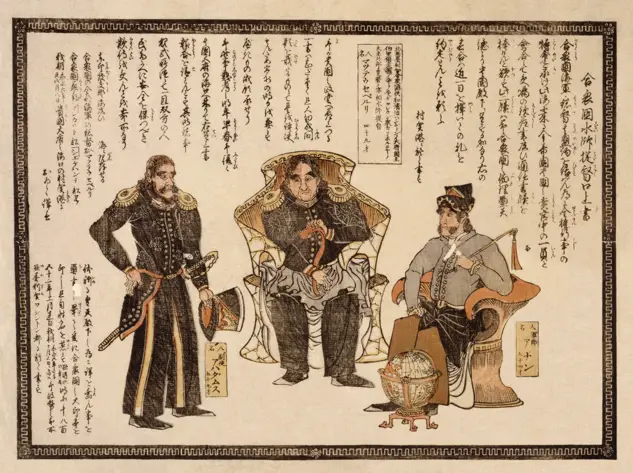
A Japanese woodblock print of Perry (center) and other high-ranking American seamen
Behind the polite language stood unmistakable military power. Perry informed Japanese officials that he would return the following year for an answer.
Japan Opens Its Doors
Perry returned sooner than expected.
On Feb. 13, 1854, he sailed back into Edo Bay with a fleet of 10 ships and about 1,600 men. The larger force reflected both America’s determination and concern that Russia might reach an agreement with Japan first.
This time, Japanese officials welcomed negotiations. After weeks of formal meetings, banquets and ceremonies, the two nations signed the Convention of Kanagawa on March 31, 1854.
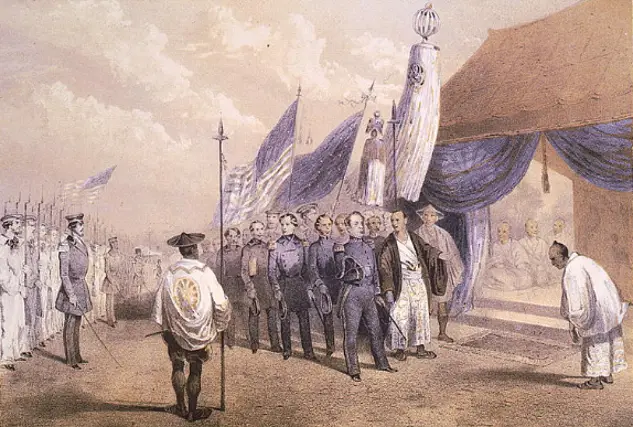
Commodore Perry meeting the imperial Commissioners at Yokohama
The treaty opened the ports of Shimoda and Hakodate to American vessels, guaranteed humane treatment for shipwrecked sailors and permitted the establishment of an American consulate. Although it stopped short of opening full commercial relations, it marked the end of Japan’s self-imposed isolation and began a profound transformation of Japanese society.
Within a generation, Japan had modernized its military, industry and government. It emerged as a major world power, altering the balance of power throughout Asia and the Pacific.
Matthew Calbraith Perry’s Lasting Legacy
Perry did not live to witness the consequences of his expedition. He died in 1858, only four years after signing the treaty.
Japan’s modernization eventually led to imperial expansion and war with the United States. Yet history came full circle on Sept. 2, 1945, when representatives of Imperial Japan formally surrendered aboard the battleship USS Missouri in Tokyo Bay.
General Douglas MacArthur requested that Perry’s battle flag be brought from the Naval Academy Museum in Annapolis and displayed above the surrender ceremony. Ninety-two years after Perry sailed his “Black Ships” into Edo Bay, the same flag overlooked the official end of World War II in the Pacific.
MacArthur recognized the symbolism, observing that Perry had sought to bring Japan “an era of enlightenment and progress” by ending its isolation.
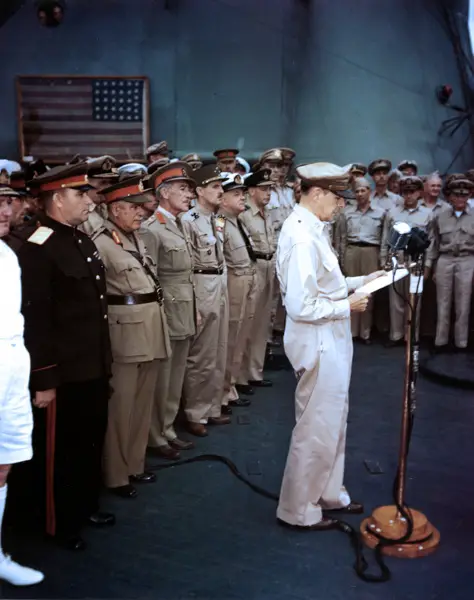
General of the Army Douglas MacArthur, Supreme Allied Commander, reading his speech to open the surrender ceremonies, on board USS Missouri (BB-63). Framed flag in upper left is that flown by Commodore Matthew C. Perry’s flagship when she entered Tokyo Bay in 1853. Photograph from the Army Signal Corps Collection in the U.S. National Archives.
Today, Japan ranks among America’s closest allies. Newport commemorates Perry each year with its Black Ships Festival, while the Japanese city of Shimoda remains Newport’s sister city. Japanese naval officers continue to study at the Naval War College in Newport.
Matthew Calbraith Perry left Rhode Island with a squadron of warships and a difficult diplomatic assignment. He returned having changed the course of history.