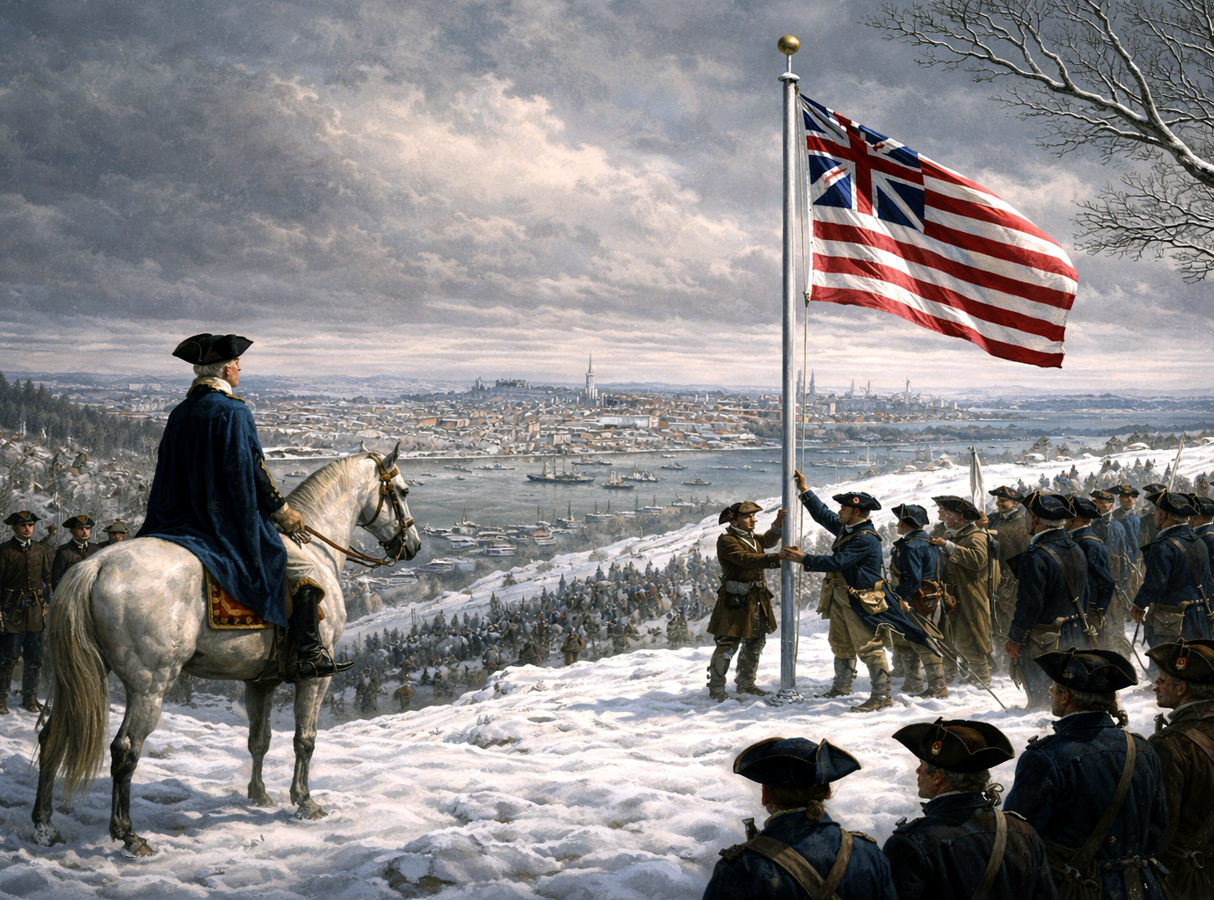
 On New Year’s Day, 1776, George Washington ordered the first American flag raised to the top of a 76-foot liberty pole at the summit of a hill in Charlestown (now Somerville), Mass. Standing in formation on the hillside, several thousand soldiers watched the red, white and blue flutter against the sky. Redcoats saw it from the ships at anchor in the harbor and from their quarters in Boston, across the Charles River. The town’s inhabitants, patriot and loyalist alike, could see the flag, and so could the country people in the snow-covered fields beyond the hill.
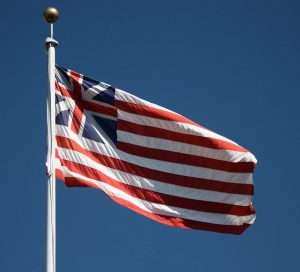
Grand Union Flag
One after another, 13 cannon boomed, and the troops on the hillside let out loud “huzzahs!”
Washington had ordered the first American flag raised to recognize the national fighting force. He intended the ceremony to boost morale and unite the troops, who came from disparate backgrounds. He chose Prospect Hill, nicknamed “The Citadel,” because of its commanding views of the British troop movements.
But the flag meant something even more than that. It was the first to represent all 13 colonies. Until then, each colony used its own flag. The raising of the flag with a stripe for each colony signified the birth of a republic called the “United States of America.”
Washington’s Irish aide-de-camp, Stephen Moylan, , wrote those four words in a letter the next day–the first time ever, according to scholars. He expressed his desire for an appointment as ambassador to Spain. He wrote:
“I should like vastly to go with full and ample powers from the United States of America to Spain.”
The Continental Army
Washington almost didn’t have an army to command that day. After the Continental Congress created the Continental Army on June 14, 1775, most enlistments were very short, either for a few months or until the end of the year.
Since the Battle of Bunker Hill, the bulk of the army surrounded Boston, besieging the redcoats bottled up on the peninsular town.
But the patriotic fervor that had inspired thousands to join their local militias and march to Boston had largely subsided during the stalemate. The army had no hope of attacking the redcoats. The Continentals had inferior weapons and almost no artillery. They had so little gunpowder that Washington ordered spears issued to them.
They also had no winter clothes, few blankets and little firewood. As winter set in the men had to eat their rations cold. As the siege dragged on, the army began to melt away.
Washington himself thought it a near-miracle that the untrained, undisciplined militias had kept the British holed up in Boston for six months. If they somehow won the siege, Washington told John Hancock, he would view it as the luckiest thing that ever happened to him.
The First American Flag
Washington summarized their desperate situation in a letter to Hancock:
It is not in the pages of History perhaps, to furnish a case like ours; to maintain a post within Musket Shot of the Enemy for Six months together, without—and at the same time to disband one Army and recruit another, within that distance, of Twenty odd British regiments, is more probably than ever was attempted; But if we succeed as well in the last, as we have heretofore in the first, I shall think it the most fortunate event of my whole life.
As luck would have it, the British had no clue about the miserable condition of the colonial forces that besieged them. A deserter had gone over to Gen. Thomas Gage, the British commander, and described the colonials’ dire straits. Gage found the description so incredible he treated it as a stratagem of war and the informant as a spy.
The Army at the First American Flag Raising
By early December, only a few thousand men had signed up beyond New Year’s Eve. Enlistments came in slowly. News of the army’s harsh conditions had spread. Washington, too, had introduced discipline: the lash, the pillory and the court martial.
And so the army offered a signing bonus: a dollar, big money in those days.
Joseph Plumb Martin described the allure of a dollar on a drum head.
A dollar deposited upon the drum head was taken by some one as soon as placed there, and the holder’s name taken, and he enrolled . . . My spirits began to revive at the sight of the money offered; the seeds of courage began to sprout . . . O, thought I, if I were but old enough to put myself forward, I would be the possessor of one dollar, the dangers of war notwithstanding.
By New Year’s Eve Washington had 9,650 men–about half of what Congress authorized.
And so on New Year’s Day, Washington ordered his troops to assemble on Prosopect Hill for the flag-raising.
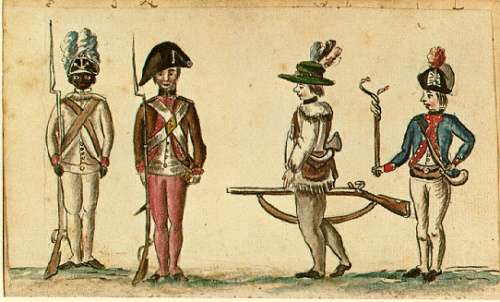
Continental Army foot soldiers.
In his general orders on the day the first American flag flew over Prospect Hill, he wrote:
This day giving commencement to the new army, which, in every point of View is entirely Continental, . . . His Excellency hopes that the Importance of the great Cause we are engaged in, will be deeply impressed upon every Man’s mind, and wishes it to be considered, that an Army without Order, Regularity and Discipline, is no better than a Commission’d Mob.
The First America Flag
The flag that flew over Prospect Hill that day was probably the “Grand Union Flag.” It had the Union Jack in the canton—the joined crosses of St. Andrew and St. George—and 13 red-and-white stripes.
Some historians believe the flags expressed the colonists’ desire to reconcile with Britain. The 13 stripes showed the 13 colonies united, but the Union Jack acknowledged Britain’s sovereignty. After all, it was six months before the Declaration of Independence. Many colonists simply wanted Parliament to treated them on a level with other British subjects.
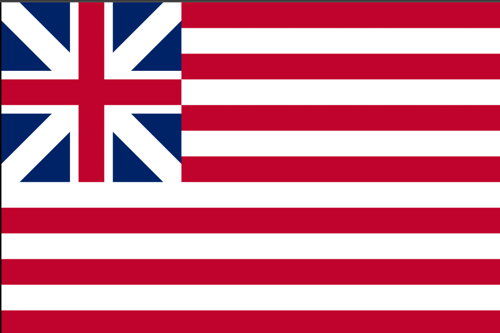
Some expected King George III to take up their cause with Parliament. But that hope would soon be dashed with a speech the king delivered to Parliament.
The speech did not suggest the King supported the rebellion. King George instead announced he was sending more troops and ships to the colonies. They would suppress the “desperate conspiracy.” He also said he received “the most friendly offers of assistance” to put a “speedy end” to the revolt.
The British had just distributed printed copies of the King’s speech in October. A messenger would deliver it to Continental Army officers under a flag of truce.
Redcoats Misinterpret the First American Flag
On Jan. 1, 1776, the besieged British thought the colonial army had gotten the news about the King’s speech. What they apparently didn’t know was that the colonials would burn the speech on Prospect Hill. And so, they thought Washington had raised the flag to signal a willingness to surrender.
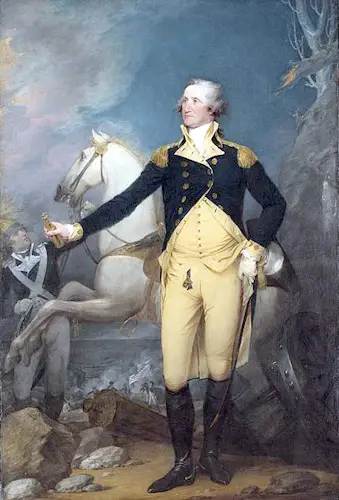
George Washington Before the Battle of Trenton by John Trumbull
Washington later wrote,
We gave great Joy to them (the red Coats I mean) without knowing or intending it, for on that day, the day which gave being to the New Army (but before the Proclamation came to hand) we had hoisted the Union Flag in compliment to the United Colonies. But behold! it was received at Boston as a token of the deep impression the speech had made upon us, and as a signal of submission. By this time, I presume, they begin to think it strange that we have not made a formal surrender of our lines.
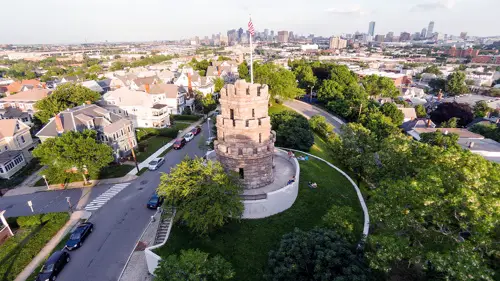
Prospect Hill today
Celebrating the First American Flag Raising
Every year, the City of Somerville commemorates that first flag raising on Prospect Hill. For the 2025 flag raising, 2025, Somerville described the event as a commemoration of an iconic moment in American history.
The event features remarks from local officials, historical reenactments, and a ceremonial parade led by the Ancient & Honorable Artillery Company of Massachusetts and Revolutionary War reenactors. Community members of all ages are encouraged to attend this tradition celebrating Somerville’s central role in America’s founding story.
***
Images: Grand Union Flag By Mmangan333 – Own work, CC BY-SA 4.0, https://commons.wikimedia.org/w/index.php?curid=132392902. Prospect Hill Tower (view) by Eric Kilby via Flickr, CC by SA 2.0. This story was updated in 2026.