
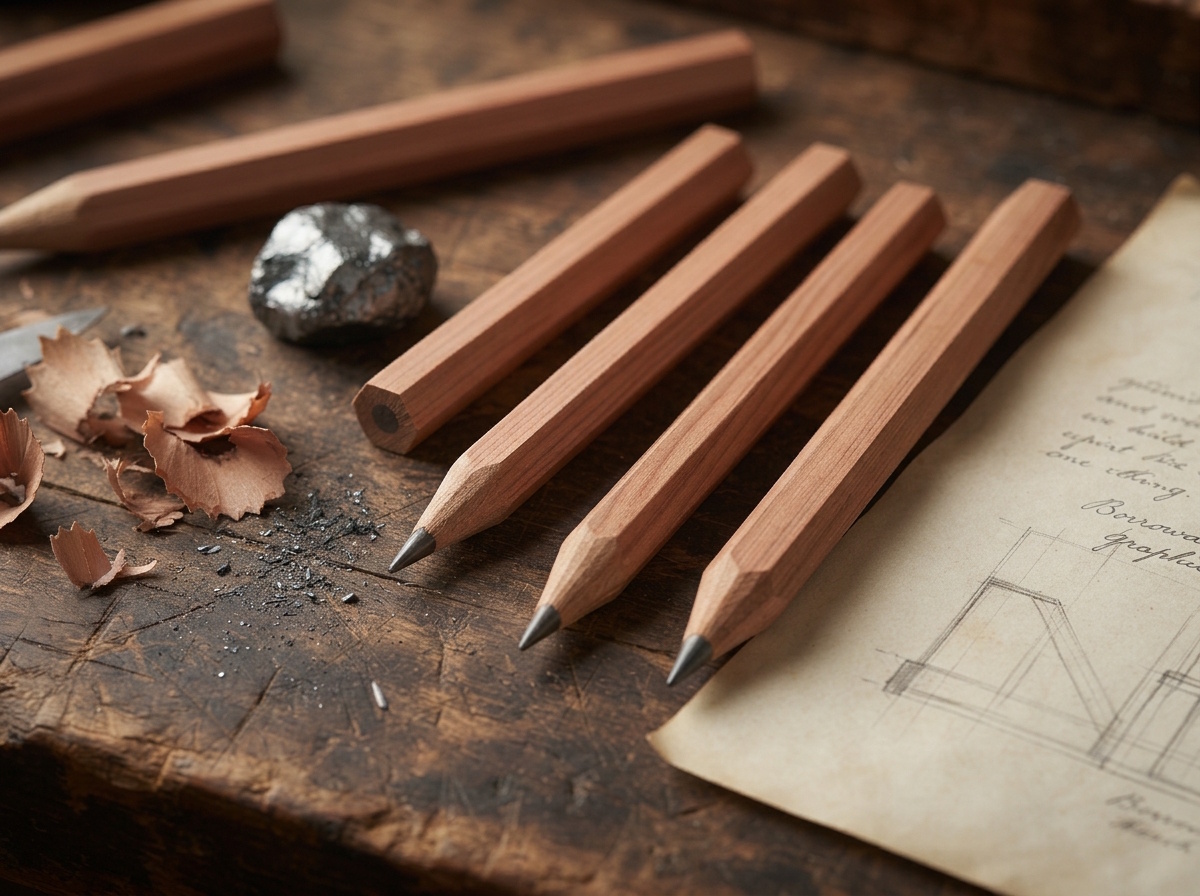
 The first American wooden pencils appeared in Concord, Mass., in the early 19th century. Made of graphite encased in wood, they did not have erasers. Through various innovations, they would surpass the quality of European imports.
Pencil Pioneers
The history of graphite and wood pencils begins in 16th-century Europe. Around 1565, a huge mass of pure solid graphite was found in the northwest of England in Borrowdale. Shepherds used the substance (mistakenly called lead or “plumbago”) to mark their animals. Around the same time, an Italian couple, Simonio and Lyndiapa Bernacotti, discovered a way to encase graphite within two pieces of juniper wood. Both developments furnished the foundation for pencil-making.
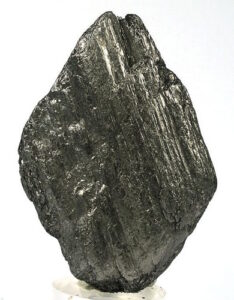
Graphite specimen
Prior to the War of 1812, no pencils had been made in the colonial era or the early decades of the United States. Americans relied mostly on quill pens for keeping records and corresponding with businesses, relatives and friends. Imported English and German wooden pencils were expensive, high-quality items. They were used mainly as tools by surveyors, architects and others.
The War of 1812 completely cut off the supply of European pencils. William Munroe (1778-1861), a Concord, Mass., cabinetmaker, decided the time had come for making the first American wooden pencils. Munroe used cedar wood cut into grooves and a paste of galvanized graphite, glue and wax to make his pencils by hand. However, because of their softness, they lacked the quality of the imports. Yet he did sell 30 pencils to Benjamin Andrews, a Boston hardware dealer, in July 1812. His sales for general use sparked an increase in demand.
In 1819 Munroe hired Ebenezer Wood (1792-1880) to help him. Wood subsequently introduced several inventions Munroe used to produce pencils. These included a circular saw for cutting grooves into slats (thin, flat, rectangular wooden blocks), a trimming machine to shape pencils and a wedge press for gluing wooden slats around the graphite cores.
A Million Pencils
With the help of Ebenezer Wood, William Munroe expanded his output to about a million pencils a year by the 1840s. From 1842 his son, Francis (1814-1870), ran the business. It permanently closed in 1854 due to financial difficulties.
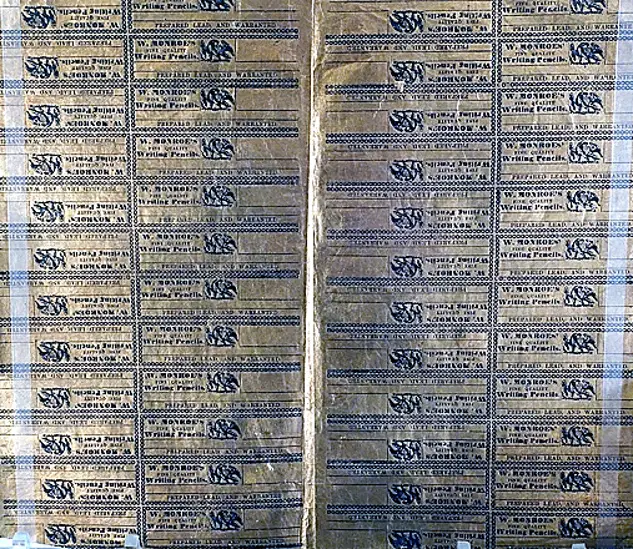
Sheet of uncut William Munroe pencil labels. Image courtesy Concord Museum.
After working with Munroe, Wood opened his own pencil-making business in Acton (near Concord). Here he ground graphite, made pencil components and produced his own pencils. Importantly, he invented the first hexagonal and octagonal pencil casings so pencils would not roll off flat surfaces. Wood never patented his inventions, allowing others to use them. Thus, his inventive techniques formed the initial basis of large-scale manufacturing of pencils.
In 1821 Claude Dunbar (1772-1859) discovered a large graphite deposit in Bristol, N.H. By 1823, he and his brother-in-law, John Thoreau (1789-1859), decided to make red cedar pencils in Concord, competing with Munroe. Henry David Thoreau (1817-1862), the Transcendentalist, joined his father sporadically in the business. He rediscovered and improved upon using the mixture of graphite and clay developed by Nicolas-Jacques Conté in 1795. By also inventing a grinding machine in 1844 to make finer graphite powder, his pencils were firmer and less brittle.
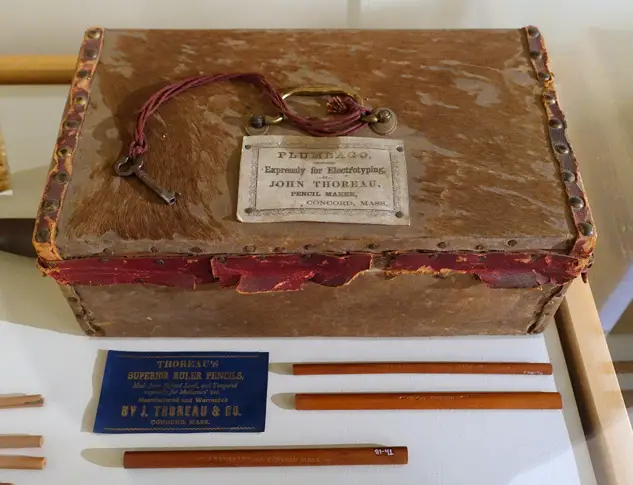
Cashbox, pencils and labels from John Thoreau and Company
In addition, like Conté, the younger Thoreau invented a scale of hardness (numbered 1 through 4) that depended upon the ratio of graphite to clay. No. 2 had a balance of both items, offering a compromise of hardness and legibility. After several decades, the Thoreau family ended pencil-making in 1853 to sell their graphite more profitably for use in replicating printing plates (electrotyping).
The Industry Expands
Besides Munroe and the Thoreaus, there were other notable pencil makers in the area. Joseph Dixon (1799-1869) began making graphite pencils by hand around 1829 in Salem, Mass. He later moved to New Jersey in 1847, where he became a mass producer. His Dixon-Crucible Company acquired the American Graphite Company in Ticonderoga, N.Y., in 1873. Benjamin Ball (n.d.) made his squared lead (graphite) pencils in Harvard, Mass., between the 1820s and 1850s. Horace Hosmer (1830-1894), a Thoreau employee, independently made pencils in Acton during the mid-19th century.
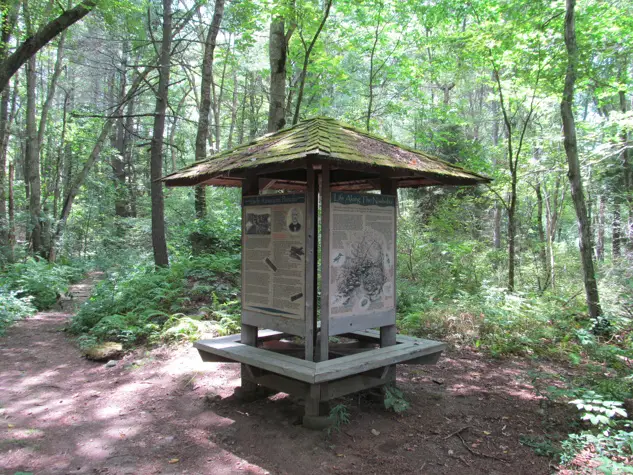
A kiosk marks the site of what was once an Acton, Mass., pencil factory.
By the 1850s, pencil-making had started to shift slowly away from Concord toward New York and New Jersey. There, mass production firms emerged in the decades after the Civil War. These included Eberhard Faber Company and the Eagle Pencil Company in New York. New Jersey pencil makers included the Joseph Dixon Crucible Company, the American Pencil Company and the General Pencil Company.
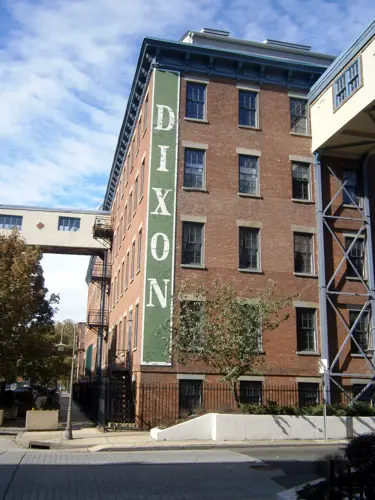
Dixon Mills, a Jersey City landmark
Finally, Erasers
The Concord era pencils did not have erasers attached. Hymen Lipman (1818-1893) of Philadelphia received a patent for a rubber eraser slotted into the end of a pencil. However, the Supreme Court invalidated it in 1875 because the combination was not an “inventive act.” Later, pencil makers used a metal band (ferrule) and an attachment to secure the eraser.
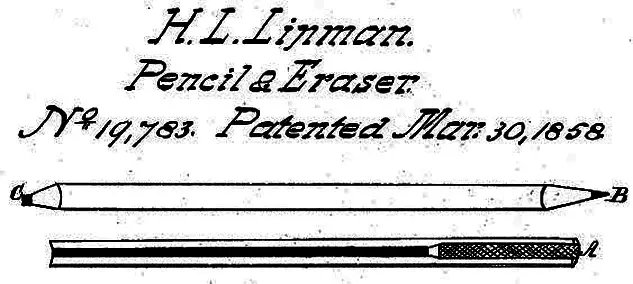
L & C Hardtmuth, an Austrian-Hungarian company, pioneered the first well-known yellow pencil at the world’s fair in Paris in 1889. The Americans who mass-produced pencils began adopting it in place of the traditional unpainted red cedar wood in the 1890s. The famous Dixon-Ticonderoga No. 2 yellow pencil did not appear until 1913.
Edward T. Howe, Ph.D. is Professor of Economics, Emeritus, at Siena University near Albany, N.Y.
***
Hundreds of curious facts and surprising stories from all six New England states. click on the image to order your copy today!
Images: Dixon Mills, By Hudconja – Own work, CC BY-SA 3.0, https://commons.wikimedia.org/wiki/Special:Redirect/page/17527918. Acton pencil factory site By John Phelan – Own work, CC BY-SA 3.0, https://commons.wikimedia.org/wiki/Special:Redirect/page/20548478. Graphite By Rob Lavinsky, iRocks.com – CC-BY-SA-3.0, CC BY-SA 3.0, https://commons.wikimedia.org/wiki/Special:Redirect/page/10164225. Featured image created by Google Gemini.