
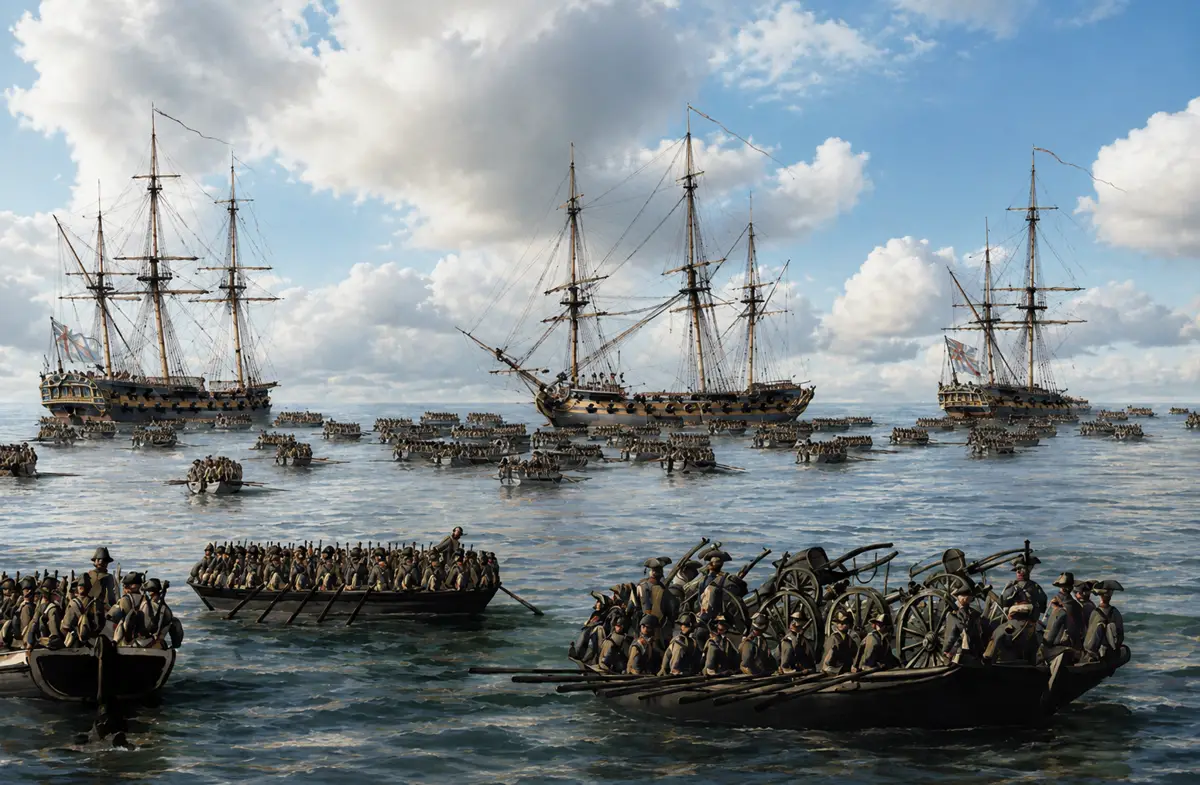
The French alliance with the American colonies in the Revolutionary War set in motion a series of events that left British warships, including the frigate Orpheus, at the bottom of Narragansett Bay. For nearly 200 years, the vessels sat in the mud, completely forgotten. Then a curious University of Rhode Island student found two of the vessels. Today, you can visit artifacts from the frigate Orpheus at the Naval War College in Newport, R.I.
History books rarely even mention how Orpheus, Juno, Lark and Cerberus ended up on the bottom of Narragansett Bay during the American Revolution. This is the story of their sinking and their recovery.
Scuttling of Orpheus
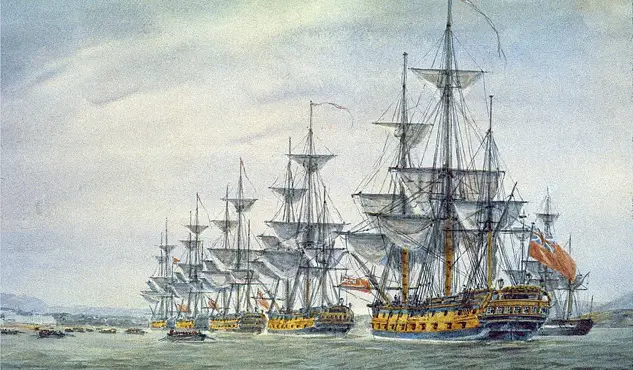
British warships entering Newport
In December 1776, a large fleet and thousands of British troops occupied Newport without serious resistance. They seized one of the finest harbors in America and tightened their grip on the region’s commerce.
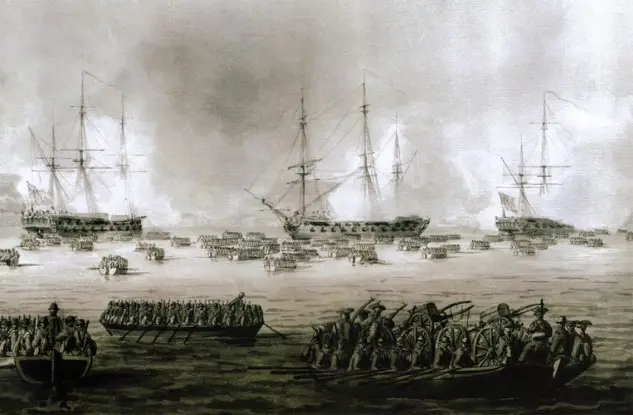
British troops landing in Newport
For nearly two years, the British occupation held. Then, in 1778, the balance shifted. A new alliance with France brought that country’s powerful fleet to American waters.
The arrival of the French fleet off the coast of Rhode Island forced the British to act. They made the desperate decision to leave Orpheus on the bottom of Narragansett Bay.
The French arrived off Point Judith on July 29 (18 miles from Newport Harbor). That set in motion pre-arranged acts of destruction and abandonment.
The British Royal Navy had decided to destroy four of their formidable warships rather than let the French capture them. They first unloaded the guns and most supplies in preparation for scuttlings.
The main French fleet entered Narragansett Bay on August 5. HMS Orpheus, a 32-gun frigate with 220 crew, was run aground at Almy’s Point. The British set it on fire a few miles north of Newport on the west side of Aquidneck Island. Juno, Lark and Cerberus suffered the same fate.
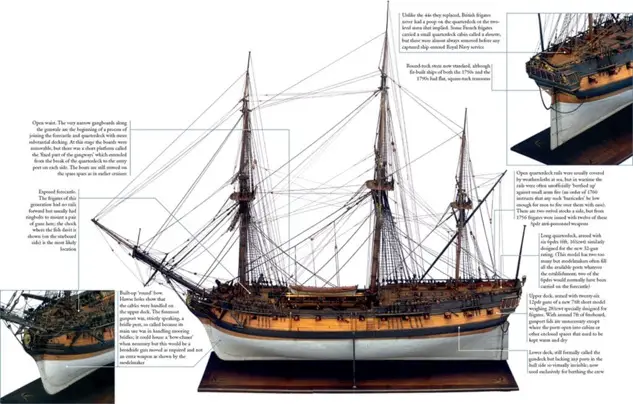
Finding the Wrecks
The hulls of these once formidable ships were largely forgotten for nearly 200 years. They settled into the muddy bottom of the Bay in what is now Portsmouth, R.I., except for Juno, farthest south in Middletown.
Then a graduate student in ocean engineering at URI found inspiration in British and American maps created shortly after the mass scuttling. In 1972, Al Davis located the remains of Lark and Cerberus by visual observation. His discovery convinced URI’s ocean engineering department to assume overall responsibility for the entire project.
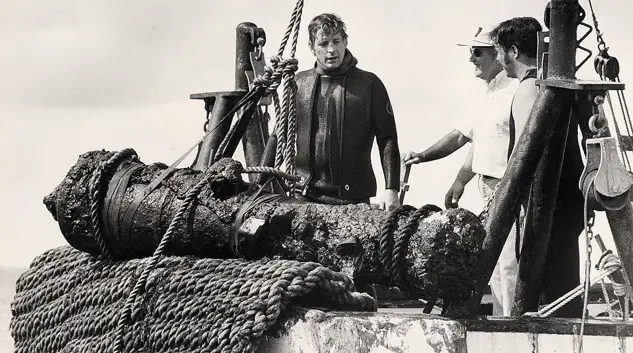
Researchers discovered Orpheus in October of 1973 using acoustical remote sensing and visual observation of air bubbles caused by decay of her wooden timbers. She was selected for excavation due to several factors including minimal current and the convenience of a nearby recreational marina.
In the summer of 1974, URI offered two field sessions excavating Orpheus. I was fortunate to participate as an undergraduate student. By early September of that year, 84 feet of her keel had been exposed and thousands of artifacts had been recovered.
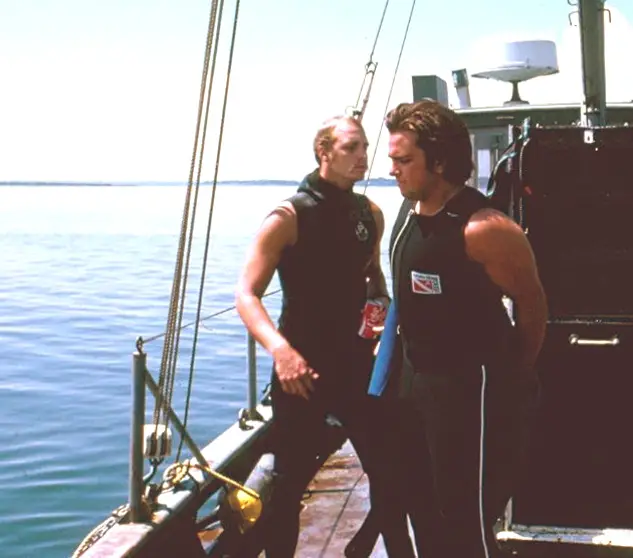
The author dressing to dive for Orpheus
Frigate Orpheus at the Naval War College
The Naval War College Museum now exhibits a representative sample of these item, including one of her 12 swivel guns. These artifacts include iron and lead cannon balls. Most surprising, they include wooden rigging blocks and even a leather shoe sole. It is estimated that less than 10 percent of the artifacts have been recovered from Orpheus site due to insufficient funding.
The Rhode Island Historic Preservation Commission in Providence loaned the artifacts on display. Th RIHPC also holds the remainder of items recovered.
These artifacts provide tangible evidence of a naval action scarcely mentioned in most history books. They also represent the tip of the iceberg of what remains in the waters of Rhode Island.
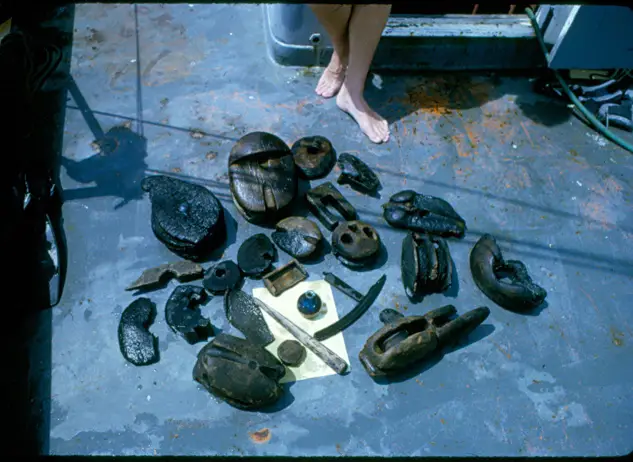
Artifacts from the Orpheus wreck
The anaerobic site conditions and the rapid burial of the heavy timbers account for the excellent organic preservation of Orpheus’ wood and leather. The burial of the timbers also protected the wreck site by preventing the destructive marine mollusk teredo navalis from devouring exposed wood much like underwater termites.
At the time Orpheus sank, the Royal Navy began experimenting with copper sheathing on hulls. The copper mitigated marine growth and teredo damage, much like toxic chemicals in bottom paint used today.
This incredible state of preservation is even more remarkable considering the intensive commercial and military activity that occurred just yards away. It began in the Civil War. In 1862 Lovell General Hospital was built to care for both Union and Confederate soldiers near the remains of Orpheus. A long pier accommodated the steam vessels bringing in the wounded. By the end of the war, Lovell cared for 10,593 patients.
A coaling station followed later in the 19th century, as well as the United States Navy’s principal Patrol Torpedo (PT) Boat Training Facility, or Melville. Melville stood just a stone’s throw from Orpheus wreckage site during World War II.
End Notes
Robert Cembrola spent 32 years at the Naval War College as curator and exhibitions manager. All photos courtesy of the author. Featured image colorized by ChatGPT.
***

Fully Updated & Expanded: This third edition includes new itineraries, a hundred new landmarks and even more stories to enrich your adventure.
Click here to order a paperback or ebook.