
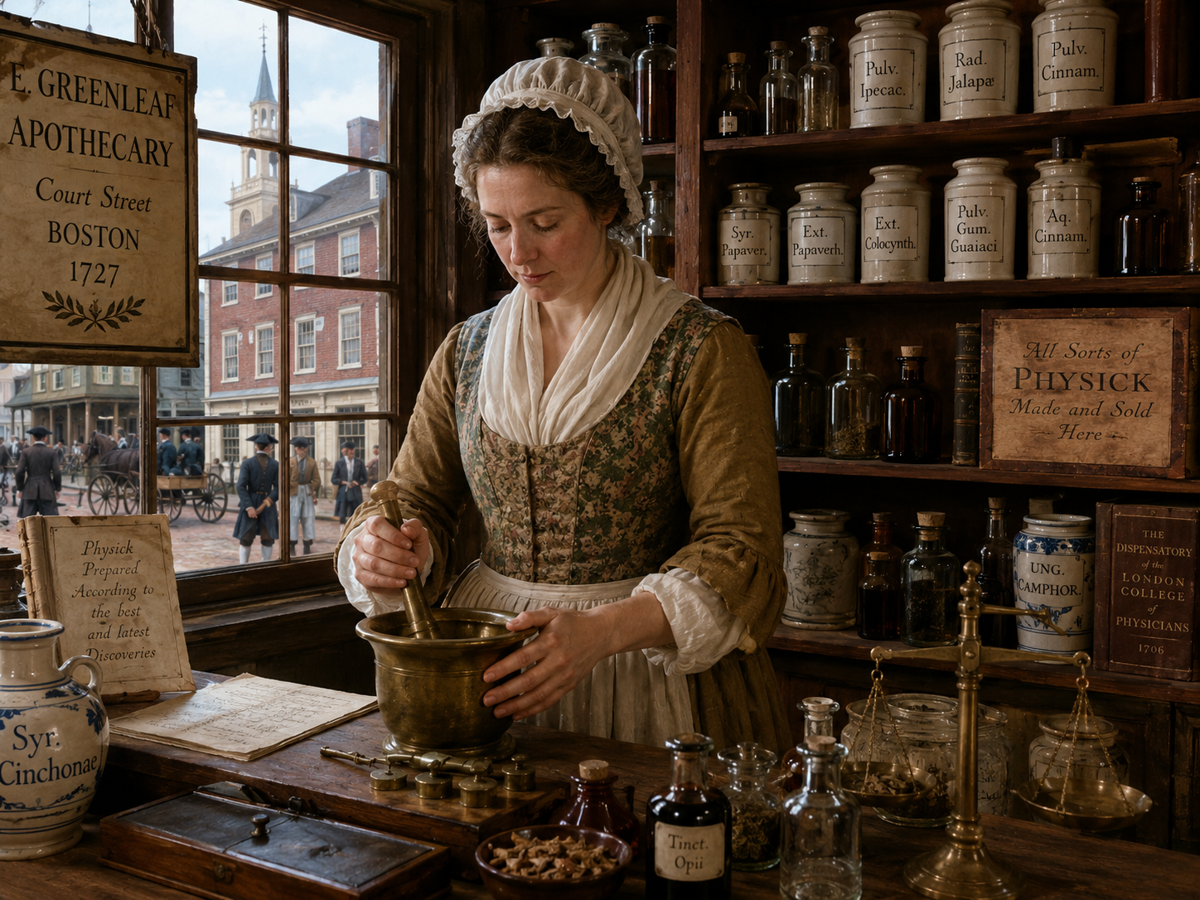
 When Elizabeth Greenleaf (1681-1762) opened her shop in Boston in 1727, she became the first female pharmacist in New England and colonial America. After her death in 1762, the Greenleaf apothecary continued in business until the early 19th century.
From the 17th to the mid-to-late 19th century, a pharmacist was known as an apothecary. This medical generalist often diagnosed illnesses, provided remedies, and performed minor surgery (e.g., bloodletting, treating broken bones). While not trained as apothecaries, Gov. John Winthrop (1588-1649) and his son John, Jr. (1606-1676), helped to treat the sick in Boston after their arrival in the Massachusetts Bay Colony. Their remedies included European imports (e.g., spices), local herbs and minerals (e.g., antimony and iron).
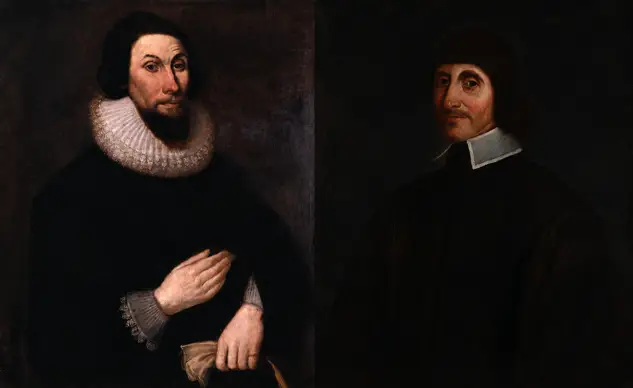
John Winthrop and John Winthrop, Jr.
Robert Cooke (c. 1615-?) joined them in 1639 from Britain. He was the first trained apothecary to practice in colonial America. William Davis (1617-1676) soon opened his dispensary or apothecary shop in Boston in 1646. It became the first in all of the colonies. Over time, the number of apothecaries in Boston grew, reaching about 14 in 1720. All of these were operated by men, but a woman would soon be among them.
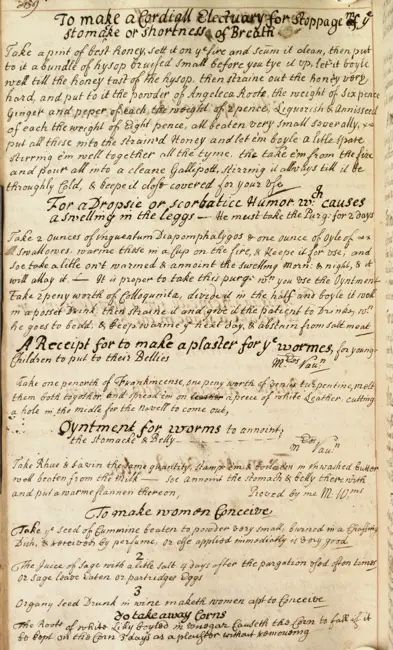
18th-century medical remedies collected by a British gentry family
Elizabeth Greenleaf
Elizabeth Gooking Greenleaf (1681-1762) was born on Nov. 21, 1681, in Cambridge, Massachusetts Bay Colony, to Samuel and Mary Gooking. On Nov. 18, 1701, she married Daniel Greenleaf (1680-1763) in Cambridge. After their marriage, they moved to Yarmouth, Mass., on Cape Cod. Daniel had agreed to become pastor of the local Congregational church. He and Elizabeth then raised 12 children. As an apprentice, Elizabeth received practical training in preparing medicines from her husband. He had become a Harvard-educated physician before turning to the ministry. Thus, he provided both spiritual and medical care to his parishioners. After resigning from his ministerial position in 1727—following years of disagreements with his congregation—Daniel and Elizabeth decided to open an apothecary shop on Court Street in Boston. No existing law prohibited Elizabeth from doing so.
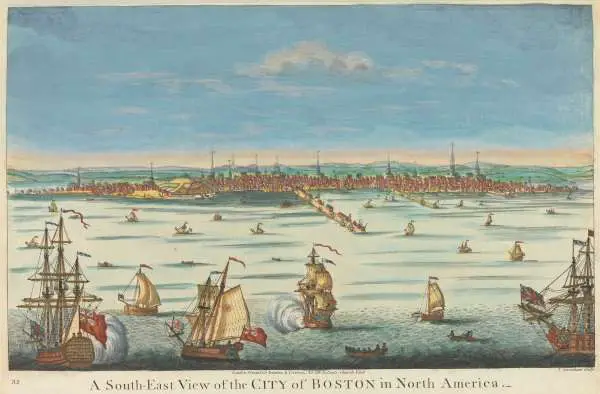
Boston in 1720
Elizabeth—joined later by Daniel—owned the shop. Together they prepared a variety of compounded medical remedies. Although no historical inventory of specific medications in the Greenleaf apothecary shop is known to exist, several well-known ingredients were commonly used by apothecaries at that time. They included plant-based items (cinchona bark, opium, jalap and camphor), salts, honey, fats, insects and others. These ingredients could be used in combination to make pills, powders, ointments, lotions, tinctures (i.e., concentrated liquid extracts) and other compounds.
Both Elizabeth and Daniel Greenleaf operated their business until their deaths from advancing age. Elizabeth died on Nov. 17, 1762. Daniel died on Aug. 26, 1763. Both are buried in the King’s Chapel Burying Ground in Boston.
Apothecary to the Revolution
Dr. John Greenleaf (1717-1778) took over the apothecary shop after the death of his parents. Beginning on April 4, 1775 (two weeks before the battles of Lexington and Concord), the Greenleaf apothecary sold medical supplies to the Continental Army. It continued to supply both the army and navy during the Revolutionary War. His nephew, Daniel Greenleaf (1762-1853), took over the shop following the death of his uncle in August 1778. Daniel ran the business until 1824 when he decided to retire to Quincy, Mass. He was the last owner of the Greenleaf apothecary in Boston.
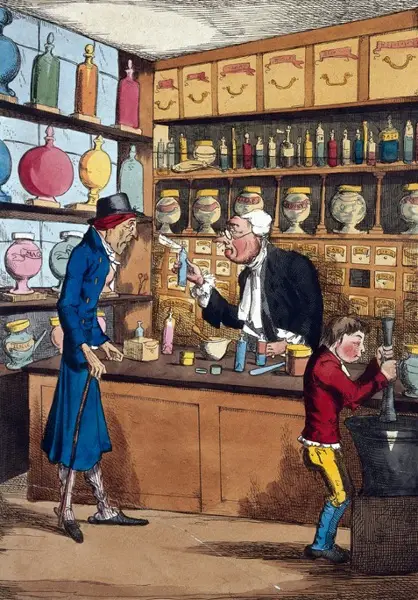
A 19th-century apothecary’s shop, with an apprentice working the mortar and pestle. Coloured etching by H. Heath, 1825. Image courtesy of the Wellcome Collection (CC).
Edward T. Howe, Ph.D. is Professor of Economics, Emeritus, at Siena University near Albany, N.Y.
***

Fully Updated & Expanded: This third edition includes new itineraries, a hundred new landmarks and even more stories to enrich your adventure.
Click here to order a paperback or ebook.
Featured image by ChatGpt.