
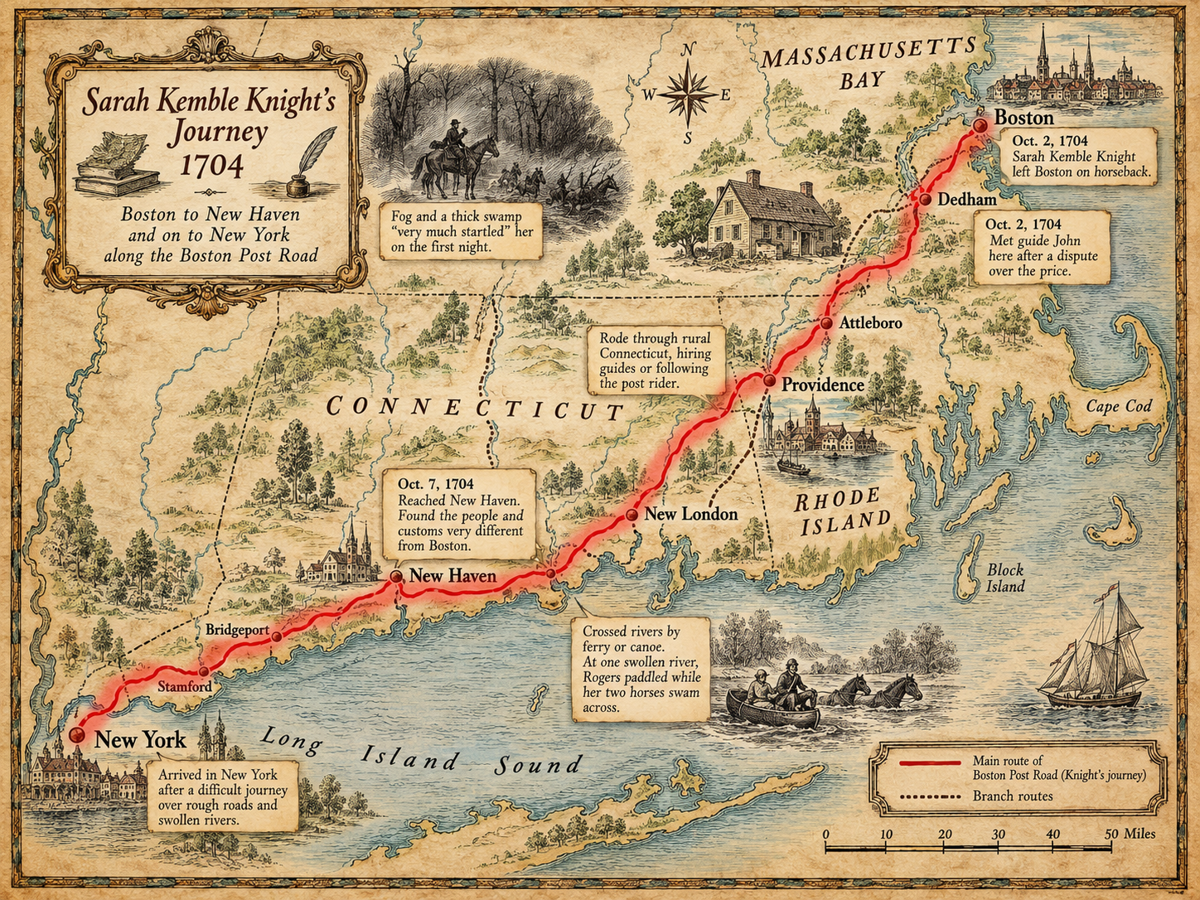
 In 1704, Sarah Kemble Knight made an extraordinary journey. A 38-year-old widow, schoolmistress and businesswoman known as Madame Knight, she rode on horseback from Boston to New Haven and then to New York along the Boston Post Road.
Women did not generally travel such distances unescorted in colonial America. The road itself was barely a road in places, with few bridges, no signs and primitive inns. Travelers depended on post riders and local guides to show them the way.
Knight not only made the journey. She kept a journal describing it with a sharp eye and a dry sense of humor. “[t]he Rodes all along this way are very bad,” she wrote, “Incumbred with Rocks and mountainos passages, wch were very disagreeable to my tired carcass.”
Her journal offers a vivid glimpse of travel in early 18th-century New England — and of the people she encountered along the way.
Madame Knight Takes to the Road
Sarah Kemble Knight was the daughter of Boston merchant Thomas Kemble and Elizabeth Trerice. She married Richard Knight, a tavernkeeper and bricklayer, and they had one daughter.
After her father and husband died, Knight ran a boarding house, operated a writing school and copied legal documents. She was well educated and she knew the law.
In 1704, she was asked to settle a relative’s estate in New York. Knight agreed, expecting that she would have to travel only as far as New Haven.
On Oct. 2, 1704, Madame Knight left Boston on horseback. She knew enough about the journey ahead to hire guides or to accompany the post rider.
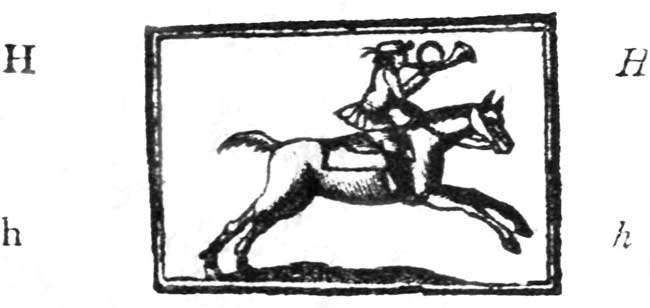
She rode to Dedham outside of Boston, expecting to meet the post rider. There she learned he had stopped 12 miles short of the village. At a local tavern she hired a guide, a local man named John, to take her to the post rider.
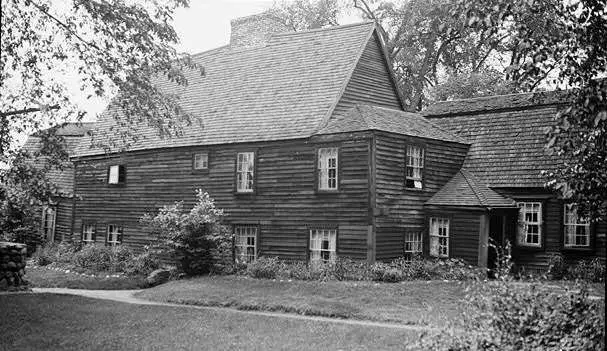
Fairbanks House, photo courtesy Library of Congress
Before they left, however, Knight argued with the tavernkeeper over the price. She refused to pay what she considered a ripoff, writing that she would not be “accessary to such extortion.” Madame Knight stood her ground and negoiated a price directly with John that she considered fair.
Finally they set out.
As darkness fell, a fog settled over the road. They came to a thick swamp, which “very much startled” Knight. John, undeterred, helped her make her way through.
About an hour later they reached a place called “Billinges,” where Knight expected to spend the night.
Her arrival caused almost as much alarm as the swamp.
“I Never See a Woman on the Rode”
Knight had barely entered the house when the eldest daughter began peppering her with questions.
“Law for mee — what in the world brings You here at this time a night?” the young woman demanded. “I never see a woman on the Rode so Dreadfull late.”
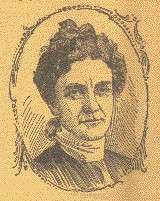
Sarah Kemble Knight (19th century illustration)
Who was Knight? Where was she going? Why was she traveling at such an hour?
Knight explained to the ill-mannered daughter that she was going to meet the post rider the next day. The young woman eventually drew up a chair and then disappeared upstairs. When she returned, she wore several rings, apparently hoping to impress her visitor.
Knight observed that the young woman’s grandmother’s new pig would have affected her just as much.
Knight then paid John and asked the girl to show her where she would sleep. She was led to a tiny parlor where the bed nearly filled the room. The bedstead was so high that Knight had to climb onto a chair to reach it.
Exhausted, she stretched out on the “wretched bed” and began to reflect on the day’s adventures.
Connecticut, a Foreign Country
Knight reached New Haven five days after she set out.
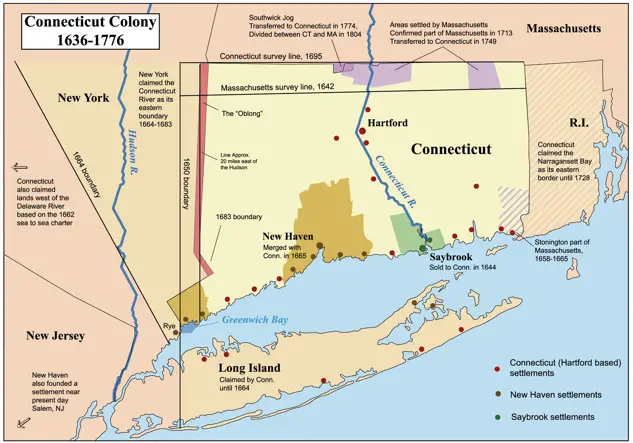
To a Bostonian, Connecticut was a foreign country — more rural than Massachusetts and more diverse. Thousands of immigrants had arrived from Germany, Scotland, Ireland, the Netherlands and France. Knight, a proper Bostonian, found their manners, clothes and customs endlessly amusing.
She conceded that many of the people were “good, Sociable people, and I hope Religious too.”
But she thought they lacked the polish and education of Boston.
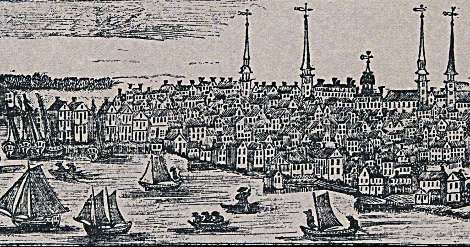
Woodcut of New Haven, 1786
Connecticut’s laws also caught her attention. She thought the colony was especially strict about youthful behavior. Judges, she noted, sometimes ordered whippings for offenders and punished young people for what Knight considered “harmless kiss[es]” and “innocent merriment.”
The irony was not lost on history: Knight’s own father had once spent two hours in the stocks for kissing his wife on Sunday after returning from a long ocean voyage.
Knight also found the colony’s political and social customs entertaining.
On Training Days, young men competed at shooting targets. The winner received yards of red ribbon, which he tied to his hatband before he was led away in triumph. Knight compared the spectacle to the Olympic Games.
She was equally amused by Connecticut weddings. Just before the ceremony, she wrote, the bridegroom would leave the room, only to be followed by the bridesmen, who would essentially drag him back to his duty.
“Bumpkin Simpers”
Knight observed that country customers often stood silently in merchants’ shops for a long time, apparently intimidated by the merchants to whom they frequently owed money.
In one Connecticut shop, she encountered a tall country man with his cheeks full of tobacco. He chewed and spit as he stood in the room, staring around him like a “cat let out of a basket.” Knight called him “Bumpkin Simpers.” At last he opened his mouth. “Have you any ribbon for hatbands to sell, I pray,” he asked.
He eventually asked whether the merchant had ribbon for hatbands. When he finally bought the ribbon he exclaimed, “It’s confounded gay, I vow.”
Then, beckoning to the door, “in comes Joan Tawdry, dropping about 50 curtseys and stands by him: he shows her the Ribbon.”
She bought hood silk and thread, and the pair left.
Madame Knight noted that merchants accepted many forms of payment, including grain, pork, beef, pieces of eight, Massachusetts coins and wampum.
A customer might enter a shop and ask for an item, only to have the merchant first ask, “Is Your pay ready?”
“What do You pay in?” the merchant would then ask.
Madame Knight on Connecticut
Knight’s observations also reveal the assumptions and prejudices of a prosperous Boston woman of her time.
She was surprised that Connecticut farmers allowed enslaved people to sit at the table and eat with them. She described this as excessive familiarity.
Knight also recorded stories about Native people who lived on their own land and governed themselves. She noted, however, that English authorities might punish them for offenses committed on English ground.
New Haven to New York
Knight spent about two months in New Haven. There she discovered that her business could not be completed without going on to New York.
Fortunately, her kinsman Thomas Trowbridge also had business there and agreed to travel with her.
On December 6, they set out.
They crossed the Stratford ferry and continued toward Fairfield. The next day they reached Norwalk, where Knight enjoyed a dinner of fried venison.
Then came the difficult ride to Rye. They had to walk and lead their horses for nearly a mile up a “prodigios high Hill.” By about 9 that night they reached a French family’s ordinary.
Knight was hungry and ordered a fricassee. The cook prepared it so badly that she gave up on supper and went to bed hungry.
The accommodations were scarcely better. Her bed was hard, the covering was inadequate and the room was crowded with furniture. She spent most of the night awake and finally got up at about three in the morning to sit by the fire.
By breakfast the next day, she was ready to continue.
They reached New Rochelle, a French Huguenot settlement, and had a good breakfast. About an hour before sunset they finally arrived in New York.
Knight liked the city.
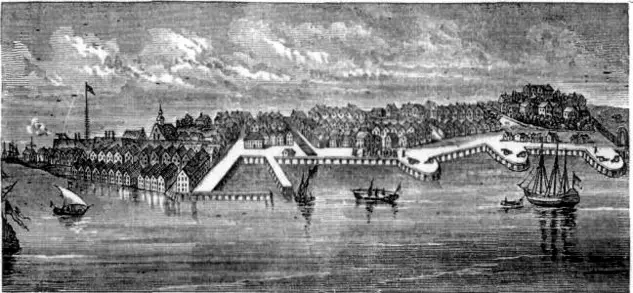
New York in 1700
She admired its neat brick houses, pleasant manners and fashionable clothing. After spending a fortnight there settling the estate, she was reluctant to leave.
Lost in a Snowstorm
On Dec. 21, Knight set out for home.
She hoped to reach New Rochelle that night, but she and her companions became lost about four miles short of the town. Then a storm of wind and snow struck them as darkness fell. “We were very uneasy,” she wrote. But a local man opened the door of his cottage to them and let them sit by his fire. His wife was sick and they only had one bed, so he took them to a house where he thought they might spend the night.
Knight then reported they were met at the door by a “surly old shee Creature, not worthy the name of woman, who would hardly let us go into her Door.” Her son, however, took them to a house where Knight found a high, hard bed.
She was cold and sick. Her hosts had little to offer her except milk sweetened with molasses. Knight drank it, promptly threw up and concluded that may nevertheless have helped clear her stomach.
The next morning the weather improved, and the travelers continued.
The journey home would prove nearly as difficult as the journey south.
The Terrifying River Crossing
After completing her business, Knight eventually made her way back through Connecticut.
She stayed with the Rev. Gurdon Saltonstall, later governor of Connecticut, who treated her graciously. Gov. Fitz-John Winthrop also insisted that she stay an extra day and dine with him.
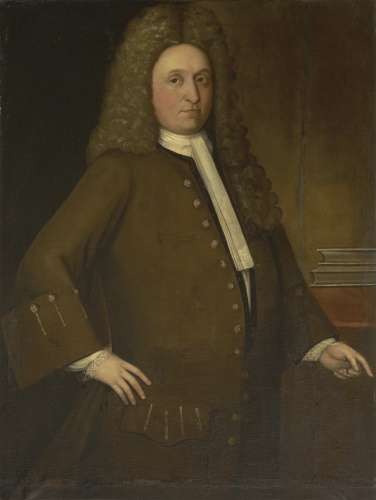
Gurdon Saltonstall
Then Knight continued toward Massachusetts. She hired a guide she called Mr. Rogers.
At one point, heavy rains had swollen a river so much that the travelers feared it was impassable. Their only option was a small canoe.
Knight waited on shore for nearly an hour while Rogers considered the crossing. Finally she got into the canoe.
Rogers paddled upstream along the bank before turning into the swift current. Knight was terrified.
He steered across to the other side, where Knight waited while he returned for the horses.
The horses swam across.
She had made it.
Madame Knight, Home Again
Once back in Massachusetts, Knight encountered another obstacle: spring weather had turned the roads into mud. She described the “sloughy ways thawed by the sun.”
Near Dedham, her horse collapsed “as if dead” while climbing a steep hill.
Knight obtained another horse and tried to continue to Boston, but the roads were still too difficult. She spent another night at an inn.
Finally, on March 3, after five months away from home, Sarah Kemble Knight reached Boston.
There she found her mother and her “Dear and only Child” waiting for her, along with friends and relatives eager to hear about her travels.
Knight was overjoyed.
She thanked God for carrying her safely through her journey and bringing her home.
Her journal was not published until 1825, more than a century after she made the trip. But it remains an rare record of early colonial travel — the primitive roads, dangerous crossings, miserable inns and unfamiliar communities along the Boston Post Road.
Sarah Kemble Knight kept a journal of the trip that wasn’t published until 1825. She opened a boarding house and ran a writing school that earned an excellent reputation. In 1713, her daughter married John Livingston, the son of a wealthy and prominent New Yorker, Robert Livingstron. Madam Knight moved to New London, Conn., to live near her daughter. She spent the rest of her life in Connecticut.
Featured image by ChatGPT. Map of Cononecticut Colony By No machine-readable author provided. Kmusser assumed (based on copyright claims). – No machine-readable source provided. Own work assumed (based on copyright claims)., CC BY-SA 2.5, https://commons.wikimedia.org/w/index.php?curid=1270050
***
Hundreds of curious facts and surprising stories from all six New England states. click on the image to order your copy today!