
 The Massachusetts Charitable Mechanic Association is traceable to the late 18th century. It was formed to promote the diversity of crafts in the Boston area. When necessary, it offered mutual aid to its needy members and their families. It currently provides material support for nonprofit organizations.
Up until the mid-18th century, skilled workers were known variously as artisans, master craftsmen or meckhanic(k)s in New England and the other colonies. They independently worked in small shops to produce handmade quality products for consumers and merchants. In the strata of society, they ranked between the upper class (i.e., merchants, large landowners, and various professionals) and unskilled laborers.
However, from the 1760s through the Revolutionary War, both craftsmen and the merchants of Boston forged shared animosity toward Britain. The craftsmen disliked restrictions placed on local manufacturing (e.g., hats) and competing with cheaper British goods. The merchants realized lower profits from British trading restrictions. Both groups opposed British taxation (e.g., the Townsend Acts of 1767) and supported boycotts against British goods. Thus, the craftsmen began to feel a growing sense of class consciousness and a lessened inferiority in their interactions with the merchants.
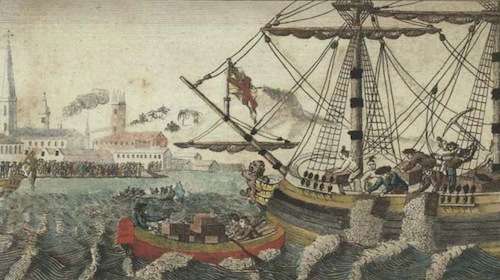
The Boston Tea Party included artisans, mechanics and craftsmen.
Craftsmen Find a Common Cause
After the war, craftsmen in Boston felt some form of organization was needed to enhance their mutual interests. On Jan. 7, 1788, the Association of Tradesmen and Manufacturers of the Town of Boston, initially formed in the spring of 1785 to advocate for protective tariffs, met to support ratification of the federal Constitution. Otherwise, the various trades would suffer as skilled craftsmen left for other areas as commerce deteriorated.
Aware of this meeting, 14 artisans convened on Feb. 27, 1789 to form the Providence, Rhode Island Association of Mechanics and Manufacturers. Thus, they became the first organized group in New England “for the Promotion of Home Manufactures, (for) cementing the Mechanic Interest, and for raising a fund to support the Distressed.”
The Rhode Island association lobbied for tariffs to aid small manufacturing members and advocated for public schools. It continued as a successful organization for its craft and manufacturing members before becoming the Providence Engineering Society in 1894.
A Name Change
After advocating for approval of the federal constitution in 1788, the Association of Tradesmen and Manufacturers of the Town of Boston continued to promote local industry and crafts. In January 1795 the artisans met in Boston to consider the issue of apprentices who left before their required years of service expired. However, they met again on March 15 to focus on the broader interests of its members.
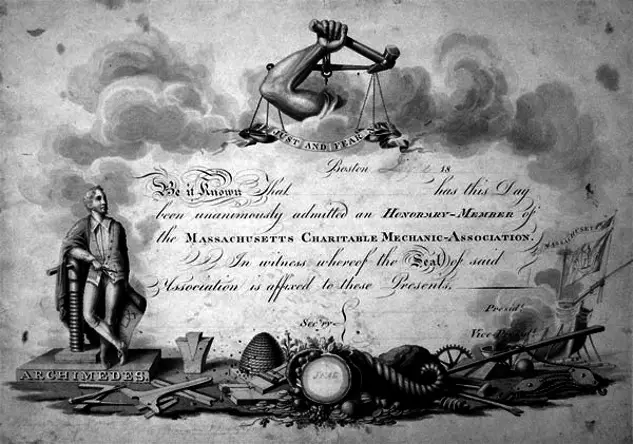
MCMA membership certificate
It adopted a constitution and changed its name to the “Associated Mechanics and Manufacturers of the Commonwealth of Massachusetts.” The constitution stated its purposes were: “To create and sustain a friendly feeling among its associates; to extend the circle of individual usefulness; to encourage industry, and promote inventions and improvements in the mechanic arts; to provide for the instruction of apprentices, and assist young mechanics with loans of money; to help the aged and unfortunate of the associates, and the widows of deceased members in poverty and suffering; and to provide for the burial of its deceased members by gifts deemed sufficient to defray the expenses of an unostentatious ceremony.” Thus, mutual benefits were needed as private insurance plans did not exist. In 1806 this group incorporated as the Massachusetts Charitable Mechanic Association.
Mechanic Association Takes Shape
When it organized in 1795, Paul Revere, goldsmith, became its first president; Edward Tuckerman, baker, vice president; Samuel Gore, painter, treasurer; and John Folsom, printer, secretary. Its 83 original members were master craftsmen and small-scale manufacturers. Members mainly worked in the metal crafts (e.g., goldsmiths, silversmiths and blacksmiths); and building and construction trades (e.g., carpenters, painters and masons). However, many other trades were represented. These included: coopers (barrel makers), curriers (tanned leather finishers), watchmakers, sailmakers, cordwainers (shoemakers), booksellers, printers, bookbinders, engine builders and shipbuilders.
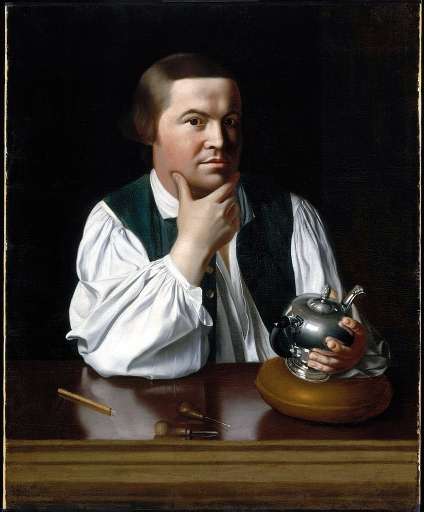
Paul Revere
In an effort to “create and sustain a friendly feeling among the associates,” the Association began holding “Triennial Festivals” from 1809 at Quincy Hall (Market) in downtown Boston. It featured business meetings, speeches, processions and banquets.
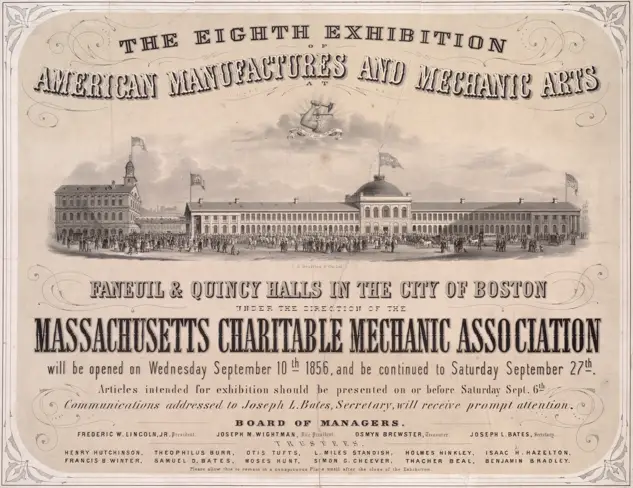
By 1837 the aforementioned festivals had transformed into exhibitions of mechanical crafts. These were generally held every two years at Faneuil and Quincy Halls. Medals were awarded for examples of creative activity involving machinery (e.g., engines), tools (e.g., drills), instruments (both precision and mechanical), metalwork (e.g., iron castings) and a diverse array of other items (e.g. artistic paintings and furniture). Mechanics Hall held the last of these exhibitions in 1902. For 65 years these affairs highlighted the contributions made by Boston craftsmen with the unfolding of the Industrial Revolution. In addition, many members of the Association assisted in the early years of the Massachusetts Institute of Technology, founded by William B. Rogers in 1861.
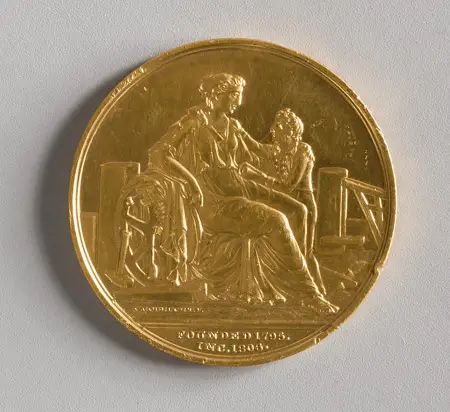
Award to Hammond Typewriter Co., 1887
Mechanic Association Promotes Innovation
As part of its attempt to “promote the mechanic arts,” the Association created the Mechanic Apprentices’ Library in 1820. It closed in 1892 mainly because craft shops had disappeared with the rise of factories, and public libraries offered more materials for study. In 1821, with several of its members serving on the Boston school committee, the committee voted to establish English High School, one of the first public high schools in the United States. Its purpose was to educate boys for jobs in business and trades.
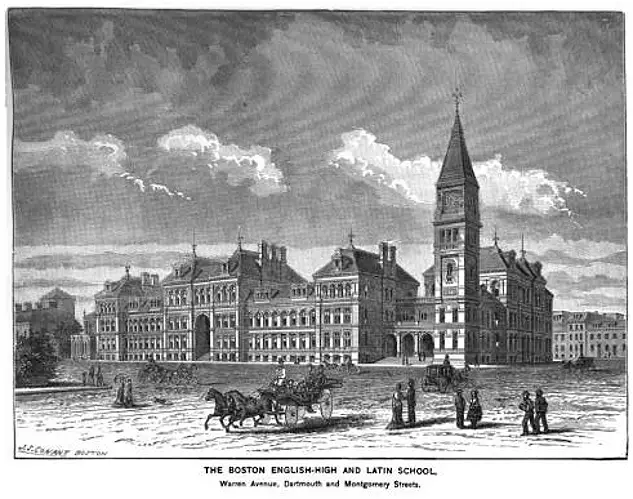
In 1829 the Association created an evening school for mechanical arts. Apprentices could acquire knowledge in mechanics, drawing, mathematics and other subjects. It ceased in 1859 due to lack of interest. However, from 1900 to 1917, the Association operated a trade school that offered practical training in electrical wiring, carpentry, sheet metal work, plumbing and other trades. It had to close as young men enlisted or were drafted to serve in World War I. After the war, the Association offered financial support for students enrolled in Wentworth Institute in Boston, founded in 1904.
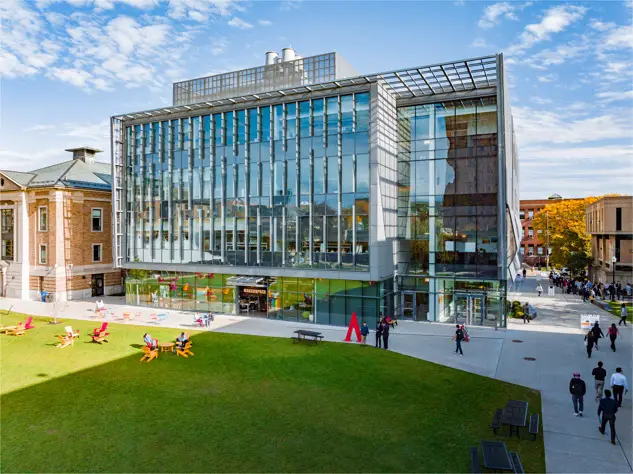
Center for Engineering, Innovation and Technology with Watson Hall on the far left, Wentworth Institute of Technology
From Trade Society to Philanthropy
Throughout the 20th century, skilled craftsmen in the Boston area had to adapt to the decline of manufacturing and the rise of the service economy. They managed to survive, for example, by shifting into specialized construction activity (e.g., new building and restoration projects), becoming entrepreneurs (e.g., making custom furniture and cabinets) and receiving training for employment in emerging industries (e.g., electronics).
Meanwhile, as its members continued to try to adapt, the Association redirected its efforts. In the late 20th century, it began to support small non-profits that focus on mechanical arts (technical knowledge of machinery) and provide vocational training. It also offers programs for disabled workers and youth facing challenges. Acting as a private foundation, its financial support primarily consists of awarding grants for special equipment and tools. It rarely hands out cash grants.
In December 2023 Christina Fuller, a woodworker, became the first woman inducted into the Massachusetts Charitable Mechanic Association.
***

Your Guide to the Living History of New England’s Revolution is Here.
Fully Updated & Expanded: This third edition includes new itineraries, a hundred new landmarks and even more stories to enrich your adventure.
Click here to order a paperback or ebook.
Edward T. Howe, Ph.D. is Professor of Economics, Emeritus, at Siena University near Albany, N.Y.
Images: Wentworth Institute today: By Redsox82 – Own work, CC BY-SA 4.0, https://commons.wikimedia.org/w/index.php?curid=150632875. Featured image by ChatGPT.