
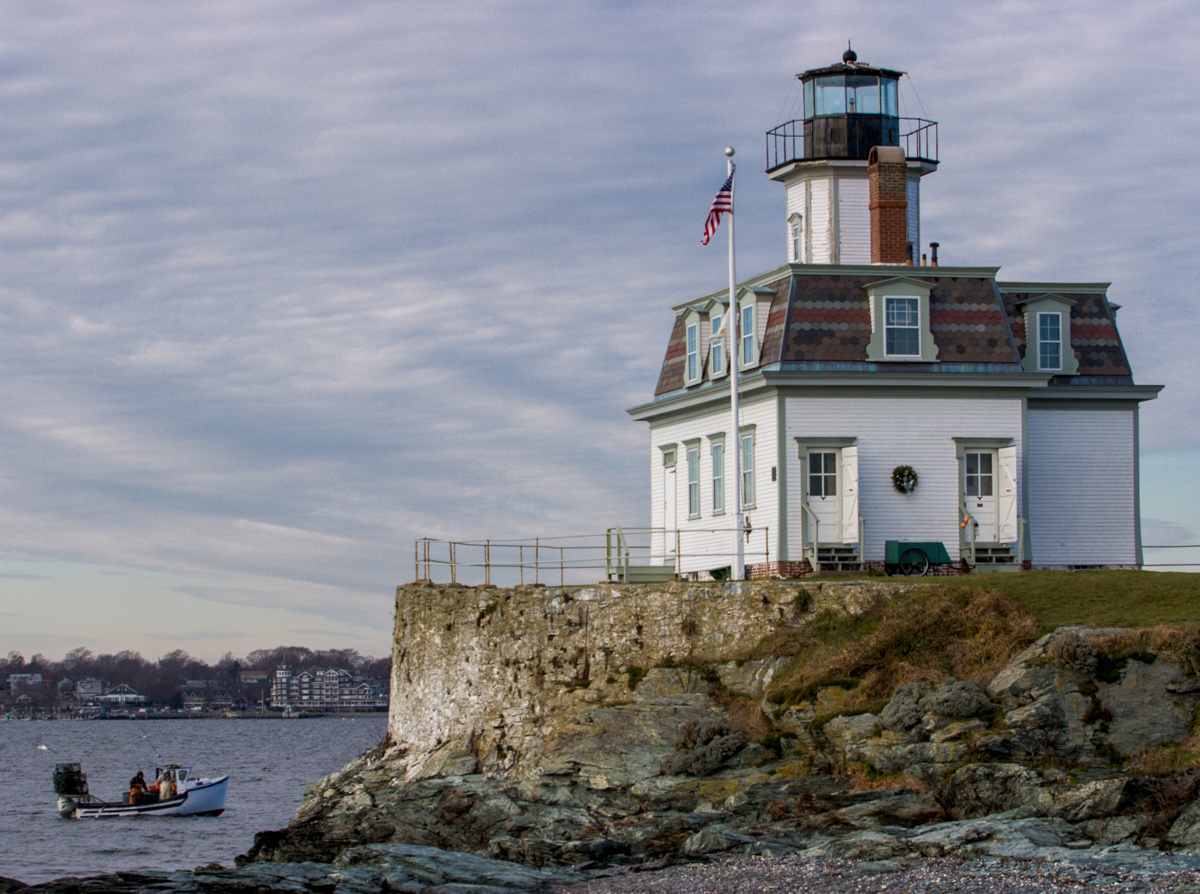
 Rose Island Lighthouse combines military history, maritime heritage and spectacular 360-degree views as one of Newport, R.I.’s most remarkable historic sites.
It may not be Rhode Island’s oldest lighthouse—that distinction belongs to Beavertail, built in 1749—but it occupies one of the state’s most strategic locations.
One of the first landmarks visitors see as they cross the Newport Pell Bridge, the lighthouse once guided ships through the East Passage of Narragansett Bay.
It has served many purposes over the years and today draws visitors from around the world.
Rose Island
Rose Island, which measures 17.5 acres, guards the East Passage into Narragansett Bay, one of the finest protected harbors on the Atlantic coast. During the mid-19th century, hundreds of vessels passed through these waters on their way to the Atlantic Ocean and the ports of Providence, Fall River and Bristol. Numerous shoals and reefs east of the island made a lighthouse essential for safe navigation.
Fort Hamilton underscores its military importance, overlooking the deep-water channel between Rose and Jamestown islands.
Both the lighthouse and the remains of Fort Hamilton are listed on the National Register of Historic Places.
Rose Island Lighthouse
Built for $7,500 in 1870, the lighthouse followed a design by Vermont architect Albert Dow. Dow also designed Sabin Point and Pomham Rocks lighthouses farther up Narragansett Bay. Workers erected it atop Fort Hamilton’s south battery at the island’s southwestern tip. It replaced a privately operated beacon maintained by the Merchants Steamship Company.
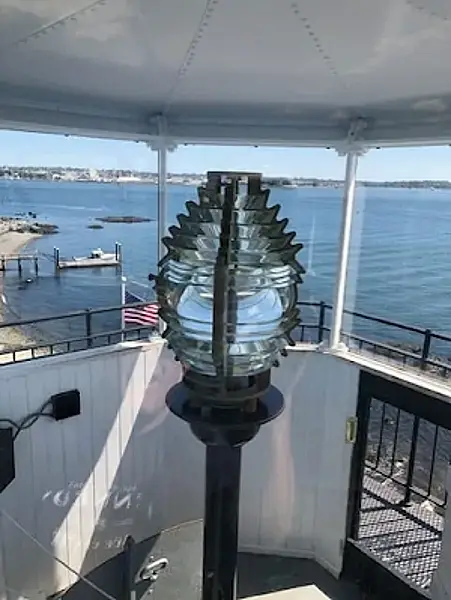
Reproduction Fresnel lens, looking toward Newport
The light entered service on Jan. 20, 1870, displaying a fixed red light through a sixth-order Fresnel lens to warn mariners away from nearby hazards. In 1885 workers added an A-frame tower to house a fog bell that rang every 15 seconds during the area’s frequent fogs.
The U.S. Lighthouse Service staffed the station, initially assigning wounded Union veterans. They lived on the island with their families. In 1939 the U.S. Coast Guard assumed responsibility for the lighthouse.
Storms, Fog and Disaster
Although protected from the open Atlantic, Rose Island has experienced its share of hurricanes, storms and perhaps its greatest hazard—fog.
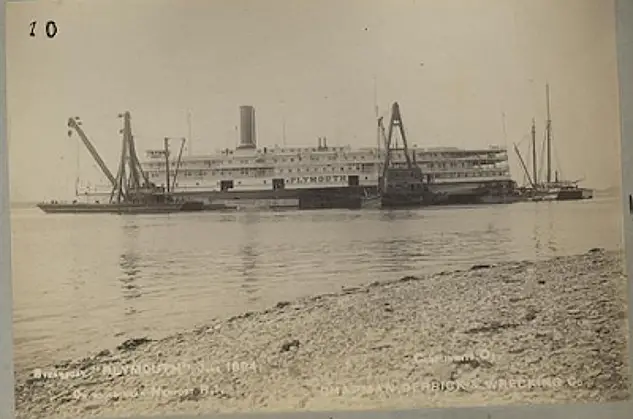
Plymouth aground on Rose Island with salvage crew at work
In 1894 the Fall River Line steamer Plymouth ran aground on the island’s south shore despite the efforts of Capt. Elijah Davis, ironically nicknamed the “Fog Eater.” Fortunately, all 700 passengers reached the island safely, although the vessel remained stranded for quite some time.
The lighthouse itself narrowly escaped destruction on Aug. 7, 1958. That morning the tankers S.E. Graham and Gulfoil collided near Fort Adams and burst into flames after the gasoline cargo aboard S.E. Graham ignited. Disabled by the collision, both ships drifted on the incoming tide directly toward Rose Island. Coast Guard and U.S. Navy fireboats from Newport managed to keep the flames from reaching the lighthouse, but the heat was so intense, even from 200 feet away, that keepers Theodore Bank and Robert Flynn were forced to leave the station until the danger passed.
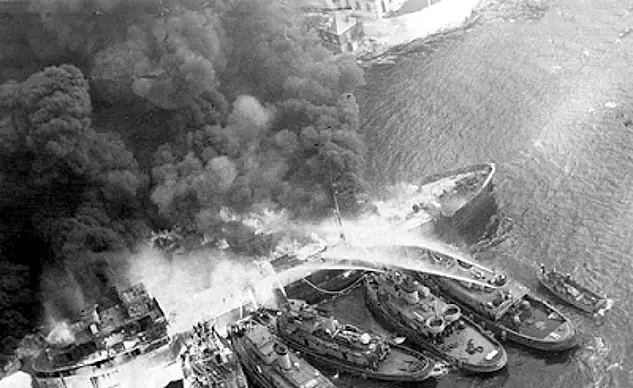
US Navy and Coast Guard vessels fighting fires engulfing S.E. Graham on August 7, 1958,
note proximity to Rose Island Lighthouse
The Bridge Darkens the Light
The completion of the Newport Pell Bridge in 1970 effectively ended the lighthouse’s usefulness as a primary navigational aid. The bridge’s modern lighting system and soaring towers eclipsed the comparatively modest beacon, and the light was deactivated in 1971.
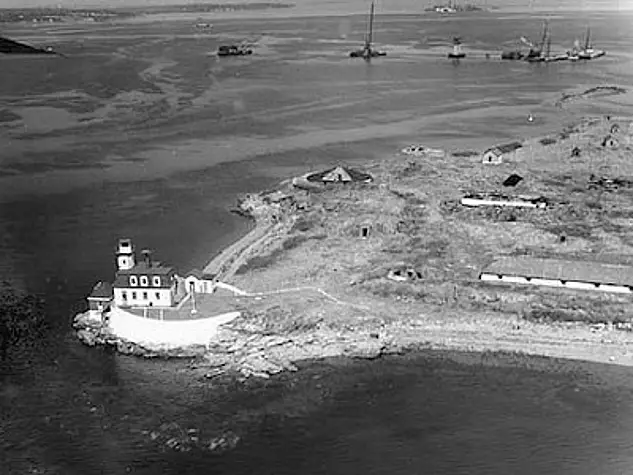
Newport Bridge under construction c. 1967
The buildings were soon abandoned and suffered years of neglect and vandalism. In 1984 the federal government declared the property surplus and transferred ownership to the City of Newport.
Saving Rose Island Lighthouse
That same year, the Rose Island Lighthouse Foundation was formed. With public and private support, volunteers began restoring the neglected lighthouse, and by 1992 it had reopened to visitors.
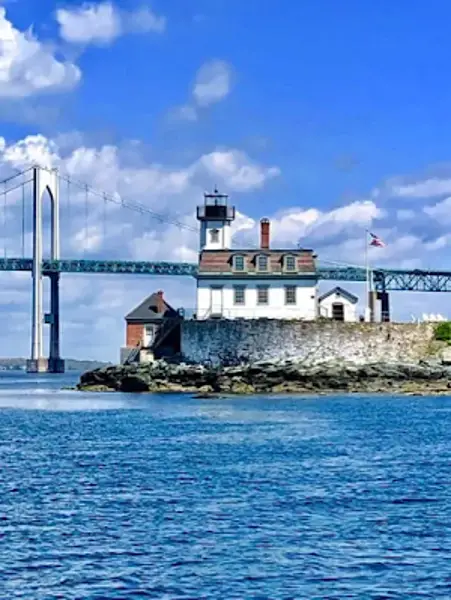
View looking north toward Rose Island 2018
The Foundation acquired the remainder of the island in 1999. Today visitors can climb the tower, tour Fort Hamilton’s remains and even spend the night in the keeper’s quarters or former barracks. A reproduction sixth-order Fresnel lens, installed in 2013, allows visitors to appreciate the technology that once guided mariners safely through Narragansett Bay.
The lighthouse officially returned to service on Aug. 7, 1993, displaying a white light flashing every six seconds. Former caretaker Christopher Owens witnessed the relighting:
“Flipping the switch and watching that beacon light for the first time in 20 years was special, yet for me the magic moment followed seconds later. All was quiet for a moment, then I heard one small horn and another and yet another until we were surrounded by sounding horns from all around the bay. Boats, cars…horns of every sort sounded.”
The Foundation also offers educational programs that let visitors experience what life was like for lighthouse keepers and their families. Guests can even serve as volunteer keepers for a week, performing daily tasks such as recording the weather, raising the flag and monitoring the island’s utilities.
***

Learn how New England’s wild weather affected the course of history in “New England Weather” by the New England Historical Society. Click here to order your copy today.
Images: Fresnel lens by Brian Tefft. Plymouth aground by Merrit-Chapman and Scott. Vessels fighting fire by R. Holmes. Newport Bridge under construction by U.S. Coast Guard. View looking north by Brian Tefft.Featured image By Kenneth C. Zirkel – Own work, CC BY-SA 3.0, https://commons.wikimedia.org/w/index.php?curid=21777409. Postcard PD-US, https://en.wikipedia.org/w/index.php?curid=20754560.
A version of this story originally appeared in the Naval War College Museum blog.