
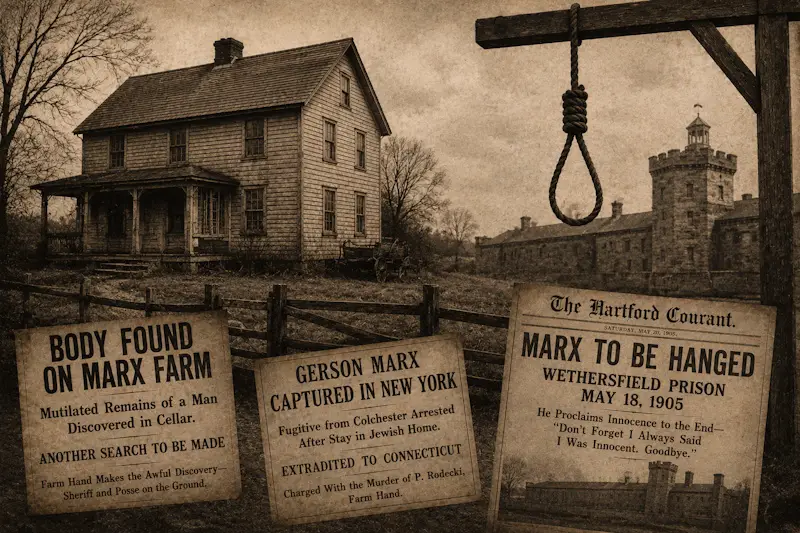
 Gershon Marx went to the gallows at Connecticut’s Wethersfield State Prison May 18, 1905 at the age of 73, leaving behind a wife, children and what the sheriff described as an unknown number of murdered victims.
The specifics of how he got there are well documented. A jury convicted Marx of killing a man, Pavol Rodecki, whom he had hired to work on his Colchester farm. The evidence against him was circumstantial but persuasive. A jury took little time in convicting him.
But how the outwardly humble immigrant farmer came to be the oldest man ever executed in Connecticut leaves more questions than answers. And nothing explains his final words to the prison warden: “Don’t forget I always said I was innocent. Goodbye.”
Wales, Women and Wandering

Varitek, CC BY-SA 3.0 <https://creativecommons.org/licenses/by-sa/3.0>, via Wikimedia Commons
According to the available records, Marx was born in 1832, most likely in Russia or, some sources say, Poland. It was an era of rapidly shifting attitudes toward Jews in Europe. Antisemitism was increasingly being encoded in law in Eastern Europe. Meanwhile, humanitarians developed various schemes to assist Jewish refugees escaping persecution.
Marx’s life took him from his Eastern Europe roots to England and Wales, where he had a well-documented career in a number of businesses in the town of Pontypridd.
He sold wallpaper, was a cattle trader, and ran a butcher shop. He was evidently attractive to women, because he marred four times, three recorded as public ceremonies. Once to a woman from Manchester, the daughter of the caretaker of the Pontypridd Synagogue and a third time to a woman from London.
It’s unclear where his fourth wife came from, but records indicate the woman, Dina, spoke little English and had several children with Marx.
While it may seem odd today, it actually would not surprise anyone that a semi-successful Jewish Welch businessman would sell up his business interests around 1897 and move to Connecticut to become a farmer.
Coming to America
By the turn of the century, there was a steady influx of Eastern Europeans to the Americas.
In 1891, German Jewish financier and philanthropist Maurice de Hirsch founded the Jewish Colonization Association, which helped relocate Jews from Europe and Asia to North and South America.
While employment offered by American mills drew many Jewish refugees, the Jewish Colonization Association specifically wanted to remove Jews from ghettos and establish them as farmers. This was the same era when the kibbutz movement sprang up.
Connecticut farms were struggling to compete with midwestern farms, where the fields weren’t littered with rocks and hamstrung by steep slopes. The Connecticut farms were available at modest prices, perfect for the association to purchase for resale at attractive terms to Jewish settlers.
Colchester and surrounding towns became home to a growing community of Jewish farmers, who not only used the farms to raise livestock and vegetables, but also as retreats or vacation spots for city-dwellers looking to escape the summer heat. Hence the nickname, ‘The Connecticut Catskills.’
The association’s terms for farms were generous. Buyers would hand over a portion of the purchase price and pay back the rest at low interest rates. Marx reportedly bought the Colchester farm in 1897 and moved to it as his home in 1901.
A Connecticut Schlemiel
Neighbors never thought Marx’s farm was anything out of the ordinary. It was, like all of his ventures, modestly successful, run down but apparently profitable.
Marx was a short, slight man, about five feet tall and weighing 135 pounds. His demeanor was one of aggressive humility. Though he was said to be a tough negotiator in business, he also went out of his way to appear a supplicant. He would greet men with a kiss on the hand or hands, an old-school gesture that no doubt helped manufacture trust.
In this way, he disarmed his associates while still negotiating tough terms. Marx’s approach to business was not terribly successful. Newspapers noted that after his arrest, his children were placed in the poorhouse.
But even his most suspicious associates could not have predicted this nebbish of a man was really a brutal, mass murderer.
A Missing Man
In the Spring of 1904, neighbors began asking what had happened to Pavol Rodecki (sometimes identified as Paul). Rodecki had come to Marx’s farm in the fall as a hired hand. He had left six months later.
Marx reportedly told anyone who asked that Rodecki had moved on to seek work in the mills. The explanation would have made perfect sense; it was not unusual for laborers to move to farms and back to factories as the demand for labor waxed and waned.
But the story fell apart in August. Marx hired a new farm hand, Joe Strange, and as one of his tasks he assigned him to fill in a hole in the basement of the farmhouse. Strange set to work but grew curious about some sacks that were in the hole. He opened one and discovered parts of Pavol Rodecki’s mutilated body, he would tell police.
Strange would later say that Marx attacked him and tried to prevent him from fleeing the farm to report his find, but he escaped and alerted the town.
By the time police arrived to search the basement of Marx’s farmhouse, he had disappeared.
The Search for Bodies
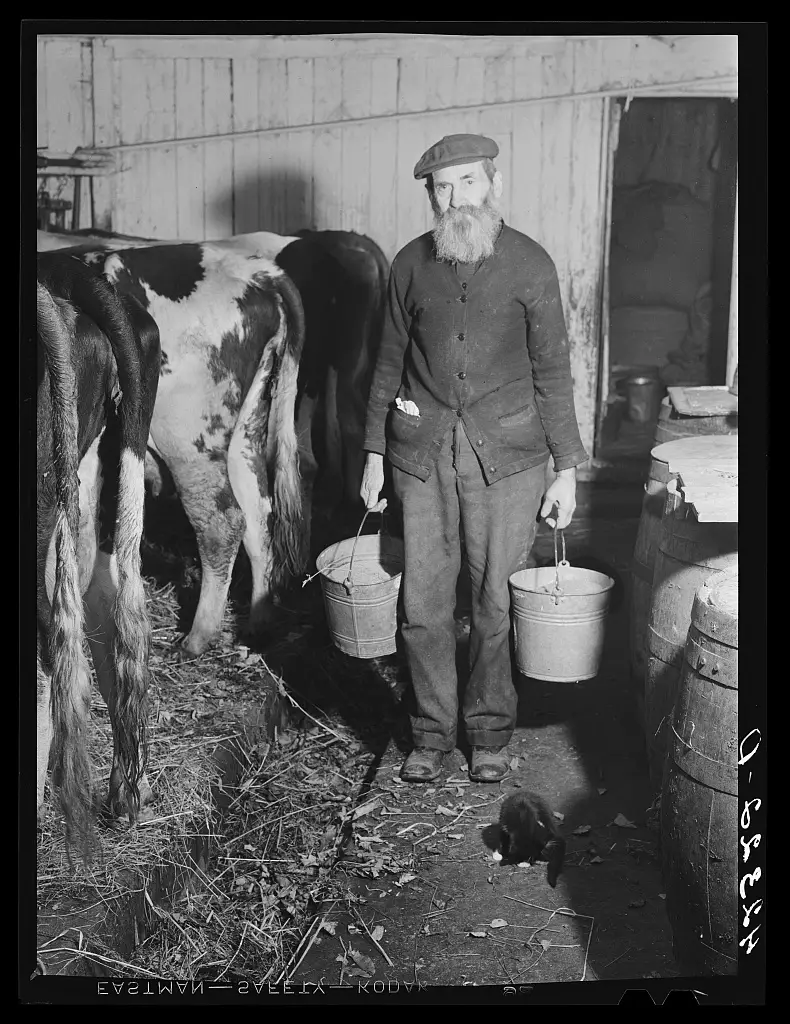
Mr. Abraham Lapping. He and his wife run a small poultry farm and take in tourists during the summer. They are part of the Jewish community in Colchester, Connecticut / Library of Congress
With Marx gone, people around Colchester began recalling other people who had disappeared. Nothing seemed suspicious at the time, but now, with a cut-up corpse in hand, people began wondering and searches began.
Within days, searchers found a second body buried at the farm. The body of Joe Palm was found similarly dismembered and buried. The narrative took shape. Marx, struggling financially, had hired these men for six-month stints. When the time came for them to leave and take payment, Marx decided to put employ his butchering skills and pocket the pay he owed to the farmhands.
More rumors surfaced, of a peddler and a young boy gone missing, and the search widened more victims.
New York, New York
As the searchers scoured Marx’s farm for more victims, police began to put out feelers to locate the fugitive. They found he had traveled to Hartford and from there to New York City, and its large Jewish immigrant population.
For a time, Marx was able to deploy his disarming persona to find help and sanctuary, A woman named Rosa Jaffe told the newspapers that Marx had been an acquaintance of her father. Jaffe said Marx unexpected arrival pleased her, though concerned because he looked so old and tired.
“Oh, Rosa, I am so g!ad to see you in this, such a beautiful home. It gives me great joy to see it, Rosa—you who have had such hard times indeed,” he said. Marx spilled out a story: his wife and children were in England; his farm had burned and ruined him. He would love to go to his family in England, but had no money.
Rosa and her husband fed Marx. She laundered his clothes. Then they decided to give him $7 to help him reach England. But people in the tight-knit Jewish community took note of Marx’s presence. And before he could escape, detectives descended on the Jaffe home. Authorities returned Marx to Norwich to await trial. His wife was initially detained, as well. Police found it difficult to believe she knew nothing of the crimes.
Faith the Facts
Throughout the proceedings there were hints of antisemitism and it became clear that just because Marx and his victims had come from Eastern Europe, they were not from the same tribe. Marx was Jewish and the two farmhands were Catholics, most who have studied the case agree.
As the trial drew near, and jurors were seated, the court attempted to weed out jurors with a prejudice. Perhaps reaching the bottom of his bag of tricks, Marx declared he was ill. Too ill for the trial to start. But once he was brought to the courthouse, he experienced a recovery.
In the end, it took the jury less than a day to convict Marx. and the court sentenced to hang. With his appeals exhausted, the state transferred him to Wethersfield to await his fate.
Finally, on May 18, 1905, he was brought to the gallows. Given the chance to confess, he told the warden, “Don’t forget I always said I was innocent. Goodbye.”
The Aftermath
Gershon Marx largely disappeared from history after his death and burial in Hartford’s Zion Hill Cemetery. But his name would crop up again a few times.
A woman committed suicide, brought on by her overwhelming sadness at what she believed was the wrongful conviction of Gershon Marx.
Playwright Louis Kuperschmidt (sometimes anglicized as Coopersmith) brought the story to the stage Vaudeville stage. His play, ‘The Connecticut Crime’ or ‘A Tale of Triumphant Revenge’ has a twist. In his version of the story, Marx was a victim of an evil villain who actually murdered the farmhands, stole their money and framed Marx.
And at the end of 1908, Hartford police investigated the death of Samuel Rodinsky, a Jewish Russian immigrant. They suspected the murder was not random, but rather was some sort of revenge. They then learned Rodinsky had aided police in their search for Marx when he fled from Hartford to New York.
For those searching for certainty, Marx’s lawyer gave the closest thing to a definitive statement on the matter. John Cuneo told a newspaper that on the day of Marx’s conviction, he told Cuneo the real story. He said: Marx had killed Rodecki. Rodecki had been agitating to receive the $53 that Marx owed him. Instead of paying, Marx enlisted a fellow Colchester resident and together they killed the man. Marx held Rodecki’s arms and the other man hit him in the head with an ax and the two dismembered him. Marx said he paid the accomplice $25 and told him to take the body away and dispose of it along a roadside. Instead, the accomplice left the body parts on the farm where police discovered them. If the accomplice had followed directions, Nuneo noted, no one would have ever caught on.
Sources
- Baltimore Sun (Baltimore, MD). “Fugitive Farmer Arrested in New York After Discovery of Severed Remains in Connecticut.” August 30, 1904.
- Iowa Postal Card (Fayette, IA). “Seven Days: Two bodies of murdered men were found on the farm of Gershon Marx near Colchester Conn.” September 8, 1904.
- Nappanee Advance-News (Nappanee, IN). “Gershon Marx, a Polish Jew, Sentenced to be Hung for Murdering a Hired Man, Pavol Rodecki.” December 14, 1904.
- Saint Johnsbury Caledonian (St. Johnsbury, VT). “Investigation Centers on the Farm of Gershon Marx of Colchester, Conn.” September 7, 1904.
- The New York Times. “Marx Convicted of Murder: Connecticut Farmer Found Guilty of Killing and Dismembering a Hired Man.” October 21, 1904.
- The New York Times. “Marx Hanged at Midnight: Aged Murderer of Connecticut Farmhand Pays the Penalty at Wethersfield.” May 18, 1905.
- The Ogdensburg Journal (Ogdensburg, NY). “Gershon Marx, the Colchester Farmer Convicted of Murder, Transferred to State Prison Ahead of Execution.” May 18, 1905.
- The St. Lawrence Herald (Potsdam, NY). “The Preliminary Hearing and Grand Jury Action Facing the Colchester Farmer Gershon Marx.” September 23, 19
- The Baron de Hirsch Community Exhibit. “The Baron Hirsch Jewish Farmer’s Dream: Documenting the Agricultural Immigrant Settlements in Rural Connecticut.” Accessed June 2026.
- New York Court Records and Local Intelligence Wires. “The Flight of Fugitive Gershon Marx to New York and the Detention of Mrs. Marx/Rosa Jaffe Networks.” State Archive Briefs, New London County Court Documents (Fall 1904 Sessions).
- South Wales Local Press & Syndicated Bulletins. “Ex-Pontypridd Cattle Dealer and Butcher Implicated in Shocking Serial Murder Case in America.” Archive Run, Glamorgan & Monmouthshire Chronicles (Late 1904 Account)
- Harris, Gareth. Pontypridd Remembered. Stroud: Chalford Publishing Company
Photos
Photo collage: Chatgpt/Findagrave.com – Contributor Realstate/Library of Congress
Colchester Farmer Delano, Jack, 1914-1997, photographer/Library of Congress