
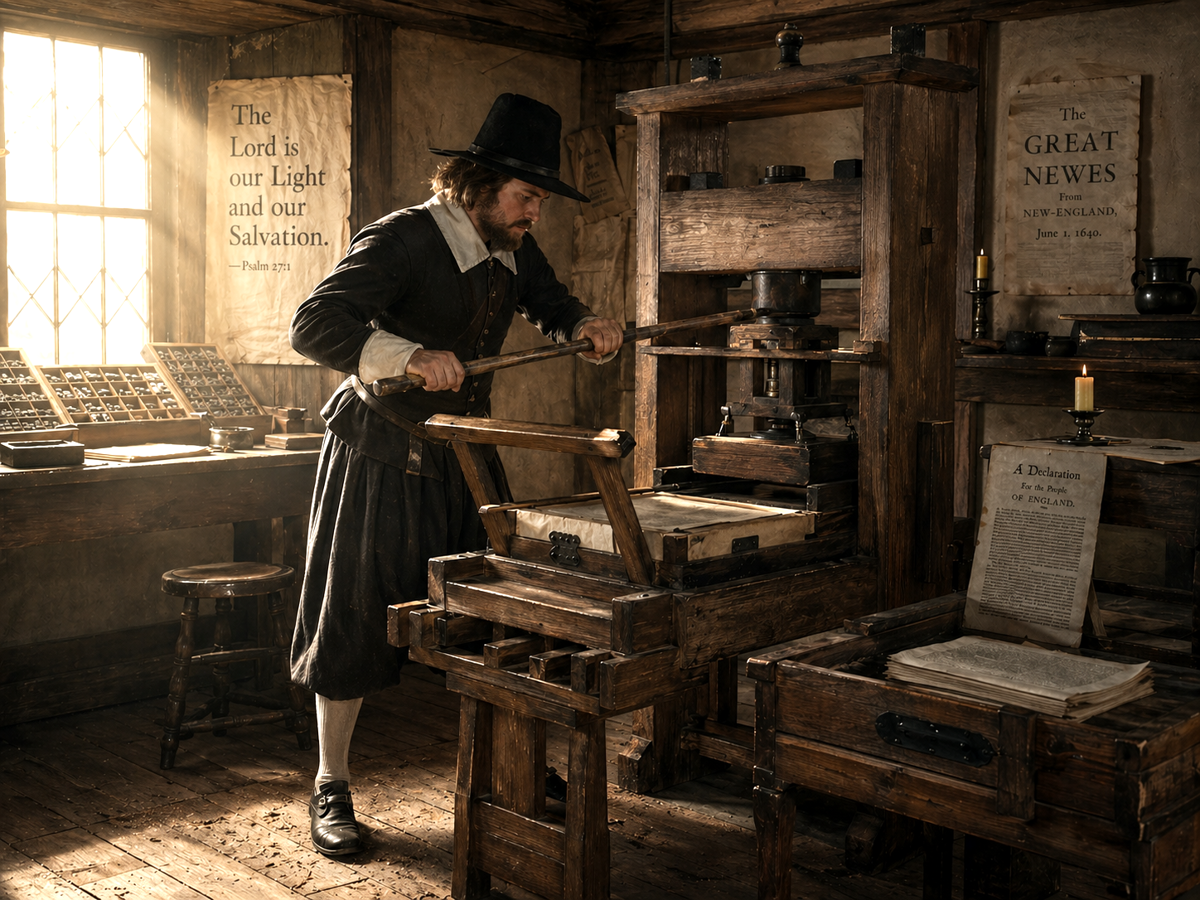
 The first colonial American printing press appeared in 1638 in the Massachusetts Bay Colony (1628-1691), founded by English Puritans. The focus was on religious works, legal documents, almanacs and translated works. An outpouring of printing activity in Boston in the early 18th century was built on this foundation.
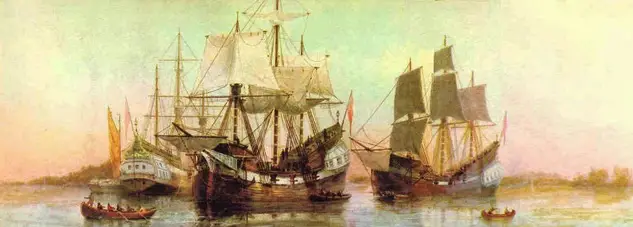
Arrival of Winthrop’s Company in Boston Harbor (1630) by William Formby Halsall (painted ca. 1880)
Puritans led by John Winthrop settled in Salem in 1626 and then in Cambridge and Boston in 1630. They brought reading material with them–especially the Bible and other religious writings. Despite knowing that the Massachusetts Bay Colony would depend on printed items from England, Rev. Joseph (Jose) Glover (c. 1600-1638) decided to bring a printing press to Cambridge in 1638. He made the decision after a dispute with his bishop in Surrey, England. Unfortunately, he died enroute – on the sailing vessel, the John of London. He left his wife,Elizabeth (1602-1643), his indentured servant Stephen Daye(1594-1668) and their respective families to mourn him. Elizabeth now became the owner of the first printing press in colonial America. Daye, now an indentured servant to Elizabeth along with his son, Matthew (c. 1620-1649), began operating the printing press the year after its arrival.
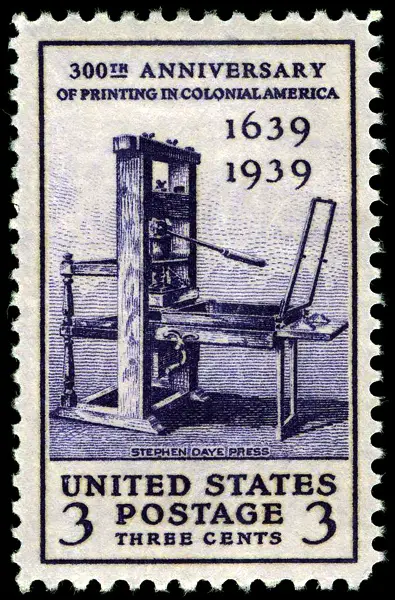
Postage stamp issued in 1939, the tercentenary of the first colonial American printing press
The First Colonial American Printing Press
The Dayes used a white oak printing press with a large wooden screw. The screw lowered a heavy wooden plate (platen) that pressed paper onto inked movable type to create words. Like the imported printing press with its movable type, paper and ink were available for the printer from the voyage. The paper was made from linen and cotton rags, while the ink came from a mixture of lampblack (a pigment from soot), turpentine and boiled linseed oil (varnish). No paper mill existed in Massachusetts until 1730 in Milton, so all the Cambridge printers had to continuously rely on supplies from England throughout the 17th century.
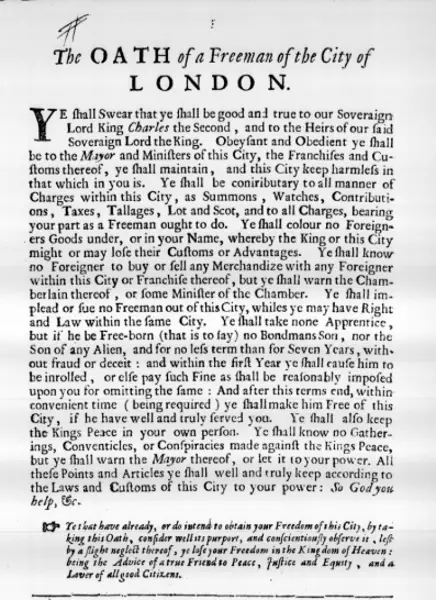
An English oath of a Freeman, 1682
The first document printed by Stephen Daye in 1638/1639 was the Oath of a Freeman, a broadside (i.e., a large simple sheet of paper for posting in public). It was a loyalty pledge required of newcomers to the colony. This is the first printed work in colonial America. The second thing printed was an almanac for 1639 by William Pierce. In 1640 the Bay Psalm Book (Whole Booke of Psalms) appeared, the first colonial American printed book. It consisted of Hebrew songs, arranged in English rhymes for singing in Puritan churches, but had many typographical errors. Nevertheless, an estimated 1700 copies initially were printed.
In 1641 Elizabeth Glover married Henry Dunster (1609-1659), who had just become the president of Harvard College in 1640. Dunster, who acquired the printing press through marriage, moved it to Harvard after her death in 1643. It was the predecessor to the Harvard University Press.
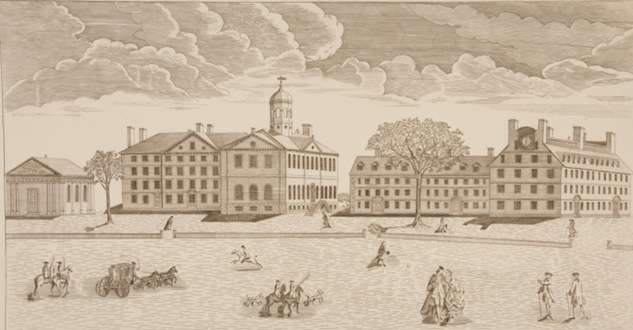
Colonial engraving, Harvard College
Theses, Almanacs, Psalms and Laws
Meanwhile, the Dayes first printed “theses” or propositions by students of Harvard College in 1642. They may have printed a spelling book in 1644. In 1645 Stephen Daye printed A Declaration of Former Passages and Proceedings Betwixt the English and the Narragansetts by John Winthrop. In it, Winthrop justified war with the tribe. It was the first historical work printed in Colonial America.
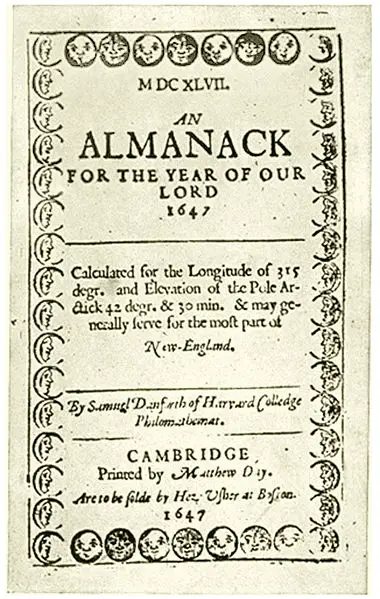
Danforth’s 1647 almanac
A second almanac, compiled by Samuel Danforth, appeared in 1646. Danforth’s almanac for 1647 only had an imprint by Matthew Daye, indicating that Dunster may have dismissed Stephen. Matthew also printed a second edition of the Bay Psalm Book in the same year. In 1648 he printed Edward Norris’s Salem Catechism and The Book of the General Lawes and Liberties, an update of the 1641 Body of Liberties. Unfortunately, Matthew Daye died on May 10, 1649.
The Third Colonial American Printer
After Matthew’s death, Samuel Green (1615-1702) then became the third operator of the “Cambridge Press,” as it was known. He immediately printed in 1649 The Platform of Church Discipline (“Cambridge Platform”). It set forth the governance of the Congregational Church, stressing the autonomy of local churches.
In 1656 Green received a second printing press from the Society for the Propagation of the Gospel in New England, based in London. Marmaduke Johnson (1628-1674), who became the fourth Cambridge printer, accompanied the printing press to Cambridge.

John Eliot
In 1663 Green collaborated with Johnson to produce The Holy Bible by John Eliot. This was a huge and unique undertaking that translated the Old and New Testaments into a Massachusetts Native American tribe’s Algonquian language. They also published Metrical Psalms and The Psalter or Book of Psalms as part of the Eliot Indian Bible Project in the same year. Green had previously printed other works by Eliot in that language. Previously, in 1659, he had printed Some Helps for the Indians by Abraham Pierson, a Connecticut catechism written in the Quiripi (Quinnipiac)dialect.
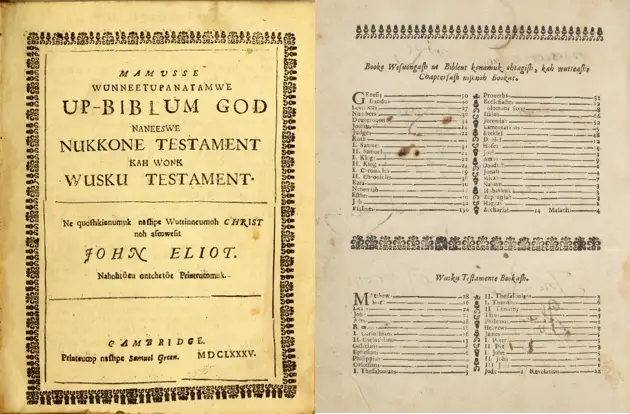
Title and contents page for the Eliot Indian Bible
The Colonial American Printing Press Publishes Books
Marmaduke Johnson and Samuel Green printed four books together as well. These were New-England’s Memoriall by Nathaniel Morton in 1669, the first non-religious book printed in colonial America; Meat Out of the Eater by Michael Wiggleworth and Daily Meditations by Philip Pain, both works of poetry in 1670; and The Life and Death of Richard Mather also in 1670. Johnson also produced many works of his own starting with The Indian Grammar Begun by John Eliot in 1666 and ending with An Exhortation Unto Reformation by Samuel Torrey, The Day of Trouble is Near by Increase Mather, and The Cry of Sodom Enquired Into by Samuel Danforth, all in 1674. Regrettably, Johnson died on December 25 of that year.
Meanwhile, in 1673, Samuel Green had printed a book of general laws for the Connecticut Colony. After Johnson’s death, he continued on with his printing activities, including his long stint with Harvard College and the Colony of Massachusetts Bay. Near the end of his career, his son Bartholomew helped with printing the almanacs of John Tulley for 1691 and 1692. They also printed Spiritual Milk for Babes by John Cotton and the second issue of Ornaments for the Daughters of Zion by Cotton Mather in 1692. As Green had decided to retire, this marked the end of printing in Cambridge. Printing would not resume again in Cambridge until 1810 when William Hilliard opened his shop.
Over time, each of the colonial printers catered to an increasingly literate population by printing religious psalms, sermons, catechisms and translated religious works; books; poetry; and almanacs; material for Harvard College; and legal documents. Thus, they created a foundation for the significant growth in printing that would move in the first half of the 18th century to Boston.
* * *

Hear History’s Heartbeat: True Love Stories, Now an Audiobook. Click here to order your copy today.
End Notes
Edward T. Howe, Ph.D. is Professor of Economics, Emeritus, at Siena University near Albany, N.Y.
Featured image created by ChatGPT.