
 The monument for the 14th Connecticut at Gettysburg is somewhat plain and doesn’t stand out among the other monuments on Cemetery Ridge. It sits to the right of center of the Union line near the extant Bryant farmhouse and is easily overlooked. But the monument marks the ground held by the regiment during two days of intense fighting.
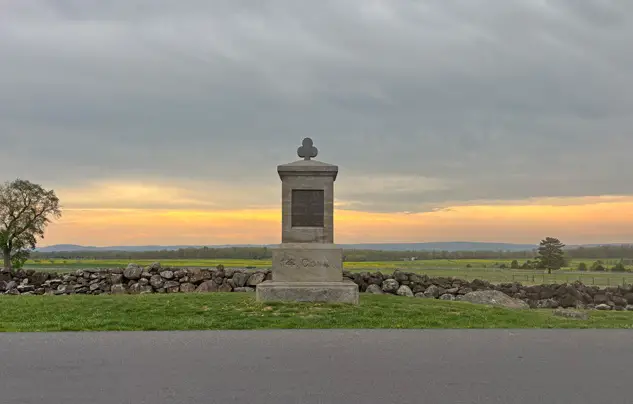
The 14th Connecticut Monument looking toward the Confederate lines on Seminary Ridge. The Bliss Farm site is to the right of the monument in the middle distance. Photo courtesy of the author.
Mustered in Hartford in August 1862, the 14th Connecticut Volunteer Infantry Regiment had already survived the bloodbaths of Antietam and Fredericksburg. By the time they reached Gettysburg, the 14th Connecticut was a regiment on paper only. Severely understrength, only 160 of the 1,015 men who marched out of Hartford were fit for duty.
The 14th Connecticut at Gettysburg
On July 1, 1863, the regiment stopped to rest about two or three miles away from Gettysburg. At about 10 p.m., the regiment was placed on picket duty along the Baltimore turnpike. The road led directly into the town of Gettysburg across Cemetery Hill, which then anchored the Union right flank. They remained there throughout the night.
At dawn on July 2, the regiment was relieved from picket duty. It moved over to the Taneytown Road, marched past Meade’s Headquarters at the widow Lydia Leister’s house and took up a position near Cemetery Ridge. The 14th Connecticut remained unengaged until about 4 p.m. when it moved up to a position on Cemetery Ridge and assumed a new position along a low stone wall near the Bryant farmhouse and barn. The house and land belonged to Abraham Bryant, a free Black.
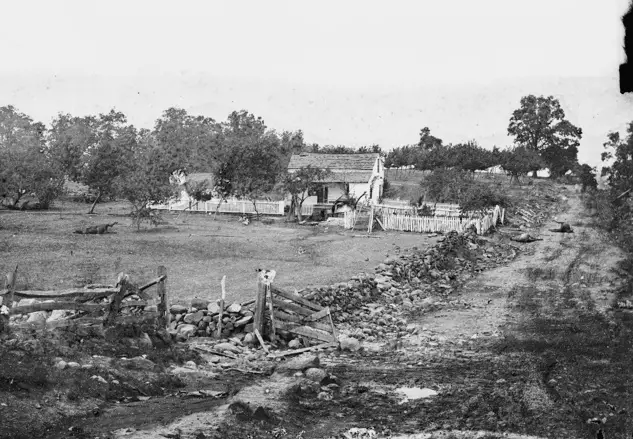
General Meade’s headquarters at Cemetrey Ridge. Photo courtesy Library of Congress.
The History of the 14th Connecticut describes the scene that faced them.
In front was a large and gently sloping plain several miles in length from north to south, and perhaps one mile in width. At its opposite side was a thick belt of woods occupied by the enemy …
Several hundred yards to their front would have been skirmishers from both armies, trading shots, with an enemy shooting both at each other’s skirmishers and the men manning the main lines. Just how many of the enemy were to their front was unclear.
No Heavy Fighting Yet
The regiment would occupy this position for the remainder of the battle and initially was in support of Arnold’s First Rhode Island Battery. While fighting raged during the day on Little Round Top, Devil’s Den, the Wheatfield, the Peach Orchard and Culp’s Hill, things were comparatively quiet in their sector. Other than the occasional stray bullet and the cannon fire along the ridge, the rest of the day was relatively uneventful. Up to this point, the regiment had missed all of the heavy fighting.
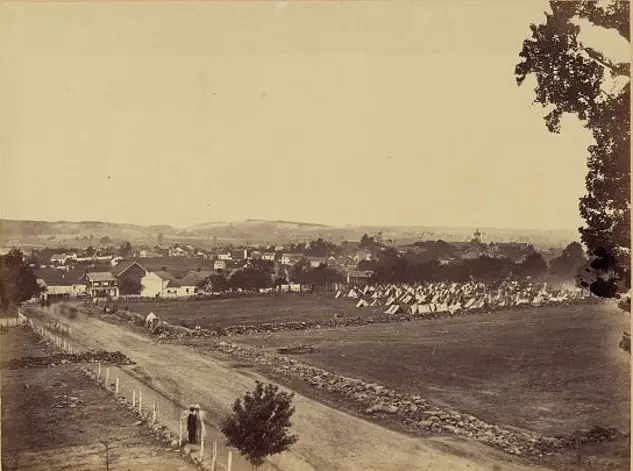
View of Gettysburg from Cemetery Ridge. Photo courtesy Library of Congress.
At about 10 p.m., the firing quieted down and the regiment lay down to rest. The exhausted men slept with their heads against the stone wall. But the distant roar of a night attack on East Cemetery Hill, well to their rear, disturbed their rest.
An Invitation for a Target
With the arrival of morning on July 3, Companies B and D were sent forward to relieve the night pickets. While it was a straightforward task, getting there was anything but straightforward.
Those of us detailed to go out in the line crawled out across the wheat field to the fence beyond [Emmitsburg Road] and lying upon the ground behind the posts and lower rails of the fence, began the sharp-shooters drill of the day. The space between us and the rebel skirmish line was open and clear in the main and the least showing of head, hand or foot was an invitation for a target of the same. One thing we learned and that was the puff of smoke from our rifles when we fired made an unpleasantly close target even when we were sure we were unseen ourselves.
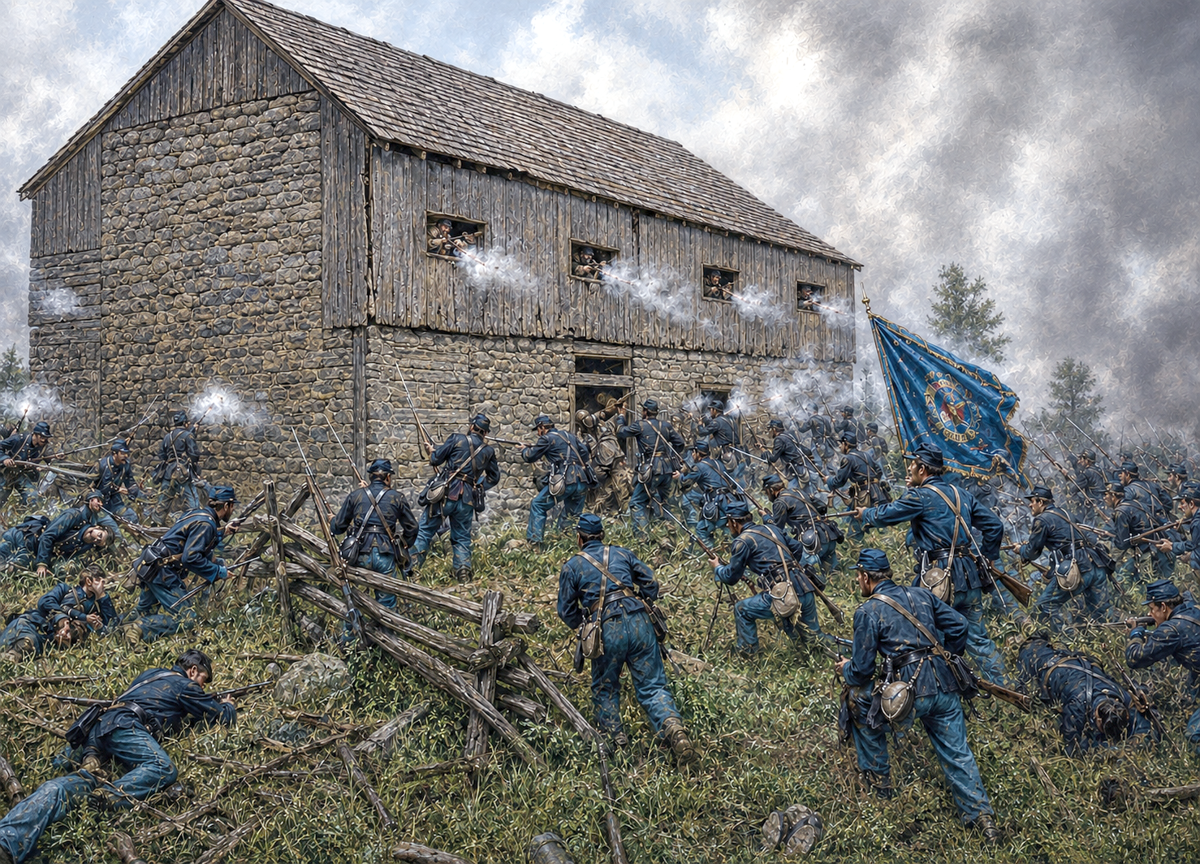
About 2,500 feet away, immediately to the front of the 14th Connecticut’s position, sat the imposing large barn and house of William and Adeline Bliss. It lay in no-man’s land, slightly closer to the Confederate lines. The 14th Connecticut history gives this description.
The barn was a rambling structure seventy-five feet long and thirty-five feet wide. It was a solid oak frame incased by a stone wall one story in height and then of brick. It was plentifully supplied with doors and windows and hastily made apertures, It was indeed a veritable fort. … The Confederate sharp-shooters were not long in seeing the advantage of this improvised fort and soon every window, door and crevice showing the protruding muzzles of long range rifles ready to do their deadly work.
As early as the evening of July 1, skirmishers on both sides had been setting up near the area. By about 5:40 a.m. the next day, Confederate skirmishers of the 13th and 38th North Carolina had taken possession of the Bliss fields and buildings. The Confederate position at the farm created an uncomfortable problem for the Union forces on Cemetery Ridge. Well within rifle range, the barn protected the shooters. On the other hand, Union forces opposite them in the main line on Cemetery Ridge had only a stone wall for cover. Any movement away from the wall was in the open and hazardous in the extreme.
In the Union line on Cemetery Ridge, the 14th Connecticut has been a witness to all the fighting at the Bliss Farm. But it has not directly participated. Two companies of the regiment that had been on duty all night on the picket line were relieved and rejoined the regiment on the ridge.
A Bloody Nightmare
For two days, the Bliss Farm was a bloody, see-saw nightmare. The massive oak-and-stone barn had become an improvised Confederate fortress, unleashing a deadly sniper fire onto the exposed Union lines on Cemetery Ridge. The property changed hands eight times in desperate, small-unit charges by various Union regiments, but they could not dislodge the rebels.
By 9:30 a.m. on July 3, the grim task finally devolved to the 14th Connecticut.
The 14th Connecticut History takes up the story.
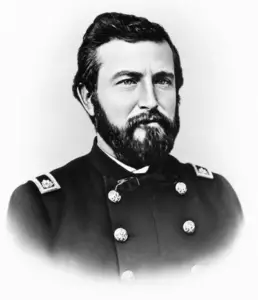
Captain S. A. Moore, with four companies of the regiment, numbering some fifty or sixty men, was sent down to capture the brick barn.
Captain Moore
To reach the barn was a perilous task and no man coveted the work. After passing up toward headquarters and down a lane across the Emmettsburg [sic] road, it was then necessary to cross a field a distance of nearly eighteen hundred feet. Reaching this field, they were given orders to break and each man reach the barn as best he could. In doing this the desperate character of the undertaking was realized, as they were open to the fire of the skirmish line and the sharpshooter in the barn, together with a flanking fire from the brigades of Thomas and McGowin located at “’Long Lane”’, but such was the dash and the wild fury of the approach that the Confederates left the barn in haste, giving only parting shots. Captain Moore was the first to enter the barn and the Federal soldiers were soon in full command.
The 14th Connecticut Charges
But the old problem still existed. The Bliss house, about 500 feet away from the barn, was still in Confederate hands. And the 14th Connecticut had not reached the barn unscathed, with several being wounded and killed, including Lieutenants Seward and Seymour of Company I, and Knowlton of C Company.
Possession of the barn also posed another problem. It had no windows in its rear to fire on the Confederates. The house had to be taken also but the men in the barn were in a poor position to undertake the assault on the house. But charge they did:
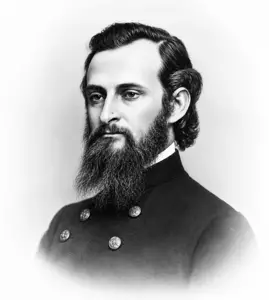
…orders were given Major Ellis to take the remaining four companies of the regiment, the other two companies being out as skirmishers, and capture the house. Leaving the colors and the color-guard at the wall, the route of Major Ellis to the house was much more exposed to the Confederate sharp-shooters firing than was the first detail, but on they went, with a vim of determination which characterized the men of the command. It was like dodging ten thousand shafts of lighting. [sic] They soon reached the house, but lost some men on the way. The Confederates left the house as precipitately as they did the barn, some of their parting shots killing Sergeant Baldwin of Company I, and John Fox of Company A was seriously wounded in the thigh.
Major Ellis
Trapped
The 14th Connecticut now possessed both the barn and the house, but not the grounds behind it. And the house proved useless, more of a trap than a fortified position. Its walls were too thin to provide much cover, and the men inside were now exposed to heavy fire from Confederate forces in the nearby orchard and fields. Bullets passed through the walls. The men in the barn could do little to help with return fire since they lacked windows facing the Confederates.
While the 14th Connecticut had been ordered to take and hold the buildings, this did not seem possible given the configuration of the buildings and the fact that the Confederates were able to reinforce their efforts much more easily. Just before the attack took place, Lieutenant Seymour had suggested to Colonel Smyth, the regimental commander, that if it looked like they could not hold the position, that they should burn the buildings down. After some thought, Smyth agreed to this.
Barn Burners
But as the charge started out, Lieutenant Seymour was shot, and the order was not passed on to the attacking force. Observing the continued fighting from Cemetery Ridge, General Hayes also ordered the buildings burned. It then fell to Captain Postles, of Colonel Smyth’s Staff, to relay the order:
Captain Postles bounded off on his magnificent charger, going over the ground like a hurricane, fully aware of the dangerous character of his mission. He, however, reached the barn, delivered the order and returned to headquarters in safety.
Upon receiving the order, the men of the 14th Connecticut lost no time in setting both buildings on fire–the barn in several places, and “a straw bed in the house proved a convenient dispenser of flame.”
Undoubtedly, the smoke and flames helped cover the withdrawal to a degree. But the men, taking their dead and wounded with them, still had to run for several hundred yards through a wall of fire in the open to reach the relative safety of their own line. With the destruction of the Bliss buildings, the Confederates could no longer use the position for unimpeded sniper fire. The smoking ruins would affect the next day’s grand charge.
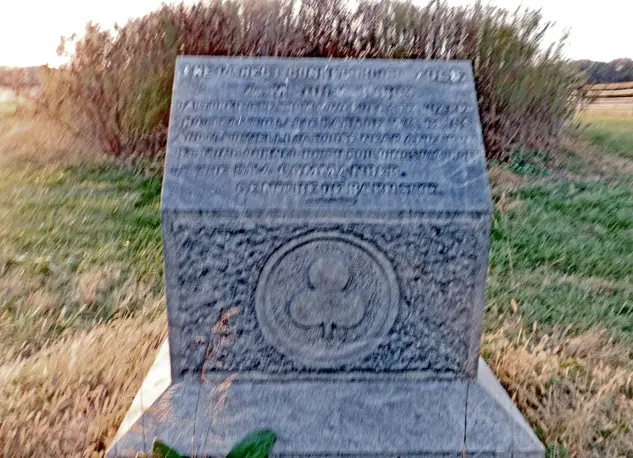
The Bliss Farm monument to the 14th Connecticut. Behind it are the remains of the Bliss Farm barn. Photo courtesy of the author.
Back to Safety
Dodging a gauntlet of sniper fire as they raced back across the open fields, the men of the 14th Connecticut collapsed back into their lines on Cemetery Ridge behind the 1st Delaware Infantry. They had little time to catch their breath. At 1:00 p.m., the earth shook as 150 Confederate guns opened up a two-hour bombardment.
Fortunately, the Confederate gunners fired almost all their ammunition high over the heads of the Union line. It caused more apprehension than harm. The 14th Connecticut narrative notes that during the brief lull after the cannonade.
We rose from the ground and stretched our cramped limbs and , in our inexperience, thought the battle was over, but Major Ellis was better posted than we. “No,” said he, ”They mean to charge with all their infantry.”
Longstreet’s grand charge of 12,000 soldiers began. The still-smoldering ruins of the Bliss buildings forced them out of position, disrupting that part of the charge.
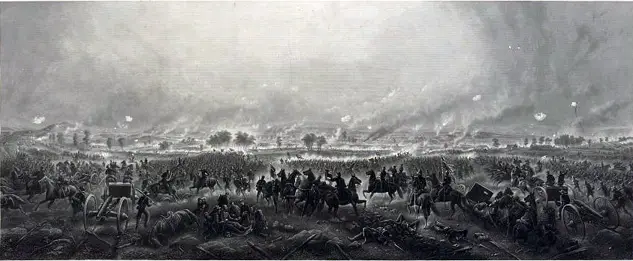
Repulse of Longstreet’s Charge, engraving of painting by James Walker. Image courtesy Library of Congress.
The 14th Connecticut then fought and helped repulse Longstreet’s charge, capturing five Confederate regimental colors and 200 prisoners.
At Gettysburg, the understrength 14th Connecticut of 160 men suffered 66 casualties: 10 enlisted men killed, 42 wounded, 10 officers wounded and four enlisted men missing.
The Aftermath of Gettysburg
The 14th Connecticut Volunteer Infantry Regiment would go on to fight in Virginia at the Wilderness, Spotsylvania Court House, Cold Harbor, the First Assault on Petersburg and the subsequent Siege of Petersburg and its associated battles. It would also be present at the surrender of Lee’s Army of Northern Virginia at Appomattox Court House.
As for William Bliss and his farm, he submitted two claims for his destroyed property, amounting to $3,256.05 (or about $66,704 today). As with most Civil War claims, he never received any compensation. Having lost everything, he sold the land to a neighbor, Nicholas Codore in November 1865. He then moved to Chautauqua County in New York. He allegedly said of the farm: “Let it go; if I had twenty farms I would given them all for such a victory.”
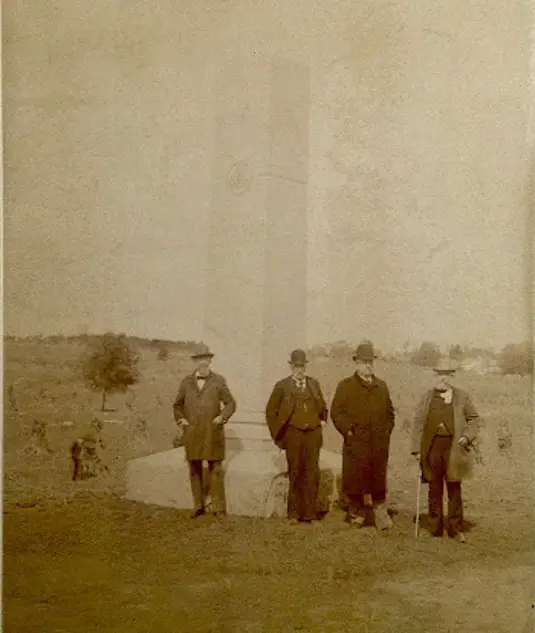
A reunion of the 14th Connecticut at Antietam in 1894. Julius Knowlton is believed to be on the far left. Photo courtesy Courtesy of the Connecticut State Library, Hartford.
My 8th cousin, 3 times removed, Lt. Julius W. Knowlton, was wounded by a shell fragment in the charge at the Bliss Farm. He would later give the dedication speech for the separate 14th Connecticut monument at the Bliss Farm site.
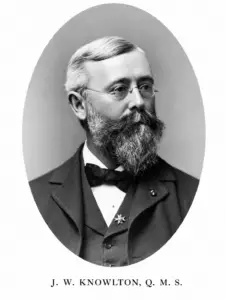
J.W. Knowlton
Note: Contemporary sources also spell “Bryant” as “Bryan” or “Brian.”
Images: Featured image created by ChatGPT.