
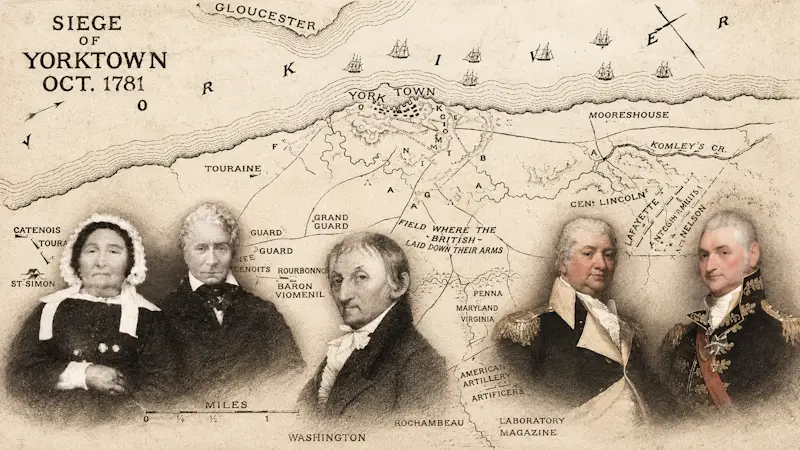
On October 19, 1781, the British army surrendered at Yorktown, Virginia. The American Revolution wasn’t officially over, but the surrender effectively sealed Britain’s military defeat and made American independence far more likely.
The road to Yorktown had been anything but certain. When fighting broke out at Lexington and Concord in April 1775, few observers predicted that the rebellion would lead to independence. Even after the Declaration of Independence in 1776, the Continental Army came perilously close to defeat. British forces drove George Washington’s army from New York and across New Jersey, and American troops endured hunger, disease and bitter winters.
The American victory at Saratoga in 1777 helped persuade France to join the war on the Patriot side. French money, troops and naval power gave the struggling revolution a fighting chance. Still, the British remained dangerous, particularly in the South, where they captured Charleston in 1780.
By the fall of 1781, however, the tide had turned. After fighting across the Carolinas, British Gen. Charles Cornwallis moved his army into Virginia, hoping to regroup and resupply. Instead, he found himself cornered at Yorktown. Washington’s army and French troops under Gen. Rochambeau marched south, while a French fleet blocked the British Navy from coming to Cornwallis’s rescue.
The allies tightened their siege, dug trenches and pounded the British defenses with artillery. By October, Cornwallis had run out of good options. On October 19, his army marched out to surrender.
The victory belonged to soldiers and officers from across the colonies, supported by their French allies. Four New Englanders who witnessed the campaign left us different ways of understanding what happened: a Boston bookseller who became an artillery chief, an army surgeon who recorded the surrender, a soldier who helped dig the siege trenches, and a veteran officer who had fought since the war’s earliest days.
Henry Knox: The Bookseller Who Mastered Artillery

Henry Knox by Gilbert Stuart 1806
Henry Knox began the Revolution as a Boston bookseller with a passion for military history. He had no formal military training, but he taught himself enough about artillery to become one of George Washington’s most trusted officers.
Knox first made his mark during the winter of 1775–76, when he helped arrange the transport of nearly 60 tons of cannon from Fort Ticonderoga to the American lines outside Boston. The guns helped persuade the British to evacuate the city in March 1776.
At Yorktown, Knox oversaw American artillery operations as the allied armies tightened their grip on Cornwallis. The guns were central to the siege. They battered British defenses, helped make the enemy positions increasingly untenable and supported the allied advance toward the British lines.
Knox’s story is one of the Revolution’s more unlikely success stories: a bookseller who became a leading artillery officer through study, determination and practical skill. At Yorktown, his expertise helped turn the allied army’s strategic advantages into overwhelming pressure on the British defenders.
After the war, Knox became the first secretary of war of the United States, helping establish the military institutions of the new nation. As Yorktown was on the brink of capture, Knox delayed his messenger long enough so that he could send decisive word to his wife in a letter:
I have detain’d William untill this moment that I might be the first to communicate good news to the Charmer of my soul. a glorious moment for America! This day Lord Cornwallis & his Army marches out & piles their Arms in the face of our victorious Army. The day before Yesterday he desir’d commissioners might be named to treat of the surrender of his troops, their ships and every thing they possess. he at first requested that the Britons might be sent to Britain & the Germans to Germany. but this the General refused, and they have now agreed to surrender prisoners of War to be kept in America untill exchanged or released – They will have the same honors as the Garrison of Charlestown – that is they will not be permitted to unfurl their Colours or play Yankee doodle We know not yet how many they are – The General has just requested me to be at head quarters instantly – therefore I cannot be more particular – I have a note from Biddle Lucy is well & perfectly contented – I send you the last letter I recd of my Brother by which you will see in some degree the state of our affairs which are not bad.
I wish your situation had been such as to have come with Mrs Washington, Truth is that you might have done it with out the least particle of injury – I shall see you if possible by the 12th, 15 or 20th of next month. how much I long for the happy moment! . . .
Adieu the best beloved of my heart. and believe me to be your ever affectionate love – HKnox
James Thacher: The Surgeon Who Recorded the Surrender
 James Thacher, born in Barnstable, Massachusetts, in 1754, spent much of the Revolution caring for the men who fought it. He joined the Continental Army’s medical service in 1775 and served through battles, harsh winters and outbreaks of smallpox. He also kept a detailed journal, later published in 1823, that offers a valuable firsthand record of the war.
Thacher’s account of Yorktown captures more than the military details of the siege. It also brings to life one of the surrender’s most memorable moments: the presentation of the British sword.
Cornwallis did not attend the surrender ceremony, reportedly because of illness. Instead, he sent his second-in-command, Gen. Charles O’Hara, to represent him. O’Hara approached Washington and offered the sword of surrender (after first offering it to the French general Rochambeau). Washington declined to receive it himself and directed O’Hara to present it to Gen. Benjamin Lincoln, his second-in-command.
That decision carried a meaning beyond ceremony. Lincoln had commanded the American forces that surrendered at Charleston, South Carolina, in May 1780. The defeat was one of the worst suffered by the Continental Army, and the British had denied Lincoln’s forces the customary honors of war. The experience had been a bitter one for the American general.
At Yorktown, Lincoln was given the opportunity to receive the sword of a defeated British army. The contrast between Charleston and Yorktown made the moment especially powerful: the officer who had endured one of the Revolution’s most humiliating defeats now helped preside over one of its greatest victories.
Thacher’s recollection from his journals brings us close to that moment and the men who took part in it.
it was in the field when they came to the last act of the drama, that the spirit and pride of the British soldier was put to the severest test—here their mortification could not be concealed. Some of the platoon officers appeared to be exceedingly chagrined when giving the word “ground arms,” and I am a witness that they performed this duty in a very un-officer-like manner, and that many of the soldiers manifested a sullen temper, throwing their arms on the pile with violence, as if determined to render them useless. This irregularity, however, was checked by the authority of General Lincoln. After having grounded their arms and divested themselves of their accouterments, the captive troops were conducted back to Yorktown and guarded by our troops until they could be removed to the place of their destination.
The British troops that were stationed at Gloucester surrendered at the same time, and in the same manner to the command of the Duke de Lauzun.
This must be a very interesting and gratifying transaction to General Lincoln, who having himself been obliged to surrender an army to a haughty foe the last year, has now assigned him the pleasing duty of giving laws to a conquered army in return, and of reflecting that the terms which were imposed on him are adopted as a basis of the surrender in the present instance.
Joseph Plumb Martin: The Soldier in the Trenches

Portrait of Joseph Plumb Martin and his wife Lucy Clewes
Joseph Plumb Martin was only 15 when he joined the Connecticut militia in 1775. He later enlisted in the Continental Army, where he experienced the Revolution not from a general’s headquarters but from the ranks. He endured Valley Forge and other hardships that made survival, let alone victory, seem uncertain.
At Yorktown, Martin served as a sergeant in the Corps of Sappers and Miners, the army’s specialists in siege work. He helped dig trenches and prepare the approaches to the British defenses, including work associated with the assault on Redoubt No. 10.
Siege warfare could be exhausting and dangerous. Soldiers dug under enemy fire, moved through exposed ground and worked to bring the attacking army ever closer to its target. The great events recorded in official histories depended on thousands of such unglamorous tasks.
Martin’s recollections are especially valuable because he wrote about the war from the perspective of the men who did the fighting and the digging. Decades later, he published his memoir, giving readers a vivid account of what military life actually felt like to an ordinary Continental soldier.
When news finally came that the British had surrendered, Martin recorded the moment in characteristically straightforward terms.
we were informed that the British had surrendered and that the siege was ended.The next day we were ordered to put ourselves in as good order as our circumstances would admit, to see (what was the completion of our present wishes) the British army march out and stack their arms. The trenches, where they crossed the road leading to the town, were levelled and all things put in order for this grand exhibition. After breakfast, on the nineteenth, we were marched on to the ground and paraded on the righthand side of the road, and the French forces on the left. We waited two or three hours before the British made their appearance; they were not always so dilatory, but they were compelled at last, by necessity, to appear, all armed, with bayonets fixed, drums beating, and faces lengthening; they were led by Gen. O’ Harra, with the American Gen. Lincoln on his right, the Americans and French beating a march as they passed out between them. It was a noble sight to us, and the more so, as it seemed to promise a speedy conclusion to the contest. The British did not make so good an appearance as the German forces; but there was certainly some allowance to be made in their favour; the English felt their honour wounded, the Germans did not greatly care whose hands they were in. The British paid the Americans, seemingly, but little attention as they passed them, but they eyed the French with considerable malice depicted in their countenances. They marched to the place appointed and stacked their arms; they then returned to the town in the same
manner they had marched out, except being divested of their arms. After the prisoners were marched off into the country, our army separated, the French remaining where they then were and the Americans marching for the Hudson.
Henry Dearborn: The Veteran Who Had Seen It All

Maj. Gen. Henry Dearborn served as U.S. Marshal for Maine during the 1790 census. Painting by Gilbert Stuart.
Henry Dearborn, born in Hampton, New Hampshire, in 1751, was a physician before the Revolution turned him into a career soldier. He fought at Bunker Hill, joined the ill-fated American expedition to Quebec, and distinguished himself at Saratoga. He also endured the hardships of Valley Forge and fought at Monmouth.
By the time he reached Yorktown in 1781, Dearborn had seen much of the war firsthand. He had witnessed the Continental Army’s early struggles, its hard-won victories and its remarkable ability to keep going when defeat seemed likely.
Dearborn’s recollections offer a view of Yorktown from the perspective of a seasoned officer who had been there almost from the beginning. He had seen how far the Continental Army had come since the uncertain days of 1775, when independence was still an ambitious and dangerous prospect.
After the war, Dearborn returned to public life, serving in Congress and as secretary of war under President Thomas Jefferson. He later commanded American forces during the War of 1812. Dearborn, who took great responsibilities in furnishing the American soldiers with all sorts of materiel throughout the latter stages of the war, recorded in his diary the moment of the surrender with attention to detail that was typical of a man or logistics:
the Treaty between Gen! Washington & his Lordship ended this fournoon by a Capitulation being agree’d on & rattified by both parties, & this afternoon the Troops march’d out & laid down their Armes, both at York & Gloster,82- amounting in the whole (including those in the Hospital,) to 7,054 including Officers, one hundred Ships & vessels of different kinds ware at York when the Seige commenced the whole of which ware distroyd & taken, about 1000 seamen ware made prisoners.— our troops took possession of the Enemies principle works previous to their marching out, their Troops ware very sickly. 2.000 ware in the Hospitals of Sick & wound ‘d at York & Gloucester was taken 74 pieces of Brass ordnance, between two & three hundred pieces of Iron, 8000 stands of armes & very conciderable quantities of ammunition, Quarter Masters Stores, clothing; & provisions. —
The Victory They Helped Win
These four New Englanders experienced Yorktown in different ways. Knox understood how artillery could help decide the outcome. Thacher recorded the events as a physician and observer, including the remarkable moment when Benjamin Lincoln received the sword of surrender. Martin showed what the siege demanded of the ordinary soldier. Dearborn brought the perspective of a veteran who had served through years of uncertainty while making sure the army was fed, clothed and armed.
Yorktown was the culmination of years of sacrifice, a striking reversal of fortune and a victory made possible by people from the command tent to the trenches.
The peace treaty would not be signed until 1783. But on October 19, 1781, the American Revolution reached its decisive moment—and these four New Englanders left us a way to see it through their eyes.
Image: James Thacher (1754–1844). Lithograph by Pendleton, courtesy of the U.S. National Library of Medicine. Public domain.
Source: Wikimedia Commons | National Library of Medicine
Image: Major-General Henry Dearborn, 1812, by Gilbert Stuart. Oil on panel. Art Institute of Chicago, accession no. 1913.793. Public domain.
Source: Art Institute of Chicago | Wikimedia Commons
Image: Henry Knox, 1806, by Gilbert Stuart. Oil on panel. Museum of Fine Arts, Boston. Image courtesy of The Athenaeum. Public domain.
Source: Wikimedia Commons | World History Encyclopedia
Image: Joseph Plumb Martin and his wife, Lucy Clewley Martin, 19th-century portrait, artist unknown. Courtesy of the Stockton Springs (Maine) Historical Society and Stockton Springs Library. Public domain.
Source: Wikimedia Commons